
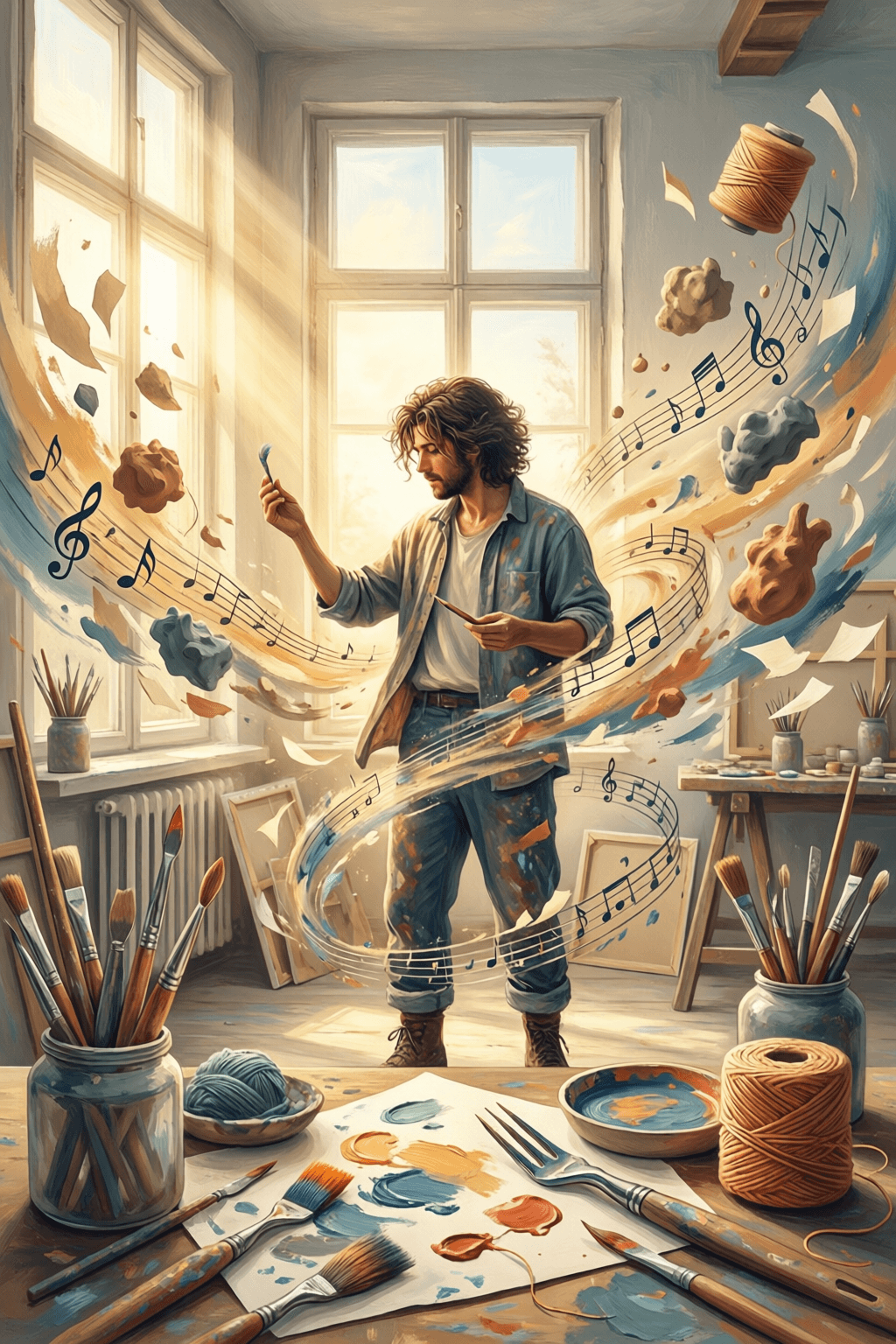
Creativity itself doesn't care at all about results—the only thing it craves is the process. Learn to love the process and let whatever happens next happen. — Elizabeth Gilbert
—What lingers after this line?
The Core Message of Creative Freedom
Elizabeth Gilbert’s quote shifts attention away from outcomes and back to the act of making itself. In her view, creativity is not a transaction in which effort must always yield praise, profit, or permanence; rather, it is a living impulse that asks only to be expressed. By saying creativity ‘doesn’t care at all about results,’ she challenges the modern habit of measuring every endeavor by visible success. This perspective immediately reframes artistic work as a relationship with process instead of performance. Once a person learns to love the daily practice—the drafting, revising, experimenting, and even failing—the emotional burden of achievement begins to loosen. What follows, as Gilbert suggests, can then unfold more naturally.
Letting Go of Outcome Anxiety
From there, the quote speaks directly to a common creative paralysis: fear of the final judgment. Many people never begin because they are preoccupied with whether the poem will be published, the painting admired, or the idea financially rewarded. Gilbert’s advice interrupts that cycle by suggesting that the work’s deepest value lies before the verdict ever arrives. In this way, loving the process becomes a practical antidote to perfectionism. The psychologist Mihaly Csikszentmihalyi’s concept of ‘flow’ in Flow (1990) describes a state in which attention is fully absorbed in the activity itself, not in its external payoff. Gilbert’s insight aligns with that tradition, proposing that freedom emerges when makers stop gripping the future so tightly.
Creativity as a Daily Practice
Once outcomes lose their tyranny, creativity can be approached less as a rare event and more as a habit. This is an important transition, because the quote does not romanticize inspiration as a lightning strike; instead, it honors repetition, curiosity, and steady engagement. A novelist returning to the desk each morning or a ceramicist centering clay again after a failed vessel embodies this process-centered devotion. Writers such as Julia Cameron in The Artist’s Way (1992) similarly argue that creative life is sustained by ritual rather than constant brilliance. Gilbert’s statement complements that idea by reminding us that the reward is already present in the doing. The process itself becomes both discipline and nourishment.
The Humility of Uncertain Results
At the same time, Gilbert’s closing phrase—‘let whatever happens next happen’—introduces a quiet humility. No artist fully controls reception, timing, or cultural relevance. A manuscript may be ignored for years, while a casual sketch may unexpectedly resonate with thousands. By accepting this uncertainty, creators release the illusion that hard work guarantees a specific response. History offers many examples of this mismatch between labor and recognition. Vincent van Gogh, whose paintings became world-renowned only after his death, illustrates how results often arrive on their own schedule. Therefore, Gilbert’s advice is not passive resignation but mature realism: do the work faithfully, then allow life to decide the rest.
A Healthier Relationship With Success
Because of this, the quote also reshapes the meaning of success. If fulfillment comes only from applause, then most creative efforts will feel like failure, since recognition is uneven and fleeting. However, if success includes immersion, discovery, and honest expression, then even unfinished or unseen work can carry profound value. This broader definition protects the artist’s inner life. Instead of being inflated by praise or crushed by indifference, one learns to return to the page, stage, studio, or workshop with steadier motives. Gilbert’s wisdom ultimately suggests that sustainable creativity depends not on controlling outcomes, but on cherishing the act that gives rise to them.
Why Process Leads to Better Work Anyway
Ironically, surrendering obsession with results often improves the results themselves. When creators are less busy proving themselves, they become more willing to take risks, revise honestly, and follow unexpected ideas. A jazz musician improvising freely or a scientist exploring a hunch without immediate concern for acclaim often reaches more original discoveries precisely because attention is rooted in exploration rather than image. Thus, Gilbert’s statement ends where it began: creativity craves process. The maker who loves the work for its own sake becomes more resilient, more playful, and often more inventive. Whatever happens next—success, obscurity, revision, or transformation—arrives as a consequence, not the master, of creation.
One-minute reflection
Why might this line matter today, not tomorrow?
Related Quotes
6 selectedThe creative process is not a straight line, but a labyrinth. To get lost in it is not a failure; it is the only way to find the hidden things worth saying. — M.C. Richards
M.C. Richards
At its core, M.C. Richards rejects the comforting myth that creative work unfolds through orderly steps.
Read full interpretation →The creative process is a cocktail of exhaustion and revelation; do not mistake the fatigue for a sign to stop, but rather for the evidence that you are building something new. — Twyla Tharp
Twyla Tharp
At first glance, Twyla Tharp’s quote reframes a feeling many creators dread: exhaustion. Rather than treating fatigue as a warning that the work is failing, she presents it as a natural ingredient in invention itself.
Read full interpretation →The creative process is a process of surrender, not control. — Bruce Lee
Bruce Lee
At first glance, Bruce Lee’s statement seems to overturn a common assumption: that great work comes primarily from discipline, mastery, and strict command. Instead, he argues that creativity emerges through surrender—the...
Read full interpretation →The creative process is a mess, but a beautiful one. Embrace the chaos, because that is where your most authentic creations come to life. — Arastasia
Arastasia
At first glance, Arastasia’s quote rejects the tidy myth that meaningful art emerges from perfect planning. Instead, it frames creativity as inherently unruly, full of false starts, contradictions, and unexpected turns.
Read full interpretation →The painting has a life of its own. I try to let it come through. — Jackson Pollock
Jackson Pollock
At first glance, Jackson Pollock’s remark gives the painting an almost independent existence, as though the canvas carries its own pulse before the artist fully understands it. Rather than describing painting as pure con...
Read full interpretation →I don't believe that external rewards should motivate a skilled craftsperson, but they can serve as an indicator of mastery. — Ryan Holiday
Ryan Holiday
At its core, Ryan Holiday’s statement separates motive from measurement. A skilled craftsperson, in this view, does not work primarily for money, praise, or status, but for the integrity of the work itself.
Read full interpretation →More From Author
More from Elizabeth Gilbert →A good-enough novel violently written now is better than a perfect novel meticulously written never. — Elizabeth Gilbert
Elizabeth Gilbert’s line immediately shifts the argument from artistic purity to artistic existence. A “good-enough” novel, even one “violently written,” has entered the world and can move, provoke, or comfort someone; b...
Read full interpretation →A calm heart is a creative heart. When we release the frantic need to prove our worth, we finally make space for the life we were meant to live. — Elizabeth Gilbert
At its core, Elizabeth Gilbert’s quote proposes that creativity does not flourish in inner chaos but in emotional steadiness. A calm heart is not an empty or passive one; rather, it is a mind cleared of constant self-def...
Read full interpretation →You don't need a massive platform to change the world; you just need to be a decent human to the three people you see every day. — Elizabeth Gilbert
Elizabeth Gilbert reframes social change in strikingly modest terms: impact does not begin with fame, scale, or public recognition, but with ordinary decency practiced at close range. Rather than imagining the world as s...
Read full interpretation →Sometimes you have to stop and be bored, because boredom is the dream-killer's worst enemy. — Elizabeth Gilbert
At first glance, Elizabeth Gilbert’s remark sounds counterintuitive, because boredom is usually treated as something to escape. Yet her point turns that assumption upside down: when we stop filling every empty moment, we...
Read full interpretation →