
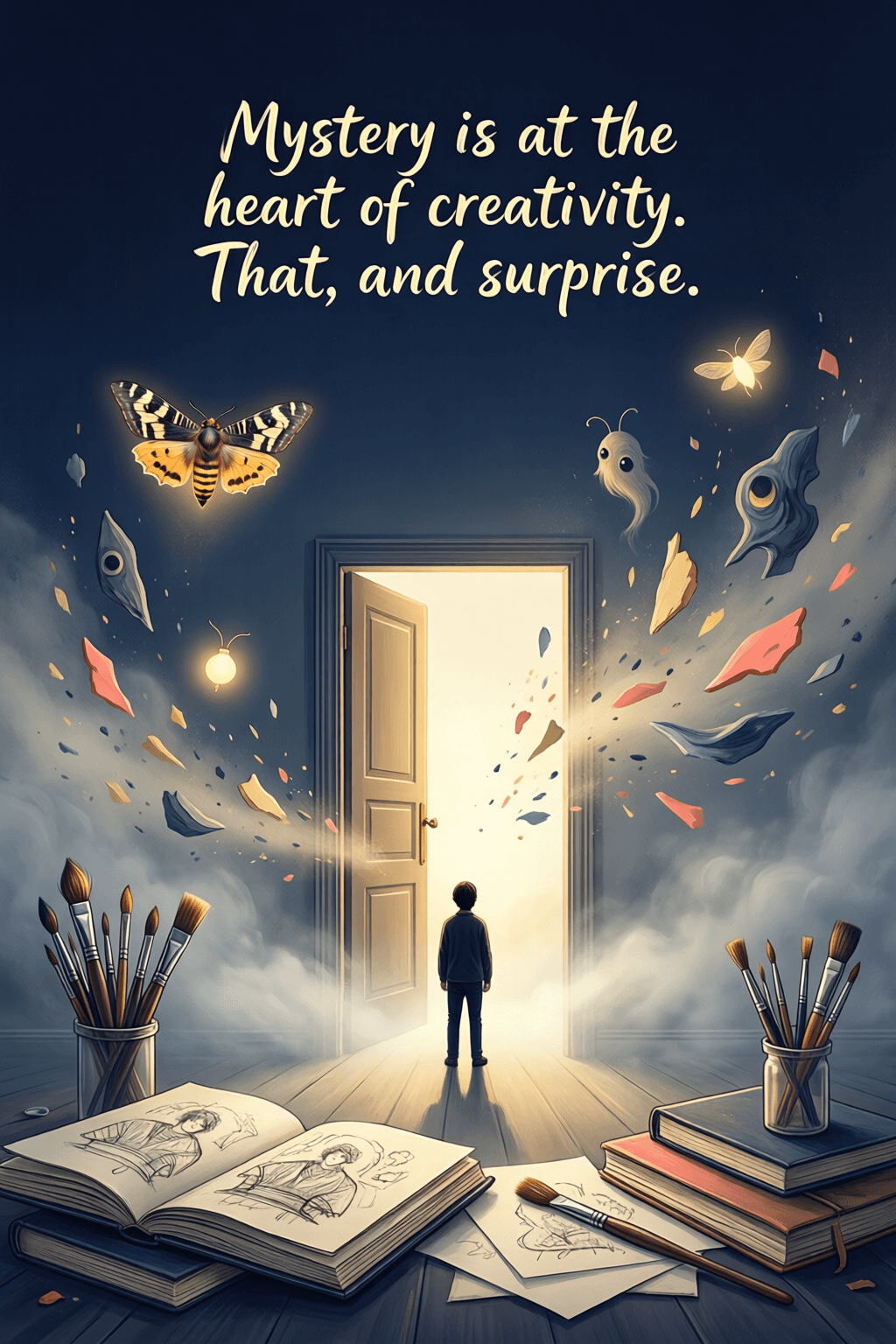
Mystery is at the heart of creativity. That, and surprise. — Julia Cameron
—What lingers after this line?
Creativity Begins in the Unknown
Julia Cameron’s remark places uncertainty at the center of artistic life. By saying that mystery is at the heart of creativity, she suggests that invention does not begin with total control, but with a willingness to enter what is not yet understood. In that sense, creativity thrives less on rigid certainty than on curiosity, trust, and the courage to follow dimly seen possibilities. From this starting point, surprise becomes the natural companion to mystery. If the artist already knows exactly what will happen, the work risks becoming mechanical. But when something unforeseen appears—a phrase, image, or idea that seems to arrive on its own—the creative act feels alive. Cameron’s insight therefore frames art as a conversation with the unknown rather than a simple execution of a plan.
Why Surprise Gives Art Its Energy
Building on that idea, surprise is what turns exploration into discovery. A painting, poem, melody, or design often gains its power from a moment that neither the maker nor the audience could fully predict. Aristotle’s Poetics (c. 335 BC) treats surprise as essential to drama, especially when events unfold in ways that are both unexpected and meaningful. Cameron extends this principle beyond storytelling to the creative process itself. As a result, surprise is not merely decorative; it is energizing. It jolts the mind out of habit and allows fresh connections to appear. Many artists describe their best moments not as acts of domination but of recognition, as though they have stumbled upon something waiting to be found. The unexpected, then, is not a threat to creation but one of its deepest pleasures.
The Artist’s Partnership With Uncertainty
Seen this way, Cameron’s statement also describes a discipline of receptivity. To work creatively is to tolerate ambiguity long enough for form to emerge. John Keats, in an 1817 letter, called this capacity “negative capability,” the ability to remain “in uncertainties, Mysteries, doubts, without any irritable reaching after fact and reason.” His phrase illuminates Cameron’s point: the artist must resist closing the question too soon. Consequently, creativity often asks for patience rather than instant mastery. A writer may begin with only a voice, a dancer with only a gesture, a scientist with only a hunch. Yet by staying open, the creator allows surprise to guide the next step. What first seems vague or unfinished becomes the very condition from which originality can grow.
How Process Invites the Unexpected
This perspective becomes especially clear in creative practice. Cameron’s own work in The Artist’s Way (1992) emphasizes routines like morning pages, which are designed not to control inspiration but to invite it. Such methods create space for ideas that bypass the censoring mind. In other words, structure can serve mystery rather than eliminate it. Likewise, many artistic breakthroughs emerge through play, accident, and revision. The history of art is full of moments in which unintended effects become defining features: from improvisation in jazz to experimental brushwork in modern painting. What links these examples is the creator’s ability to notice surprise and welcome it. Process, then, is not a straight road to a predetermined end, but a setting in which the unknown can speak.
A Wider Lesson About Human Imagination
Ultimately, Cameron’s quote reaches beyond art and says something broader about human imagination. People often seek certainty because it feels safe, yet too much certainty can narrow perception. Mystery keeps attention awake, while surprise renews it. Together they make room for wonder, and wonder is often the first spark of meaningful creation. Therefore, the quote can be read as both encouragement and instruction. It invites us to stop demanding complete clarity before we begin. Whether one is writing a novel, solving a problem, or reimagining a life, new possibilities often appear only after entering uncertain terrain. Cameron’s insight is simple but profound: creativity flourishes when we let ourselves be led by what we cannot entirely explain.
One-minute reflection
What's one small action this suggests?
Related Quotes
6 selectedSerious art is born from serious play. — Julia Cameron
Julia Cameron
At first glance, Julia Cameron’s line seems contradictory: how can play be serious, and how can seriousness produce art without becoming rigid? Yet that tension is precisely her point.
Read full interpretation →Creativity is a continual surprise. — Ray Bradbury
Ray Bradbury
Ray Bradbury’s remark distills creativity into a living process rather than a finished product. By calling it a “continual surprise,” he suggests that invention is not merely planned output but an ongoing encounter with...
Read full interpretation →Begin where you are with what astonishes you; astonishment fuels creation. — E.E. Cummings
E. E. Cummings
E.E. Cummings invites us to begin not with grand plans but with the immediacy of our own surroundings.
Read full interpretation →Creativity takes courage. — Henri Matisse
Henri Matisse
This quote highlights that being creative often involves exposing one's inner thoughts and feelings, which requires a significant amount of courage as it makes one vulnerable to criticism and judgment.
Read full interpretation →Creativity is piercing the mundane to find the marvelous. — Bill Moyers
Bill Moyers
The quote defines creativity as the act of looking beyond the ordinary to discover something extraordinary.
Read full interpretation →The moment a man begins to talk about technique, that's proof that he is fresh out of ideas. — Dylan Thomas
Dylan Thomas
Dylan Thomas’s remark begins with a sharp suspicion: when an artist talks too much about technique, the living impulse behind the work may already be gone. Technique, in this sense, becomes a substitute language, a way o...
Read full interpretation →More From Author
More from Julia Cameron →The capacity for delight is the gift of paying attention. — Julia Cameron
Julia Cameron’s line suggests that delight is not merely something that happens to us; it is something we become able to receive. By paying attention, we open a door that ordinary haste keeps shut.
Read full interpretation →If you are not willing to look stupid, nothing great is ever going to happen to you. — Julia Cameron
Julia Cameron’s remark begins with a hard truth: many people do not fail because they lack talent, but because they fear embarrassment. In that sense, ‘looking stupid’ becomes shorthand for being seen trying, stumbling,...
Read full interpretation →You get to decide what you make room for. Start there. — Julia Cameron
Julia Cameron’s line begins with a quiet but powerful reminder: our lives are shaped not only by what happens to us, but by what we choose to accommodate. To “make room” for something is to give it time, attention, and v...
Read full interpretation →Being kind enough to give yourself a break is the wisest thing you can do for your future. — Julia Cameron
At first glance, Julia Cameron’s line sounds gentle, but its core claim is surprisingly strong: giving yourself a break is not indulgence, it is wisdom. She reframes rest as a strategic act, suggesting that the future is...
Read full interpretation →