
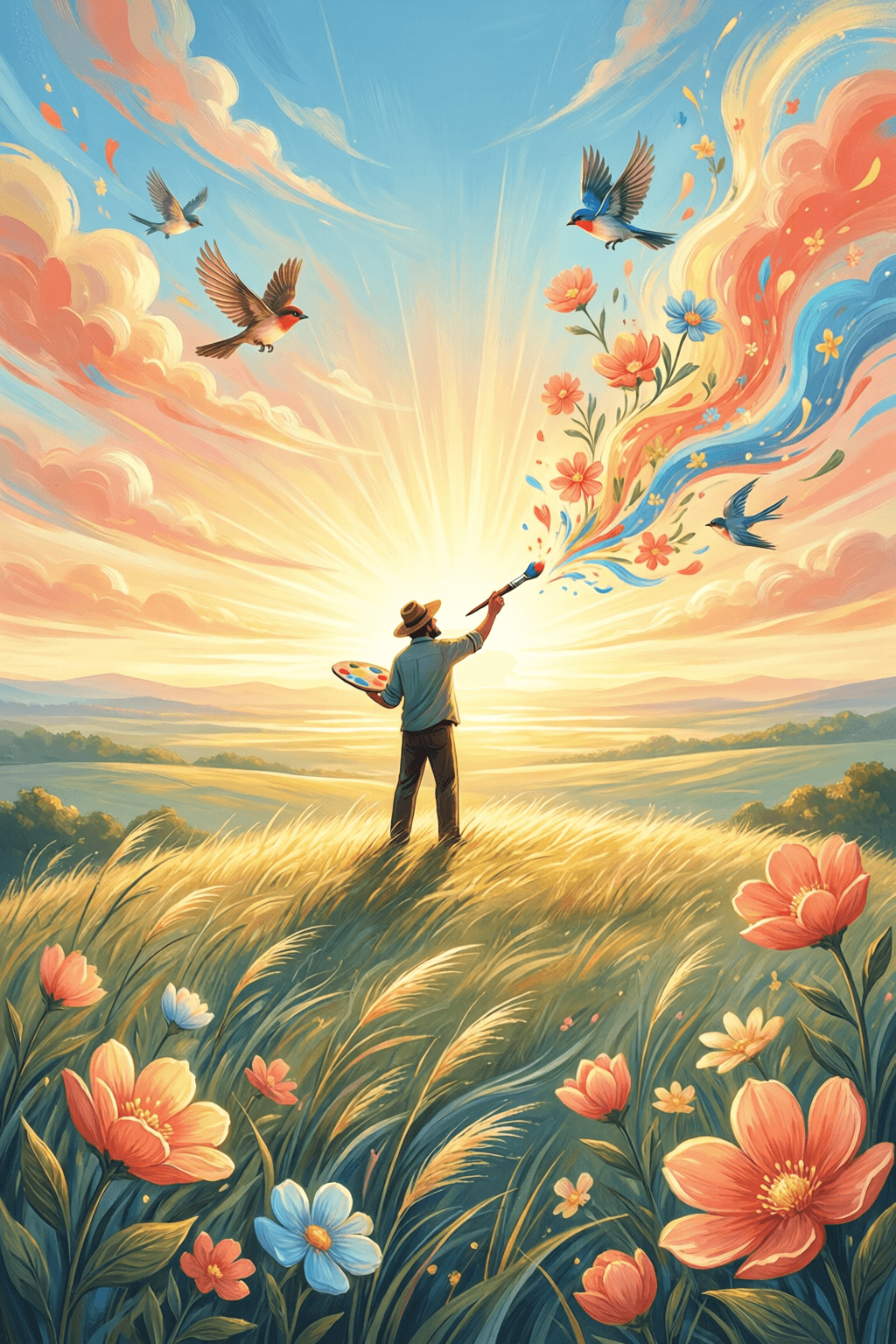
The artist has one function—to affirm and glorify life. — Saul Bellow
—What lingers after this line?
A Clear Statement of Artistic Purpose
Saul Bellow’s remark reduces the artist’s task to a striking essential: art exists to say yes to life. Rather than treating creativity as mere decoration or private self-expression, he frames it as an act of affirmation, a way of recognizing vitality, struggle, beauty, and human persistence. In this sense, the artist does not turn away from reality but gives it renewed significance. From that starting point, the quote also implies responsibility. To glorify life is not to ignore pain or contradiction; instead, it means shaping experience so that even suffering becomes part of a larger vision of meaning. Bellow’s own novels, such as Herzog (1964), often portray confusion and disillusionment while still insisting on the richness of being alive.
Affirmation Is Not Naive Optimism
Importantly, Bellow’s idea should not be mistaken for cheerful denial. Art that affirms life can include tragedy, absurdity, and moral failure, yet still leave us feeling that existence matters. In this way, affirmation is deeper than optimism: it is a commitment to the worth of human experience even when that experience is fractured. This distinction appears across literary history. Shakespeare’s King Lear (c. 1606) is full of cruelty and loss, yet its emotional magnitude enlarges our sense of humanity rather than diminishing it. Thus, the artist glorifies life not by painting it as easy, but by revealing its depth, intensity, and irreducible value.
The Artist as Witness to Human Fullness
From there, Bellow’s statement casts the artist as a witness, someone who notices what ordinary routines often conceal. A painter, novelist, or composer draws attention to fleeting gestures, private longings, and overlooked moments, turning them into forms we can see and feel anew. By doing so, art restores freshness to life that habit tends to dull. For example, James Joyce’s Dubliners (1914) finds drama in seemingly uneventful lives, while Vincent van Gogh’s letters and paintings transform fields, chairs, and night skies into emblems of intense presence. Consequently, the artist glorifies life not only through grand subjects, but through reverent attention to the everyday.
Resistance Against Nihilism and Despair
At the same time, Bellow’s claim carries a quiet defiance. To affirm life through art is to resist forces that reduce people to statistics, routines, or despair. Especially in modernity, where alienation and cynicism often dominate public language, the artist can insist that inner life, memory, love, and moral struggle still deserve reverence. This is why works born in dark times often feel especially life-giving. Pablo Picasso’s Guernica (1937) does not glorify violence, yet by bearing witness to suffering so powerfully, it defends human significance against brutality. In that sense, art becomes an act of preservation, saving what is most alive in us from indifference.
Beauty, Meaning, and the Renewal of Perception
Furthermore, glorifying life involves renewing perception itself. Art can make the familiar strange and the overlooked radiant, allowing people to encounter the world with sharpened feeling. A poem, symphony, or film may not change material conditions immediately, yet it can alter the spirit in which life is lived, and that transformation is no small achievement. Walt Whitman’s Leaves of Grass (1855) offers a useful example, praising the body, the city, labor, and the self in language meant to expand the reader’s sense of participation in existence. Accordingly, the artist’s function is not only to represent life, but to intensify our consciousness of it.
Why Bellow’s Vision Still Endures
Finally, Bellow’s statement endures because it answers a persistent cultural question: what is art for? His reply is both modest and grand. Art need not solve every social problem to matter; it matters because it keeps human beings connected to wonder, dignity, and aliveness. In periods of exhaustion or disillusionment, that reminder becomes indispensable. Seen this way, the artist serves society by deepening its capacity to feel and value existence. Whether through comedy, tragedy, realism, or experiment, the lasting work of art returns us to life with fuller awareness. That is why Bellow’s line still resonates: it defines art not as escape from living, but as its highest confirmation.
Recommended Reading
As an Amazon Associate, we earn from qualifying purchases.
One-minute reflection
Where does this idea show up in your life right now?
Related Quotes
6 selectedTo be an artist is to believe in life. — Henry Moore
Henry Moore
This quote implies that creating art is an inherently optimistic act. Artists must have faith in the value and potential of life in order to interpret, express, and celebrate it through their work.
Read full interpretation →The artist is not a solid, static being. The artist is fluid, like water, moving with the tides and changing form. — James McCrae
James McCrae
James McCrae’s image of the artist as fluid immediately challenges the common idea that creative people possess a single, fixed essence. Instead, he suggests that artistry is a process of becoming, not a stable condition...
Read full interpretation →The artist works by locating the world in himself. — Gertrude Stein
Gertrude Stein
At first glance, Gertrude Stein’s line suggests that art does not begin with the outer world alone, but with the artist’s inner ability to absorb and reinterpret it. To ‘locate the world in himself’ means that experience...
Read full interpretation →The artist must be a master of what he rejects. — Carlos Fuentes
Carlos Fuentes
At first glance, Carlos Fuentes’s remark suggests that artistic refusal is not mere negation but an act of deep knowledge. An artist earns the right to reject a style, convention, or influence only after understanding it...
Read full interpretation →The artist's duty is to stay in the fire, to keep the question alive long after the answers have gone cold. — Adrienne Rich
Adrienne Rich
Adrienne Rich presents the artist not as a maker of neat conclusions, but as someone willing to remain inside uncertainty. The image of “staying in the fire” suggests discomfort, risk, and sustained attention; in other w...
Read full interpretation →The artist must elect to fight for the beauty of the work, stitch by patient stitch, against the rush of the world. — Ursula K. Le Guin
Ursula K. Le Guin
Ursula K. Le Guin’s line begins with a deliberate verb: the artist must “elect.” In other words, beauty is not an accident or a luxury but a conscious choice made in resistance to haste.
Read full interpretation →More From Author
More from Saul Bellow →