
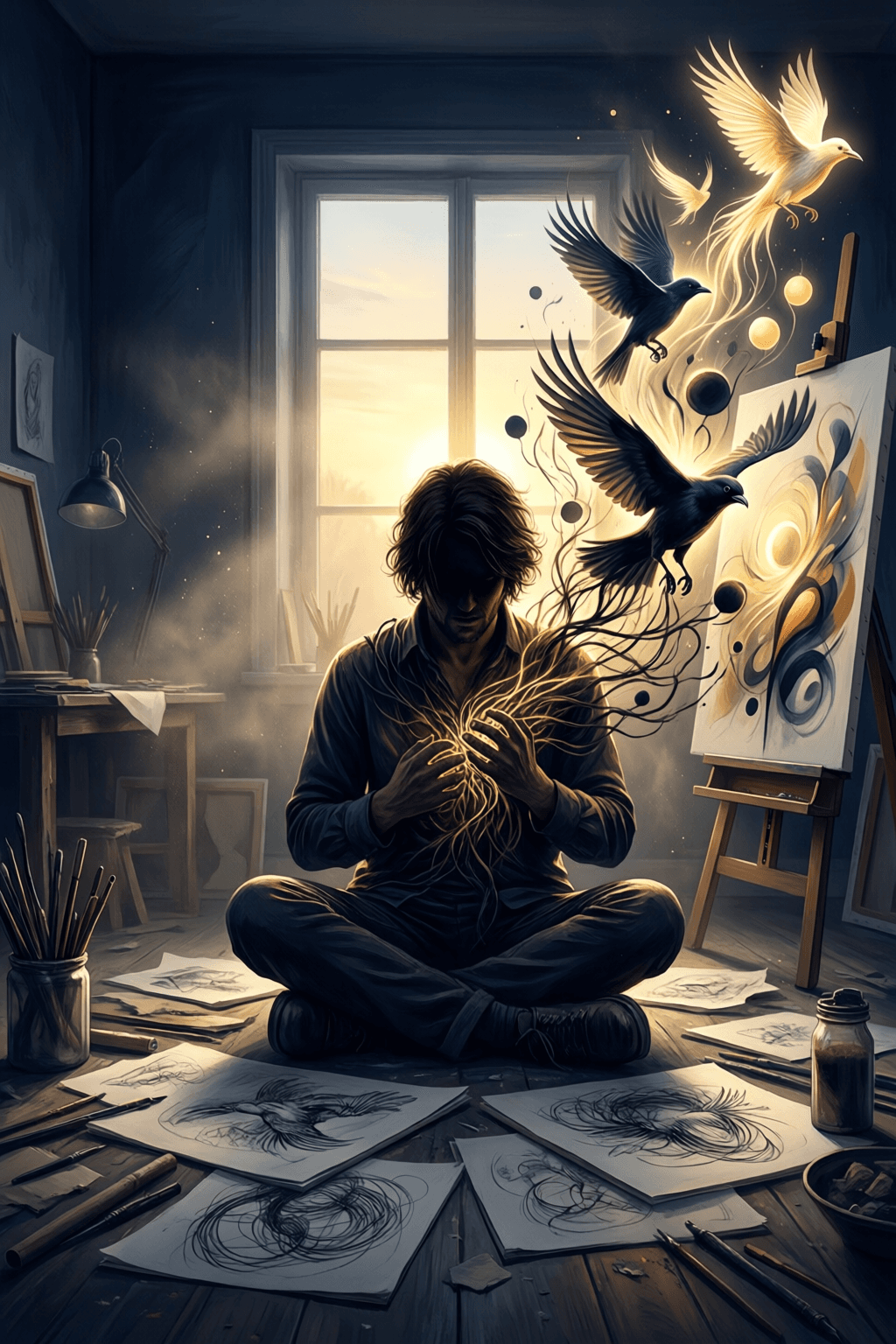
Anxiety is the precursor to creativity, and every great creation is born from anxiety. — T.S. Eliot
—What lingers after this line?
The Tension Before Creation
At its core, Eliot’s statement frames anxiety not as a purely destructive force but as the restless tension that often precedes invention. Anxiety unsettles the mind, making ordinary answers feel insufficient; in that discomfort, the creator is pushed to search for new forms, new language, or new solutions. Rather than signaling failure, this inner agitation can become the first movement of imaginative work. In this sense, creativity begins where certainty ends. The artist, writer, or thinker feels the pressure of something unresolved, and that pressure demands expression. Eliot’s insight suggests that great creation is rarely born from complete calm; instead, it emerges from the urge to transform unease into meaning.
Eliot’s Own Modernist Struggle
Seen in context, the quote also reflects Eliot’s own artistic world. His poetry, especially The Waste Land (1922), is saturated with fragmentation, spiritual exhaustion, and cultural instability—precisely the conditions that generate anxiety. Yet from that atmosphere came one of the defining works of modernism, showing how artistic innovation can arise from an age of collective unease. Therefore, Eliot was not merely offering an abstract theory. He was speaking from within a tradition in which personal strain and historical crisis became raw material for art. His work demonstrates that anxiety, when shaped by craft, can become not noise but structure.
Why Unease Sharpens Imagination
Moreover, anxiety heightens attention. When the mind senses a problem, contradiction, or threat, it becomes alert, scanning for patterns and possibilities. That heightened vigilance can feed creativity, because invention often depends on noticing what others overlook and on feeling compelled to resolve what remains unfinished. Psychologists have long noted a link between tension and problem-solving, even if excessive distress can overwhelm performance. In moderate form, however, anxiety can act like a spark: it energizes thought, deepens reflection, and keeps the creator from settling too quickly for easy answers. As a result, unease may become the engine of originality.
Art as a Form of Containment
From there, creativity can be understood as a way of giving shape to inner disorder. A poem, painting, symphony, or scientific theory does not erase anxiety, but it can contain it. By turning diffuse fear into form, the creator gains a measure of control over what once felt overwhelming. This is why so much powerful art feels emotionally charged: it has been forged from pressure rather than detached observation. Virginia Woolf’s Mrs Dalloway (1925), for instance, transforms private fragility and social tension into a carefully structured narrative. The achievement lies not in the absence of anxiety but in its refinement. Creation becomes an act of transmutation—making something shareable, coherent, and lasting out of inward unrest.
The Risk of Romanticizing Distress
At the same time, Eliot’s claim needs balance. To say that anxiety precedes creativity is not to say that suffering is always beneficial or that artists must be miserable to produce meaningful work. Severe anxiety can paralyze rather than inspire, and many creators work best when they have support, discipline, and periods of calm in which to shape their ideas. Consequently, the value of Eliot’s insight lies in recognizing anxiety as one possible source of creative energy, not as a requirement for greatness. The important transformation happens when distress is met with method—drafting, revising, experimenting—so that emotion becomes expression instead of mere torment.
Turning Restlessness Into Meaning
Ultimately, the quote points to a profound human pattern: we create because we are unsettled. Whether the anxiety comes from personal doubt, social upheaval, or spiritual longing, it presses us to respond. Great works often begin as attempts to answer questions that cannot be ignored, and their power comes from the urgency behind them. Thus, Eliot’s idea endures because it recognizes creativity as more than decoration. It is a response to inner necessity. Anxiety may be the precursor, but creation is the act that gives that tension direction, allowing something difficult and invisible to become visible, communicable, and transformative.
One-minute reflection
What does this quote ask you to notice today?
Related Quotes
6 selectedCreativity takes courage. — Henri Matisse
Henri Matisse
This quote highlights that being creative often involves exposing one's inner thoughts and feelings, which requires a significant amount of courage as it makes one vulnerable to criticism and judgment.
Read full interpretation →Shifting the mind into lower gear can bring better health, inner calm, enhanced concentration and the ability to think more creatively. — Carl Honoré
Carl Honoré
Carl Honoré’s insight begins with a simple but countercultural claim: the mind often works better when it stops racing. In a world that rewards speed, multitasking, and constant responsiveness, shifting into a “lower gea...
Read full interpretation →In order to be open to creativity, one must have the capacity for constructive use of solitude. One must overcome the fear of being alone. — Rollo May
Rollo May
Rollo May’s insight begins with a quiet but demanding premise: creativity requires the ability to stand apart from constant noise, approval, and distraction. To be open to new ideas, a person must first become comfortabl...
Read full interpretation →The moment a man begins to talk about technique, that's proof that he is fresh out of ideas. — Dylan Thomas
Dylan Thomas
Dylan Thomas’s remark begins with a sharp suspicion: when an artist talks too much about technique, the living impulse behind the work may already be gone. Technique, in this sense, becomes a substitute language, a way o...
Read full interpretation →Imperfection inspires invention, imagination, and creativity. — Mary Sharratt
Mary Sharratt
Mary Sharratt’s insight begins with a reversal of ordinary expectations: imperfection is not merely something to fix, but something that awakens possibility. When a plan fails, a surface cracks, or an idea refuses to fit...
Read full interpretation →Don't think. Thinking is the enemy of creativity. It's self-conscious, and anything self-conscious is lousy. — Ray Bradbury
Ray Bradbury
At first glance, Ray Bradbury’s line sounds almost rebellious: “Don’t think. Thinking is the enemy of creativity.” Yet his target is not intelligence itself, but the paralyzing kind of self-awareness that makes an artist...
Read full interpretation →More From Author
More from T. S. Eliot →There is no vocabulary for love within a family, love that's lived in, but not looked at. — T.S. Eliot
T.S. Eliot’s line points to a quiet paradox: the love most constantly present in family life is often the least articulated.
Read full interpretation →If you aren't in over your head, how do you know how tall you are? — T. S. Eliot
At first glance, Eliot’s question turns self-knowledge into a matter of pressure rather than comfort. We do not truly learn our limits while standing safely on familiar ground; instead, we discover our height only when c...
Read full interpretation →The secret to mastery is not a giant leap, but the quiet, relentless rhythm of showing up when the light is dim. — T.S. Eliot
At first glance, the quote overturns the popular fantasy that mastery arrives through a single breakthrough. Instead, it presents excellence as something quieter: the repeated act of returning to the work, especially whe...
Read full interpretation →Every moment is a fresh beginning. — T.S. Eliot
This quote highlights the idea that each moment is an opportunity to start anew. Life is filled with endless possibilities, and we can always make a fresh start regardless of past experiences.
Read full interpretation →