
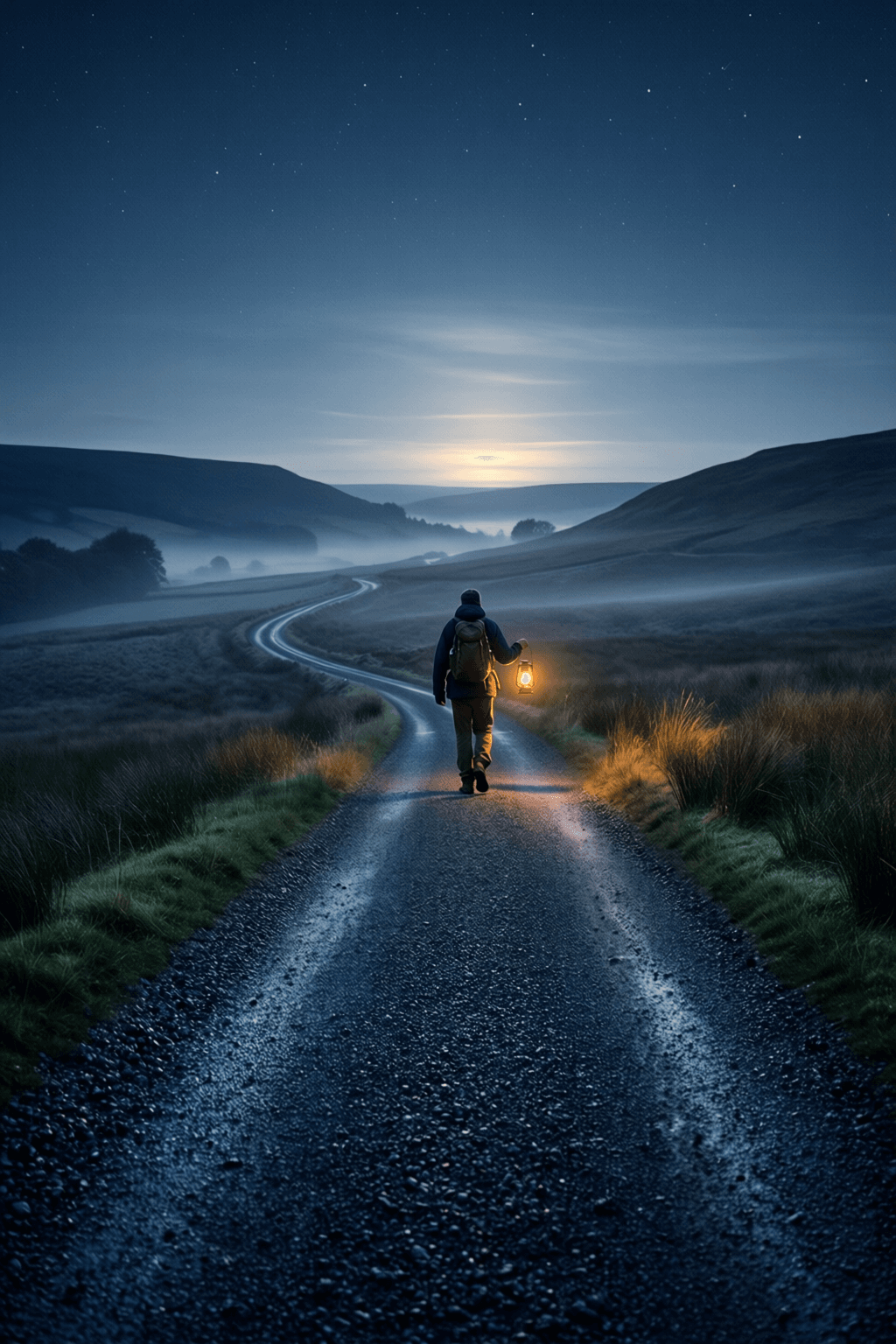
Do not be impatient with your seemingly slow progress. A traveler walking the road in the darkness of night is still going forward. — Vernon Howard
—What lingers after this line?
Patience with Hidden Growth
Vernon Howard’s quote begins with a gentle correction to our usual self-judgment: progress does not cease simply because it feels slow. In moments when change is invisible, people often assume they are failing, yet Howard suggests the opposite. What appears stagnant may actually be the quiet, necessary pace of real development. In this way, the saying invites patience not as passive waiting but as trust in motion that cannot yet be measured. Just as growth in nature often happens underground before it breaks the surface, personal transformation may be advancing long before it becomes obvious.
The Traveler as a Human Image
Howard then turns to the image of a traveler on a dark road, giving the reader a concrete picture of uncertainty. The traveler cannot see the whole journey, and perhaps not even the next bend, yet each step still carries them onward. This metaphor captures the emotional reality of effort made without reassurance. As a result, the quote speaks especially to those working through grief, study, recovery, or spiritual searching. Like Dante’s opening in the Inferno (c. 1308), where he finds himself lost in a dark wood, the image reminds us that confusion is often part of the path rather than proof that one has left it.
Darkness Does Not Cancel Direction
Importantly, the darkness in Howard’s line is not merely an obstacle; it represents the periods when clarity disappears. During such times, people may mistake uncertainty for regression, believing that if they cannot see progress, there is none. Howard overturns that assumption by separating visibility from movement. This insight aligns with many reflective traditions. St. John of the Cross, in Dark Night of the Soul (c. 1578), describes spiritual darkness not as abandonment but as a difficult passage toward deeper transformation. Thus, the absence of light may conceal direction, but it does not erase it.
A Lesson Against Self-Impatience
From there, the quote deepens into a practical moral lesson: impatience with oneself can become a second burden added to the first. Struggle is already difficult, but when people condemn themselves for not progressing faster, they turn hardship into shame. Howard’s words interrupt that habit with compassion. Consequently, the statement encourages a kinder internal voice. Rather than demanding dramatic breakthroughs, it honors small continuities—getting up, trying again, enduring uncertainty. In many lives, these modest acts are the true architecture of change, even if they do not look impressive in the moment.
Steady Motion as Quiet Courage
Finally, Howard reframes perseverance as a subtle form of courage. The traveler in darkness is not heroic because the road is easy or brightly lit; the courage lies in continuing without full assurance. That makes the quote less about speed and more about fidelity to the journey itself. Seen this way, progress becomes an act of trust. Much like the tortoise in Aesop’s fable steadily advancing while others focus on pace alone, the person who keeps moving through uncertainty often arrives through consistency rather than brilliance. Howard’s wisdom endures because it dignifies the unnoticed step, the one that still, quietly, goes forward.
One-minute reflection
What's one small action this suggests?
Related Quotes
6 selectedMarch on. Do not tarry. To go forward is to move toward perfection. — Kahlil Gibran
Kahlil Gibran
Gibran’s opening imperative—“March on. Do not tarry.”—sets a tone of disciplined urgency.
Read full interpretation →Roses do not bloom hurriedly; for beauty, like any masterpiece, takes time to blossom. — Matshona Dhliwayo
Matshona Dhliwayo
At its heart, Matshona Dhliwayo’s quote reminds us that true beauty cannot be forced. A rose does not rush toward bloom, nor does it apologize for the time required to unfold.
Read full interpretation →There is no road too long to the man who advances deliberately and without undue haste; there are no honors too distant to the man who prepares himself for them with patience. — Jean de La Bruyère
Jean de La Bruyère
At its core, La Bruyère’s line praises steady movement over restless speed. A long road feels intimidating only when seen all at once; once it is broken into deliberate steps, distance loses much of its power.
Read full interpretation →The ultimate mysteries are opened only to those who have immense patience. — Osho
Osho
Osho’s statement begins with a simple but demanding premise: the deepest truths do not yield to force. In this view, mystery is not a puzzle to be solved quickly but a reality that unfolds on its own terms.
Read full interpretation →Do you have the patience to wait until your mud settles and the water is clear? — Lao Tzu
Lao Tzu
Lao Tzu’s question frames patience not as passive delay but as an active kind of wisdom. The image of muddy water settling on its own suggests that confusion often clears not through force, but through restraint.
Read full interpretation →Don't go expecting perfection; be satisfied with even the smallest progress. — Marcus Aurelius
Marcus Aurelius
Marcus Aurelius advises against the exhausting demand for flawlessness and redirects attention toward modest improvement. In the spirit of Stoic thought, especially in his Meditations (c.
Read full interpretation →More From Author
More from Vernon Howard →A truly strong person does not need the approval of others any more than a lion needs the approval of sheep. — Vernon Howard
Vernon Howard’s image is striking because it sets true strength against the habit of seeking validation. A lion does not pause to ask sheep whether it is powerful; likewise, a genuinely grounded person does not build sel...
Read full interpretation →You cannot run away from a weakness; you must go back and master it. — Vernon Howard
This quote emphasizes that avoiding your weaknesses or challenges only delays the inevitable. Instead of running away, you must confront them to overcome and grow stronger.
Read full interpretation →