
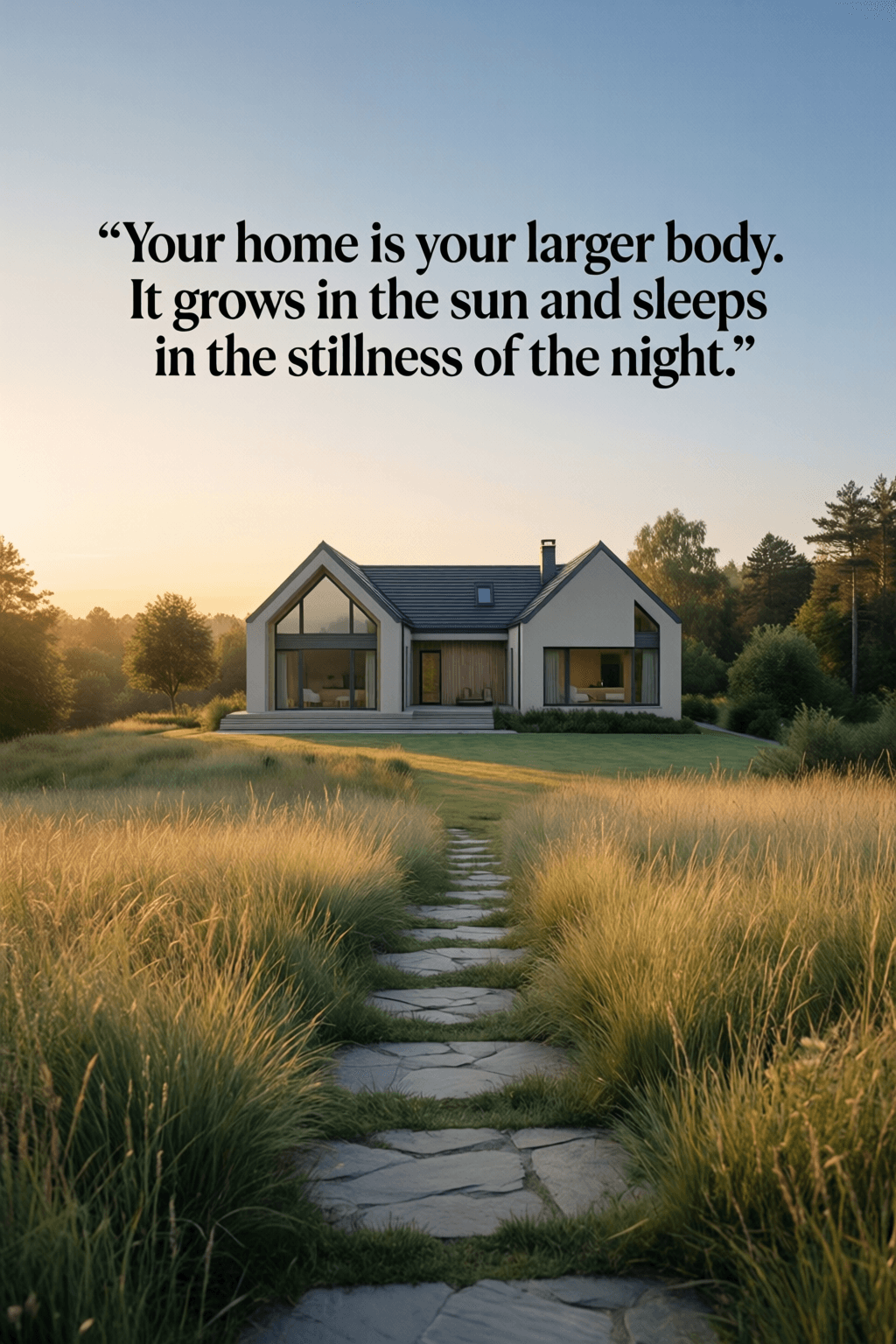
Your home is your larger body. It grows in the sun and sleeps in the stillness of the night. — Kahlil Gibran
—What lingers after this line?
A House That Breathes With You
At first glance, Gibran transforms the idea of home from a mere structure into something intimate and organic: “your larger body.” In this image, a dwelling is not separate from the person who inhabits it, but an outward extension of inner life. Walls, rooms, and windows become analogous to skin, limbs, and senses, suggesting that home shelters not only the body but also memory, identity, and feeling. From this starting point, the quote invites us to see domestic space as alive with human presence. Much as the body carries traces of experience, a home gathers habits, rituals, and emotional residue. Gaston Bachelard’s The Poetics of Space (1958) similarly argues that houses are repositories of daydream, intimacy, and psychological life, reinforcing Gibran’s vision of home as a living companion rather than inert property.
Growth Under Light
Gibran then adds that home “grows in the sun,” introducing a rhythm of nourishment and development. This phrase suggests that a true home evolves through openness, warmth, and daily care. Just as living beings depend on sunlight, homes flourish through attention: shared meals, conversation, repair, celebration, and the quiet accumulation of ordinary days. In this way, the quote shifts from metaphor to process. A home is not finished when it is built; it matures as life unfolds within it. Frank Lloyd Wright’s organic architecture, especially in works like Fallingwater (1935), pursued a similar idea by treating buildings as forms that should live in harmony with their surroundings. Gibran’s image therefore implies that home grows not only physically, but spiritually, through its relationship to both nature and those who dwell inside it.
Rest in the Stillness of Night
Just as the body must rest, Gibran says home “sleeps in the stillness of the night.” With this gentle turn, he gives the dwelling its own cycle of restoration. Night quiets the rooms, softens activity, and lets the space return to itself. The image suggests that a home has moods and tempos, echoing the lives that move through it by day and retreat by evening. Moreover, this nocturnal stillness points to home as a place of safety. It is where vulnerability becomes possible, where one can withdraw from the demands of the outside world. In many literary traditions, from Homer’s Odyssey to Virginia Woolf’s reflections on private interior life, shelter is not merely protection from weather but refuge for the mind. Gibran captures that emotional truth by imagining home as sharing in the same restorative silence that human beings need.
Belonging Beyond Possession
From here, the quote subtly challenges modern ideas of ownership. If home is a “larger body,” then it cannot be reduced to real estate or market value alone. It belongs to a person in the deeper sense that a body belongs to a self: through use, care, vulnerability, and lived experience. The bond is existential before it is economic. Consequently, Gibran’s insight helps explain why even modest spaces can feel profound, while luxurious ones may remain emotionally empty. A childhood apartment, a grandparent’s kitchen, or a rented room can become deeply meaningful because home is created through attachment rather than status. Sociologist Yi-Fu Tuan’s work in Space and Place (1977) shows how repeated experience turns abstract space into place; Gibran expresses the same truth more lyrically, grounding belonging in embodied intimacy.
The Unity of Human Life and Shelter
Ultimately, Gibran presents home as part of a larger continuity between person, dwelling, and world. Because it grows in the sun and sleeps at night, home participates in natural cycles rather than standing outside them. This closes the gap between architecture and existence: to live somewhere fully is to enter into a rhythm shared by body, house, and earth. Thus, the quote leaves us with a tender but demanding idea. We should not think of home merely as a container for life, but as a living extension of it, shaped by our presence and shaping us in return. In Gibran’s vision, to care for one’s home is, in a sense, to care for one’s enlarged self—a poetic reminder that the places we inhabit are never entirely outside us.
One-minute reflection
What feeling does this quote bring up for you?
Related Quotes
6 selectedHome is where the heart is. — Pliny the Elder
Pliny the Elder
At its simplest, “Home is where the heart is” shifts the idea of home from a physical address to an emotional center. Pliny the Elder, the Roman naturalist associated with this saying, points toward a truth that outlasts...
Read full interpretation →In the embrace of family, we find our true home, where love wraps around us like a warm, familiar blanket. — Mitch Albom
Mitch Albom
At first glance, Mitch Albom’s reflection shifts the meaning of home away from walls, roofs, and addresses toward something more intimate: the emotional shelter created by family. In this view, home is not merely where w...
Read full interpretation →There is nothing pleasanter than spading when the ground is soft and damp. — John Steinbeck
John Steinbeck
At first glance, Steinbeck’s line seems almost modest, yet its pleasure is precise and deeply felt. Spading soft, damp ground turns labor into something nearly sensual: the tool enters easily, the earth yields without re...
Read full interpretation →Home is the place where one finally allows the armor to drop and the spirit to breathe. — Maya Angelou
Maya Angelou
At its core, Maya Angelou’s reflection defines home not merely as a structure but as a sanctuary of emotional safety. The image of letting “the armor drop” suggests that daily life often requires protection—composure, re...
Read full interpretation →A home should be an anchor, a port in a storm, a refuge, a happy place in which to dwell. — Marvin J. Ashton
Marvin J. Ashton
Marvin J. Ashton’s statement presents home not merely as a physical structure but as a place of emotional and spiritual grounding.
Read full interpretation →Nature is not only all that is visible to the eye, it also includes the inner pictures of the soul. — Edvard Munch
Edvard Munch
At first glance, Munch’s statement expands the ordinary idea of nature beyond forests, skies, and seas. He argues that nature is not limited to what the eye can measure; it also includes the emotional and imaginative ima...
Read full interpretation →More From Author
More from Kahlil Gibran →March on. Do not tarry. To go forward is to move toward perfection. — Kahlil Gibran
Gibran’s opening imperative—“March on. Do not tarry.”—sets a tone of disciplined urgency.
Read full interpretation →There must be spaces in your togetherness, and let the winds of the heavens dance between you. — Kahlil Gibran
Gibran’s line opens with a gentle paradox: he speaks to people who are already “together,” yet insists that togetherness is healthiest when it includes room. Rather than portraying love as fusion, he frames it as a relat...
Read full interpretation →Our anxiety does not come from thinking about the future, but from wanting to control it. — Kahlil Gibran
Kahlil Gibran reframes anxiety as something more specific than mere anticipation. The future itself—uncertain, unfolding, and not yet real—doesn’t automatically distress us; rather, distress appears when we demand certai...
Read full interpretation →Work on the bright corner of your world and light will spread. — Kahlil Gibran
Kahlil Gibran’s line points to a deceptively simple strategy for change: begin with what is closest and most workable. “Your world” need not mean the entire planet; it can mean your desk, your household, your street, or...
Read full interpretation →