
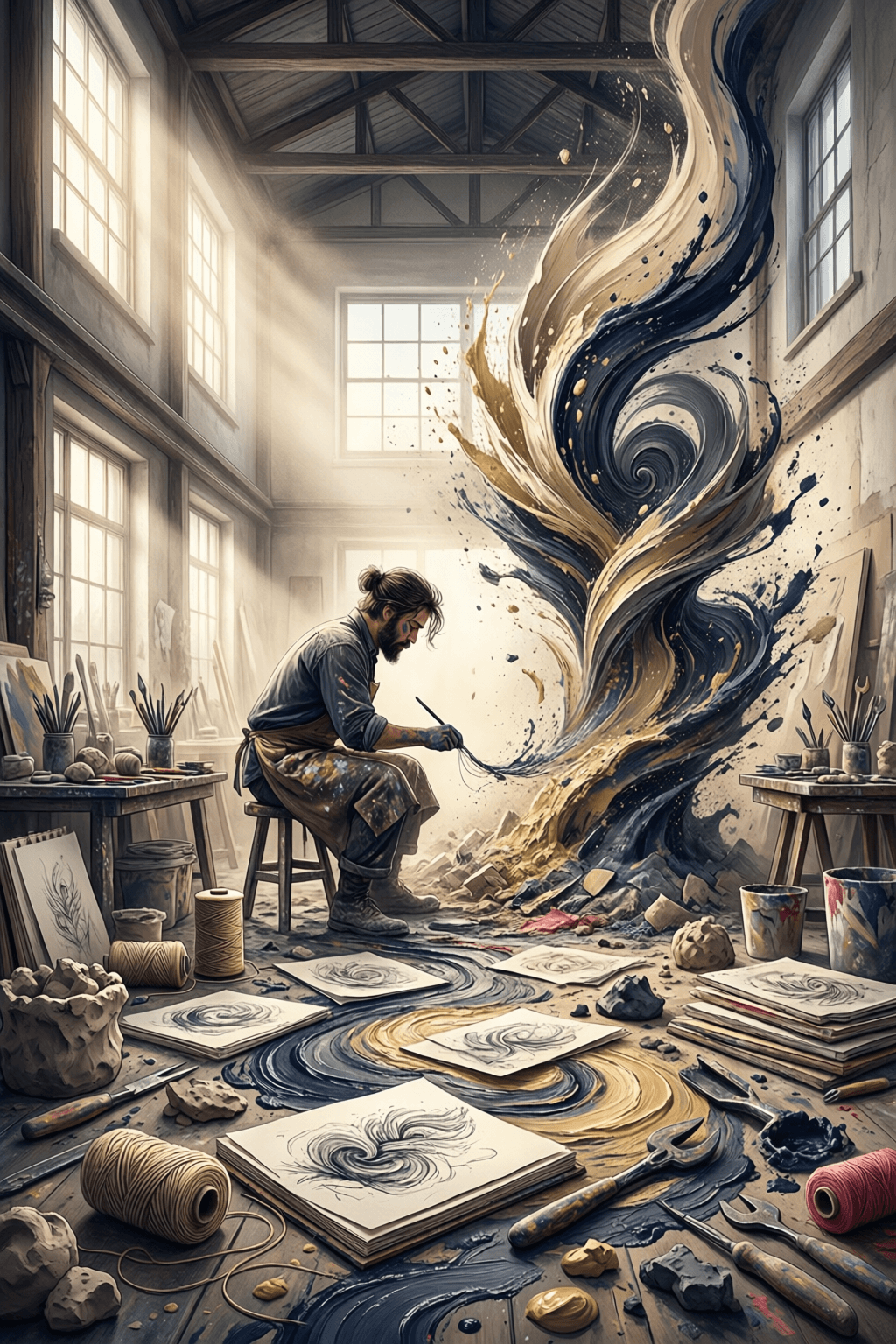
To create something new, one must first learn to be comfortable with the mess of the process. — Yayoi Kusama
—What lingers after this line?
The Disorder Behind Original Work
At first glance, Yayoi Kusama’s insight reframes creativity as something far less polished than people often imagine. To create something truly new, she suggests, one must stop fearing confusion, failed attempts, and unfinished forms. In this view, the mess is not a regrettable side effect of invention but the very condition that makes invention possible. This idea feels especially fitting coming from Kusama, whose immersive installations and repeating patterns emerge from obsession, accumulation, and emotional intensity. Rather than hiding disorder, her work often transforms it into meaning. As a result, the quote invites us to see cluttered drafts, abandoned sketches, and uncertain experiments not as signs of inadequacy, but as evidence that creation is alive.
Why Uncertainty Is Part of Making
From there, the quote leads naturally to a deeper truth: originality rarely arrives in a neat, linear sequence. Most creative breakthroughs unfold through detours, revisions, and moments when the maker cannot yet see the final shape. In other words, discomfort is often the price of discovery. This pattern appears throughout artistic and scientific history. Leonardo da Vinci’s notebooks, for instance, are filled with sketches, fragments, and unresolved ideas rather than tidy conclusions. Similarly, Thomas Edison’s oft-cited reflections on repeated experimentation show that progress usually emerges through accumulation and error. What looks like chaos from the outside, then, may actually be the hidden structure of learning.
The Emotional Skill of Staying With Chaos
However, Kusama’s statement is not only about technique; it is also about temperament. Being “comfortable with the mess” means resisting the urge to quit simply because the work feels unclear or imperfect. That emotional endurance is crucial, because many promising ideas are abandoned in the awkward stage between excitement and completion. Psychologist Donald Winnicott’s writing on play and creativity in "Playing and Reality" (1971) helps illuminate this point. He argued that genuine creation emerges in spaces that are not fully controlled, where uncertainty can be tolerated rather than eliminated. Seen this way, creative maturity is less about constant confidence and more about learning to remain present when the process becomes unruly.
Kusama’s Life as a Living Example
In this light, the quote gains further power when read alongside Kusama’s own biography. Her career was shaped by struggle, repetition, and the transformation of personal anguish into radical visual language. Works such as her Infinity Mirror Rooms did not arise from a pristine path; they emerged from persistence through psychological distress, experimentation, and years of reinvention. Consequently, her words carry the authority of experience rather than abstraction. Kusama does not romanticize ease; instead, she points toward a harder but more liberating truth: the artist often advances by working through inner and outer disorder. Her example shows that the mess can become not only manageable, but generative.
A Lesson Beyond the Arts
Finally, Kusama’s insight extends well beyond painting, sculpture, or installation. Anyone building something new—a business, a relationship, a research project, even a new sense of self—must pass through stages that feel incomplete and unstable. The temptation, of course, is to interpret that instability as failure. Yet the quote asks for a different response. Instead of demanding immediate clarity, it encourages patience with process and faith in emergence. New things often begin in fragments before they become coherent forms. By accepting that reality, people give themselves permission to continue shaping, revising, and discovering until the mess gradually reveals its hidden design.
One-minute reflection
What feeling does this quote bring up for you?
Related Quotes
6 selectedThe creative process is a mess, but a beautiful one. Embrace the chaos, because that is where your most authentic creations come to life. — Arastasia
Arastasia
At first glance, Arastasia’s quote rejects the tidy myth that meaningful art emerges from perfect planning. Instead, it frames creativity as inherently unruly, full of false starts, contradictions, and unexpected turns.
Read full interpretation →The creative process is a journey through your own vulnerability. When you stop running from the discomfort of the blank page, you finally start creating from the truth of who you are. — Brené Brown
Brené Brown
Brené Brown’s quote begins with a familiar image: the blank page as both invitation and threat. At first, that emptiness can feel exposing because it offers no place to hide behind polish, certainty, or imitation.
Read full interpretation →The painting has a life of its own. I try to let it come through. — Jackson Pollock
Jackson Pollock
At first glance, Jackson Pollock’s remark gives the painting an almost independent existence, as though the canvas carries its own pulse before the artist fully understands it. Rather than describing painting as pure con...
Read full interpretation →The creative process is not a straight line, but a labyrinth. To get lost in it is not a failure; it is the only way to find the hidden things worth saying. — M.C. Richards
M.C. Richards
At its core, M.C. Richards rejects the comforting myth that creative work unfolds through orderly steps.
Read full interpretation →The creative process is a sanctuary for healing, a space where resilience is transformed into art that speaks to our shared humanity. — Ben Okri
Ben Okri
At its heart, Ben Okri’s statement imagines the creative process as more than production; it becomes a refuge. A sanctuary is a place of shelter, and by choosing that word, Okri suggests that making art offers protection...
Read full interpretation →It is through the process of creating that we discover who we are, not by waiting for a finished masterpiece to tell us. — Twyla Tharp
Twyla Tharp
Twyla Tharp’s insight begins with a reversal of a common assumption: we often imagine that identity arrives fully formed and then expresses itself through art, work, or achievement. Instead, she argues that we come to kn...
Read full interpretation →More From Author
More from Yayoi Kusama →