
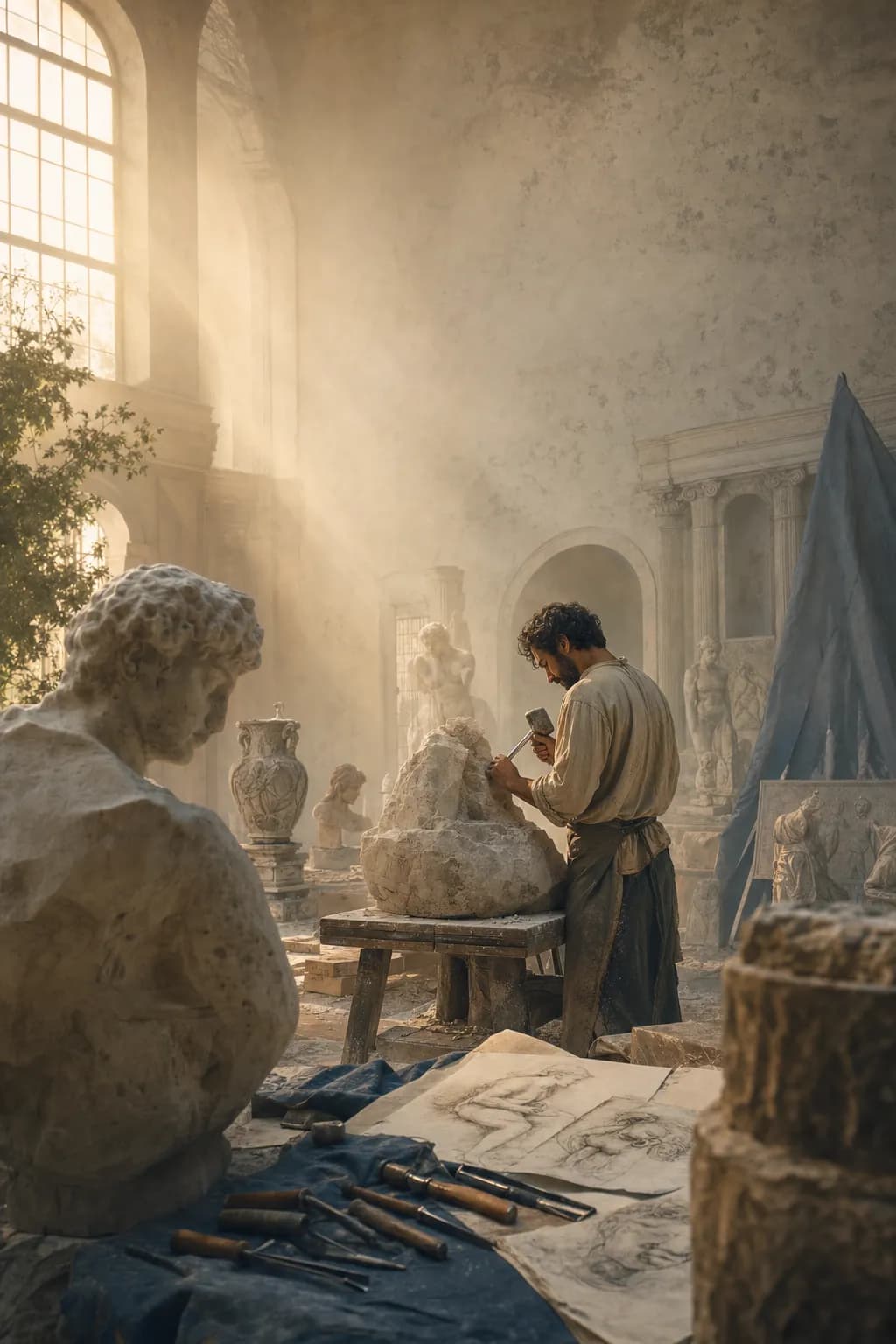
I am still learning. — Michelangelo
—What lingers after this line?
Humility in a Few Words
Michelangelo’s brief statement, “I am still learning,” carries unusual force because it comes from a master whose achievements might have justified certainty. Instead, he presents knowledge as unfinished and the self as always in progress. In that sense, the quote transforms greatness from a fixed status into an ongoing practice of humility. This humility is precisely what gives the line its enduring appeal. Rather than treating learning as something that ends with age or success, Michelangelo suggests that wisdom begins when we admit how much remains unknown. The remark therefore feels less like a confession of inadequacy and more like a declaration of intellectual vitality.
A Master Who Refused Completion
Seen in context, the quote becomes even more striking. Michelangelo, the sculptor of the David and painter of the Sistine Chapel ceiling, was already celebrated across Europe, yet accounts often attribute to his later years the phrase “Ancora imparo” or “I am still learning.” Whether repeated exactly as legend tells it or not, the sentiment fits a life marked by relentless revision and ambition. Accordingly, the statement reflects more than modesty; it captures the discipline of a creator who never considered his craft finished. Renaissance artists studied anatomy, architecture, poetry, and theology alongside technique, and Michelangelo’s career shows how mastery often expands, rather than narrows, a person’s curiosity.
The Renaissance Ideal of Lifelong Study
From there, the quote opens onto a larger Renaissance worldview. Humanists such as Petrarch and Erasmus promoted the continual cultivation of the mind, arguing that education was not merely for youth but for the shaping of a whole life. Michelangelo’s words fit naturally within that tradition, where learning meant becoming more fully human through constant effort. As a result, the phrase resists the modern temptation to divide life neatly into periods of schooling and periods of expertise. Instead, it suggests a more fluid model: one learns, creates, fails, adjusts, and learns again. In this way, the line becomes not only personal but civilizational, expressing a culture that prized growth over complacency.
Why the Quote Still Resonates
Even so, the saying feels distinctly modern because it answers a familiar anxiety: the fear of not knowing enough. In classrooms, workplaces, and creative fields, people often assume competence means having immediate answers. Michelangelo offers a gentler alternative, implying that the truly accomplished person remains open, curious, and corrigible. Consequently, the quote can be read as encouragement for beginners as much as for experts. A student struggling with first attempts may hear permission to continue imperfectly, while a seasoned professional may hear a warning against stagnation. The same words thus bridge insecurity and excellence by reminding both groups that learning is the common condition.
Learning as a Sign of Inner Youth
Finally, Michelangelo’s remark carries a subtle philosophy of aging. To say “I am still learning” is to refuse spiritual rigidity; it keeps the mind active and the imagination porous. In many traditions, from Socrates’ profession of ignorance in Plato’s Apology (c. 399 BC) to modern educational thought, openness to learning signals not weakness but aliveness. Therefore, the quote endures because it joins dignity with incompleteness. It suggests that a meaningful life is not measured by reaching a final state of mastery, but by preserving the willingness to grow. What sounds simple at first ultimately becomes profound: as long as one is learning, one is still becoming.
One-minute reflection
Why might this line matter today, not tomorrow?
Related Quotes
6 selectedOver the years I've grown more comfortable with making people uncomfortable because that is when growth can happen. You need a little conflict. — Jamie Lee Curtis
Jamie Lee Curtis
Jamie Lee Curtis’s reflection begins with a hard-won realization: discomfort is not always a sign that something has gone wrong. Often, it signals that a person, group, or relationship has reached the edge of its familia...
Read full interpretation →Everything that is great in life is the product of slow growth; the newer, and greater, and higher, and nobler the work, the slower is its growth. — William George Jordan
William George Jordan
William George Jordan’s reflection begins with a quiet but demanding truth: the most meaningful achievements rarely arrive quickly. He suggests that greatness is not manufactured in sudden bursts but cultivated through t...
Read full interpretation →We are powerful because we have survived, and that is what it is all about—survival and growth. — Audre Lorde
Audre Lorde
At its core, Audre Lorde’s statement redefines power not as domination, status, or control, but as the hard-won strength that comes from continuing despite adversity. To survive is already to have resisted erasure, and L...
Read full interpretation →If you aren't in over your head, how do you know how tall you are? — T. S. Eliot
T. S. Eliot
At first glance, Eliot’s question turns self-knowledge into a matter of pressure rather than comfort. We do not truly learn our limits while standing safely on familiar ground; instead, we discover our height only when c...
Read full interpretation →Today's tears water tomorrow's gardens. — Matshona Dhliwayo
Matshona Dhliwayo
At first glance, Matshona Dhliwayo’s line transforms grief into something unexpectedly fertile. Tears, usually seen as signs of pain or loss, become water for a future garden, suggesting that suffering is not merely endu...
Read full interpretation →Whatever challenge you might find yourself in has a solution. It is very much possible that it is not an obvious one, but it is an opportunity—to grow, to create, to transform. — Dalai Lama
Dalai Lama
At its core, this reflection insists that no challenge is entirely closed off from resolution. The Dalai Lama does not promise that every answer will be easy or immediate; instead, he shifts attention toward possibility...
Read full interpretation →More From Author
More from Michelangelo →If people knew how hard I had to work to gain my mastery, it would not seem so wonderful at all. — Michelangelo
At first glance, Michelangelo’s remark strips genius of its mystique. Rather than presenting mastery as a gift bestowed at birth, he insists that extraordinary achievement is rooted in sustained and often invisible effor...
Read full interpretation →The true work of art is but a shadow of the divine perfection. — Michelangelo
Michelangelo’s statement immediately frames art as an act of humility rather than conquest. Instead of claiming that human creativity rivals ultimate truth, he suggests that even the finest painting or sculpture merely r...
Read full interpretation →Chisel away the needless to reveal the bold figure of what you are meant to be. — Michelangelo
Michelangelo’s line frames identity as something already present, waiting beneath excess. Instead of “building” a self from scratch, he suggests we uncover a truer form by removing what obscures it—habits, fears, and bor...
Read full interpretation →Chisel away at your fears until only the sculpture of your purpose remains. — Michelangelo
Michelangelo’s metaphor invites us to imagine fear not as an enemy to be destroyed, but as surplus marble hiding who we really are. Just as a block of stone contains a statue within it, our lives often contain a clear pu...
Read full interpretation →