
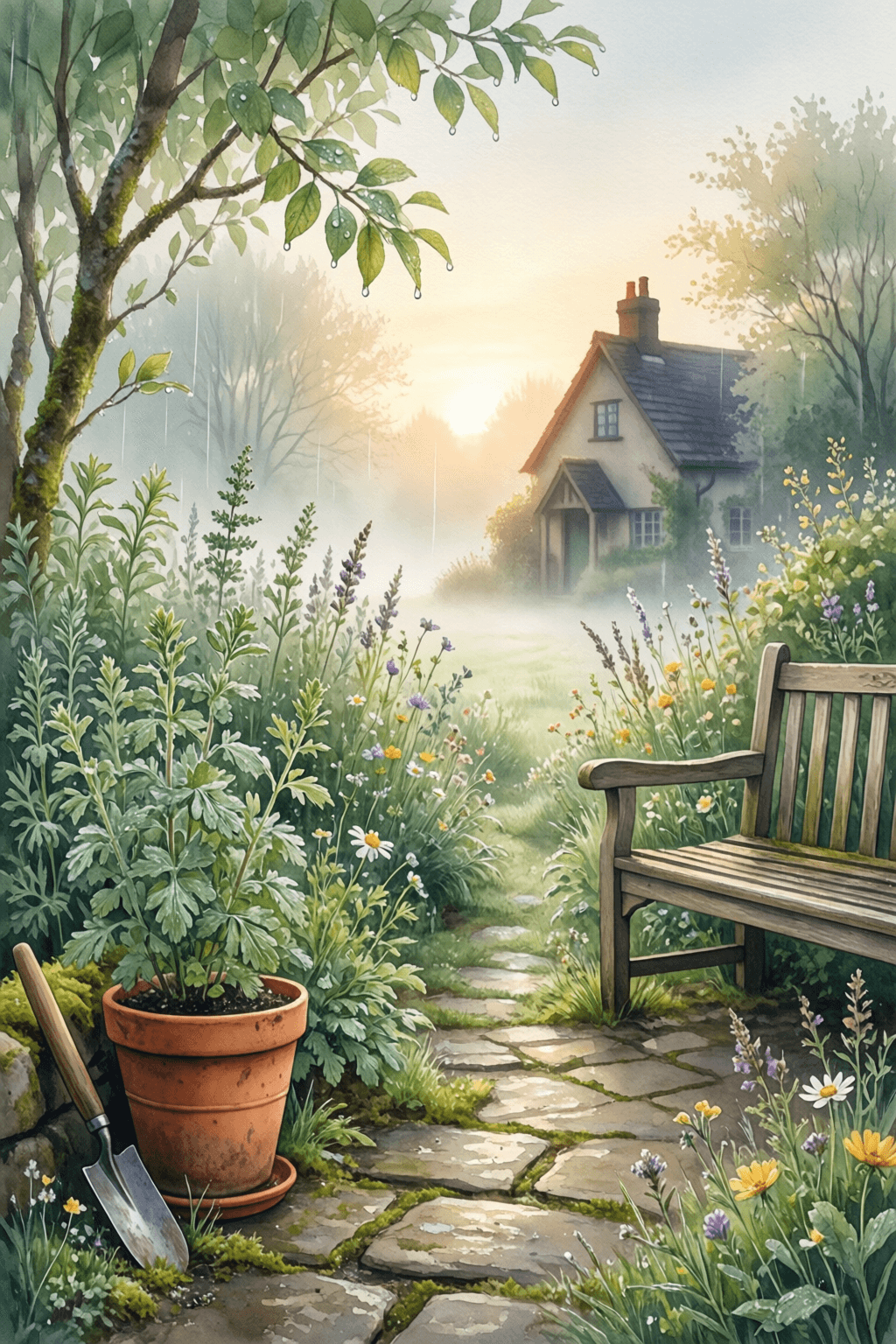
When the world wearies and society fails to satisfy, there is always the garden. — Minnie Aumonier
—What lingers after this line?
A Retreat from Human Exhaustion
Minnie Aumonier’s line begins with a quiet admission: the world can tire us, and society can leave us emotionally underfed. In that context, the garden appears not as a luxury but as a dependable refuge, a place that asks little while offering calm in return. Her wording suggests that when public life feels noisy, disappointing, or impersonal, nature provides a more honest kind of companionship. From this starting point, the garden becomes more than a patch of cultivated earth. It stands for withdrawal without bitterness—a restorative pause rather than an escape born of defeat. In other words, Aumonier frames the garden as a gentle answer to modern fatigue.
Nature’s Quiet Form of Consolation
What makes a garden consoling is precisely its silence and rhythm. Unlike society, which often demands performance, agreement, or endurance, a garden offers presence without judgment. The opening of a flower, the scent of wet soil, or the repetition of seasonal care can steady the mind in ways conversation sometimes cannot. Indeed, this idea echoes earlier literary traditions. Voltaire’s *Candide* (1759) ends with the famous counsel to “cultivate our garden,” a phrase often read as a turn away from abstract frustration toward meaningful, grounded living. Aumonier’s thought follows a similar path, suggesting that peace may be found not in fixing every social failure at once, but in tending what is alive and immediate.
The Garden as a Moral Counterworld
As the quote deepens, the garden also appears as a subtle contrast to society’s shortcomings. Human institutions may disappoint through vanity, conflict, or exclusion, yet the garden operates by different terms: patience, reciprocity, and growth. Seeds do not respond to status, and seasons do not flatter ambition. This natural order can feel morally clarifying when social life becomes distorted. For that reason, many writers have treated gardens as spaces of truth. In Frances Hodgson Burnett’s *The Secret Garden* (1911), renewal happens not through social approval but through contact with living things. Aumonier’s statement carries a similar faith: when society fails to nourish the spirit, the garden restores proportion and reminds us what healthy flourishing looks like.
Healing Through Simple Acts of Care
At a practical level, the garden heals because it invites participation. Watering, pruning, planting, and waiting are modest acts, yet they return a sense of agency to those who feel worn down by the larger world. When everything public seems chaotic, the small certainty that a tended plant may bloom becomes deeply reassuring. Modern research supports this intuition. Studies in environmental psychology, such as Roger Ulrich’s hospital recovery research (1984), found that views of nature can measurably reduce stress and support healing. Thus Aumonier’s observation is not merely sentimental; it reflects a real human response. The garden consoles us partly because care given outwardly often repairs something inward as well.
Solitude That Does Not Feel Empty
Finally, Aumonier’s quote hints at a form of solitude that feels full rather than lonely. Society may fail because it surrounds us with people yet leaves us unseen, whereas a garden offers aloneness enriched by life, color, and motion. Birds, insects, leaves, and light create a quiet fellowship that does not intrude. In this way, the garden becomes a companion to the inner life. Rather than isolating us, it reconnects us to slower forms of attention and gratitude. Aumonier ultimately suggests that when the world disappoints, we are not left with nothing: there remains a living sanctuary where the spirit can rest, recover, and begin again.
One-minute reflection
What feeling does this quote bring up for you?
Related Quotes
4 selectedTo be kind to oneself is to understand that even the most beautiful garden needs a season of rest before it can bloom again. — Thich Nhat Hanh
Thich Nhat Hanh
At first glance, Thich Nhat Hanh’s image of the garden transforms self-kindness into something organic rather than indulgent. Just as a garden cannot flower endlessly without pause, the human spirit cannot remain product...
Read full interpretation →Plant your own garden and decorate your own soul, instead of waiting for someone to bring you flowers. — Veronica A. Shoffstall
Veronica A. Shoffstall
This quote emphasizes the importance of self-reliance and taking responsibility for your own happiness. Instead of waiting for others to fulfill your needs or bring you joy, take proactive steps to cultivate your own wel...
Read full interpretation →Everyone needs a place to retreat; a spot where the world grows quiet enough for the soul to speak. — Angie Wyland Crosby
Angie Wyland Crosby
At its core, Angie Wyland Crosby’s reflection suggests that retreat is not escapism but renewal. A private place—whether physical or emotional—offers relief from noise, pressure, and constant demands.
Read full interpretation →To tame the mind, build a garden of silent waiting. — Rabindranath Tagore
Rabindranath Tagore
Tagore’s evocative metaphor likens the mind to an ungoverned expanse—untamed, teeming, and often wild with restless thoughts. Before one can aspire to clarity or focus, it’s crucial to recognize this innate turbulence.
Read full interpretation →More From Author
More from Minnie Aumonier →