
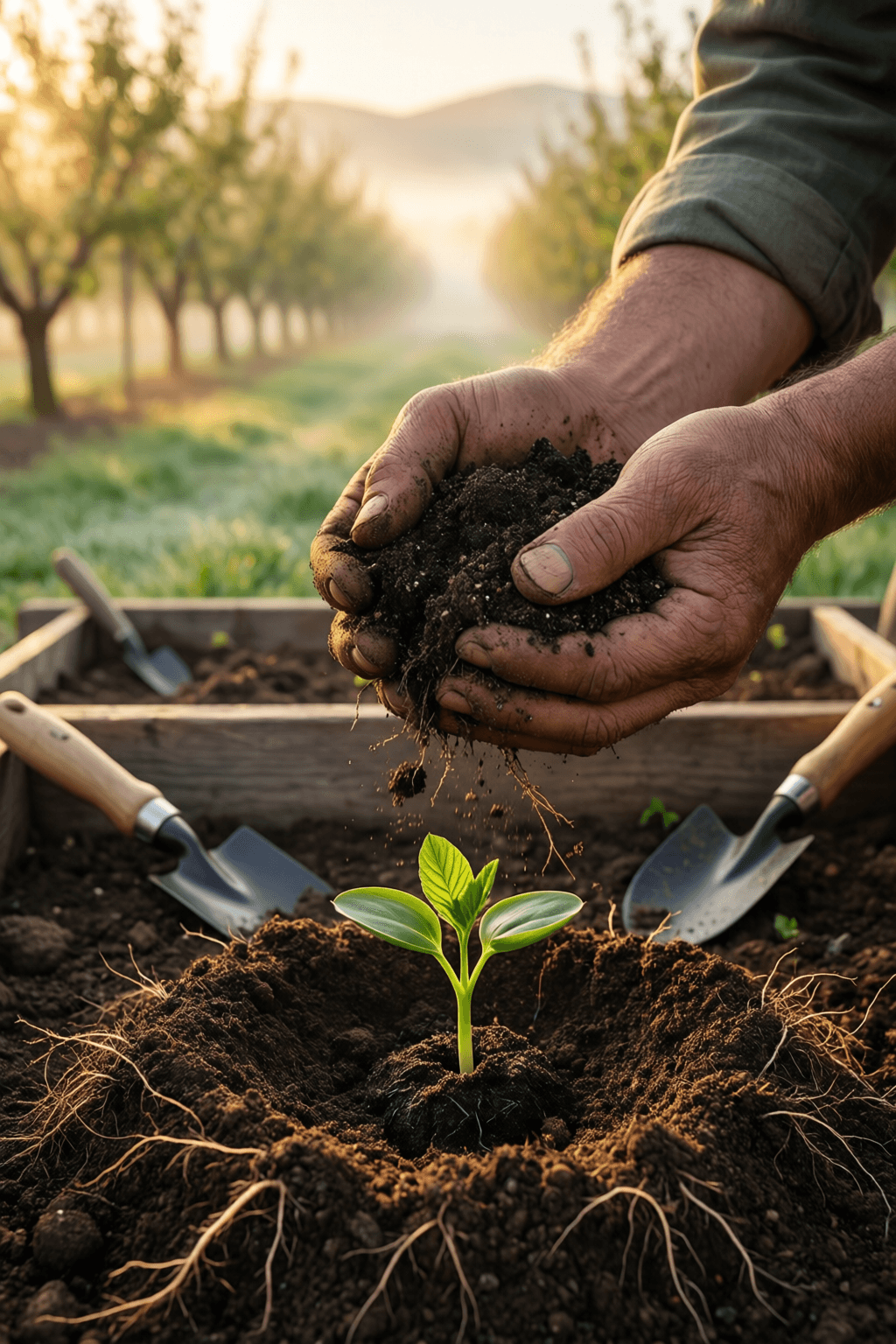
To be a successful farmer one must first know the nature of the soil. — Wendell Berry
—What lingers after this line?
The Ground of All Farming
Wendell Berry’s statement begins with a simple but profound truth: successful farming does not start with machinery, markets, or even seeds, but with the soil itself. Before any harvest can be imagined, the farmer must understand the living ground that makes growth possible. In this sense, Berry shifts attention from visible results to the hidden foundation beneath them. Just as importantly, the quote implies that farming is not an act of domination but of attention. To ‘know the nature of the soil’ means observing its texture, moisture, fertility, and limits. Success, therefore, comes not from forcing the land to comply, but from working with its character.
Knowledge Through Intimacy and Observation
From this foundation, Berry points toward a kind of knowledge that is practical, patient, and intimate. Soil cannot be understood only in abstract terms; it must be encountered through seasons of watching, testing, and remembering. A farmer learns where water gathers after rain, which patch dries first in summer, and how certain crops respond to particular fields. In this way, the quote honors experience as a form of wisdom. Berry’s broader essays, such as those in The Unsettling of America (1977), repeatedly argue that good agriculture depends on close local knowledge rather than detached industrial efficiency. The farmer succeeds by becoming a careful reader of the land.
Respecting Natural Limits
At the same time, knowing the soil also means accepting that land has limits. Not every field can support every crop, and not every weakness can be corrected without consequence. Berry’s insight therefore challenges the modern temptation to treat nature as infinitely adjustable through chemicals, extraction, or brute force. This respect for limits has deep roots. Roman writer Virgil’s Georgics (29 BC) advises farmers to study the qualities of different lands before planting, showing that agriculture has long depended on humility before nature. Berry renews that older wisdom by reminding us that stewardship begins when we listen to what the earth can and cannot give.
Soil as a Living Community
Moving further, the quote gains depth when we remember that soil is not inert dirt but a living system. Healthy soil contains microbes, fungi, insects, minerals, roots, air, and water in delicate relationship. To know its nature, then, is to recognize that fertility arises from life and interdependence rather than from mere input and output. Modern soil science reinforces Berry’s intuition. Researchers such as those discussed by agronomist Rattan Lal have shown that soil health affects water retention, carbon storage, and long-term productivity. Thus, Berry’s line is not only poetic; it anticipates an ecological truth: the farmer’s success depends on protecting the vitality of the whole underground community.
A Moral Vision of Stewardship
Because of this, Berry’s remark also carries an ethical dimension. If one truly knows the soil, one is less likely to exploit it carelessly. Knowledge creates responsibility: the farmer becomes not merely a producer of crops but a steward of a place that must endure beyond a single season or generation. Berry often writes in this moral register, linking agriculture to character, restraint, and care. His quote suggests that success should not be measured only by yield or profit, but by whether the land remains healthy after use. In that sense, true farming success includes preserving the conditions for future life.
A Lesson Beyond the Farm
Finally, Berry’s observation reaches beyond agriculture into a broader philosophy of work and life. Before acting well in any field, one must understand the nature of the material, community, or circumstance involved. A teacher must know students, a builder must know wood and stone, and a leader must know the people and place they serve. Thus, the quote endures because it expresses a universal principle: lasting success begins with humble attention to reality. By starting with the soil, Berry gives that principle its most concrete form. He reminds us that wisdom grows from knowing the ground beneath our ambitions.
Recommended Reading
As an Amazon Associate, we earn from qualifying purchases.
One-minute reflection
What feeling does this quote bring up for you?
Related Quotes
6 selectedThe farmer's work is never done. It's passed on, generation after generation. Let us not forget that the cultivation of the earth is the most important labor of man. — Daniel Webster
Daniel Webster
Daniel Webster’s statement begins with a plain truth: farming is never truly finished. Unlike work that ends with a contract or a season, cultivation returns in cycles—plowing, planting, tending, harvesting, and preparin...
Read full interpretation →To cultivate anything—a garden, a skill, a soul—requires the courage to wait for what you have planted. — Wendell Berry
Wendell Berry
At first glance, Wendell Berry’s quote seems to praise patience, yet it goes further by naming patience as courage. To plant anything—a seed, a habit, a belief in oneself—is to act without immediate proof of success.
Read full interpretation →The beauty of a life well-lived is measured by the depth of the roots you grow into the lives of those standing right beside you. — Wendell Berry
Wendell Berry
At first glance, Wendell Berry shifts our idea of a successful life away from personal achievement and toward human closeness. The beauty of living well, he suggests, is not counted in status, wealth, or visibility, but...
Read full interpretation →Nobody can discover the world for somebody else. Only when we discover it for ourselves does it become common ground and a common bond. — Wendell Berry
Wendell Berry
Wendell Berry begins with a simple but demanding truth: no one can hand another person a fully lived understanding of the world. Facts can be taught, maps can be drawn, and advice can be offered, yet genuine knowledge re...
Read full interpretation →We must learn to treat our own hearts with the same patience and steady hand we would offer to a piece of fine, delicate wood. — Wendell Berry
Wendell Berry
Wendell Berry’s line begins with a striking comparison: the human heart is like fine, delicate wood, something beautiful yet easily damaged by haste or rough treatment. In that image, he shifts self-regard away from judg...
Read full interpretation →You are not a machine designed to be productive 24/7. Even the most fertile land must lie fallow to produce a harvest again. — Wendell Berry
Wendell Berry
Wendell Berry’s line begins by challenging a modern assumption: that our worth is measured by constant productivity. By stating plainly that you are “not a machine,” he re-centers the conversation on human limits—physica...
Read full interpretation →More From Author
More from Wendell Berry →The beauty of a life well-lived is measured by the depth of the roots you grow into the lives of those standing right beside you. — Wendell Berry
At first glance, Wendell Berry shifts our idea of a successful life away from personal achievement and toward human closeness. The beauty of living well, he suggests, is not counted in status, wealth, or visibility, but...
Read full interpretation →To cultivate anything—a garden, a skill, a soul—requires the courage to wait for what you have planted. — Wendell Berry
At first glance, Wendell Berry’s quote seems to praise patience, yet it goes further by naming patience as courage. To plant anything—a seed, a habit, a belief in oneself—is to act without immediate proof of success.
Read full interpretation →Nobody can discover the world for somebody else. Only when we discover it for ourselves does it become common ground and a common bond. — Wendell Berry
Wendell Berry begins with a simple but demanding truth: no one can hand another person a fully lived understanding of the world. Facts can be taught, maps can be drawn, and advice can be offered, yet genuine knowledge re...
Read full interpretation →We must learn to treat our own hearts with the same patience and steady hand we would offer to a piece of fine, delicate wood. — Wendell Berry
Wendell Berry’s line begins with a striking comparison: the human heart is like fine, delicate wood, something beautiful yet easily damaged by haste or rough treatment. In that image, he shifts self-regard away from judg...
Read full interpretation →