
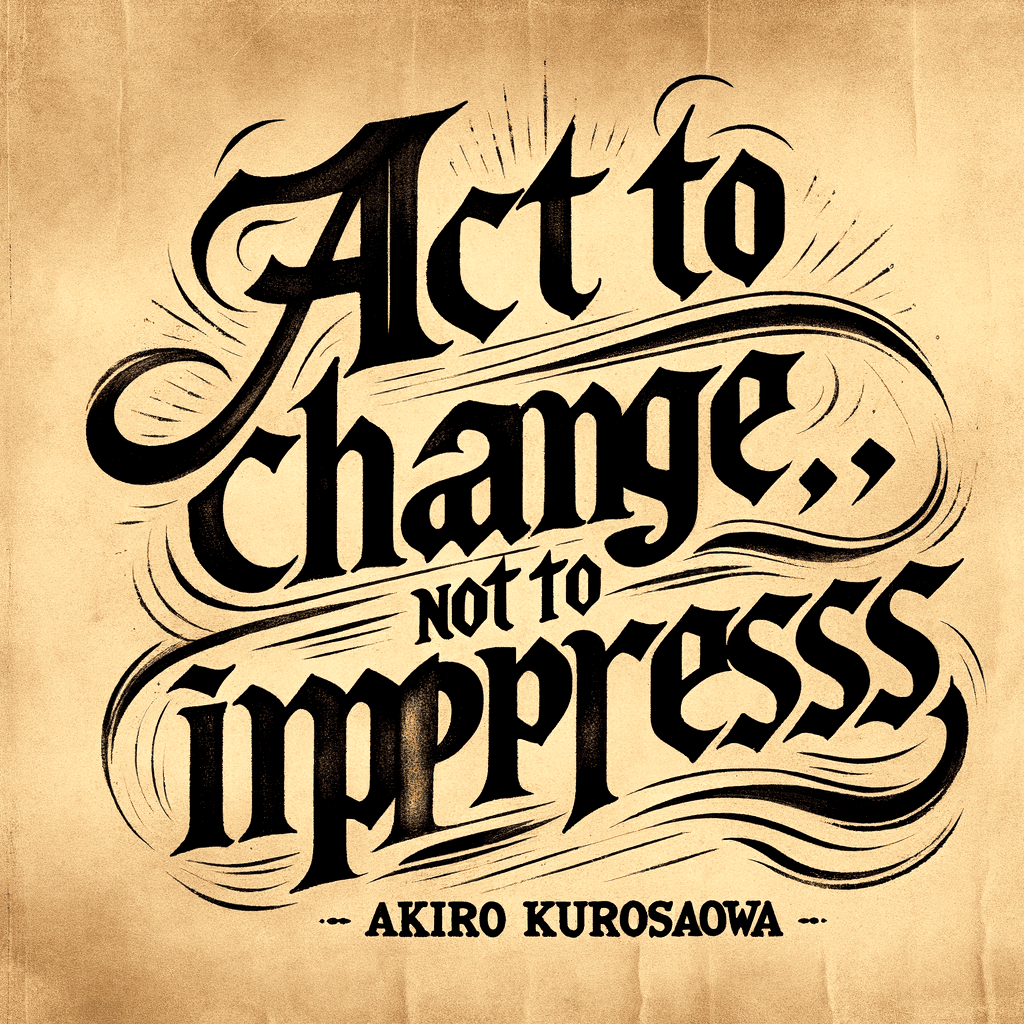
Act to change, not to impress. — Akiro Kurosawa
—What lingers after this line?
Authenticity in Actions
This quote emphasizes the importance of acting with authenticity and integrity. Rather than performing actions for the sake of gaining approval or admiration from others, one should focus on making meaningful changes.
Purposeful Living
Kurosawa suggests that our actions should be guided by purpose and intention. By acting with the aim of bringing about change, we can contribute positively to the world and ourselves.
Avoiding Superficiality
The quote warns against the dangers of superficiality, where actions are taken merely to create a favorable image. It encourages individuals to look beyond appearances and prioritize genuine impact over popularity.
Legacy and Impact
Focusing on change rather than impressing others can lead to a lasting legacy. It stresses that true value lies in the positive effects we have on others and our surroundings, rather than in temporary accolades.
Influence of Akira Kurosawa
Akira Kurosawa was a renowned Japanese filmmaker known for his influential movies that often tackled deep social issues and moral dilemmas, which reflects his belief in purposeful and impactful storytelling.
One-minute reflection
Why might this line matter today, not tomorrow?
Related Quotes
6 selectedThere is a quiet power in the ability to simply be, to exist without the need for constant performance. — Eileen Caddy
Eileen Caddy
Eileen Caddy’s words begin with a gentle challenge to modern restlessness: we often feel compelled to prove our worth through productivity, charm, achievement, or constant visibility. Yet her phrase “quiet power” suggest...
Read full interpretation →Be who you are and say what you feel, because those who mind don't matter, and those who matter don't mind. — Bernard M. Baruch
Bernard M. Baruch
Baruch’s quote begins with a simple but demanding instruction: be yourself and speak honestly. At its core, the line argues that authenticity is not merely a personality trait but an act of courage, especially in a world...
Read full interpretation →You're born an original—don't die a copy. — John Mason
John Mason
At its core, John Mason’s line is a sharp reminder that every person begins life with a distinct combination of temperament, talent, and perspective. To be “born an original” suggests that individuality is not something...
Read full interpretation →Authenticity is a habit. It is a road we are comfortable with. — Ai Weiwei
Ai Weiwei
At first glance, Ai Weiwei’s statement shifts authenticity away from dramatic self-revelation and toward repetition. By calling it a habit, he suggests that being genuine is not an occasional act of courage but a pattern...
Read full interpretation →Quietly persist. The world is loud, but your work only needs to be true. — Anne Lamott
Anne Lamott
Anne Lamott’s line begins with a simple imperative: “Quietly persist.” At once, it rejects the idea that meaningful work must announce itself to be real. Instead, she points toward a steadier form of effort, one rooted i...
Read full interpretation →Fitting in is one of the greatest barriers to belonging. Belonging doesn't require us to change who we are; it requires us to be who we are. — Brené Brown
Brené Brown
At the heart of Brené Brown’s statement is a crucial distinction: fitting in is about adaptation, while belonging is about acceptance. When people try to fit in, they often study the room, edit themselves, and perform wh...
Read full interpretation →More From Author
More from Akiro Kurosawa →When you have a vision, there’s no challenge you can’t overcome. — Akiro Kurosawa
This quote highlights the transformative power of having a clear vision. With a well-defined goal, obstacles become stepping stones rather than roadblocks.
Read full interpretation →Your life is a story told by your heart. — Akiro Kurosawa
This quote suggests that our emotions, desires, and passions—things that come from the heart—shape the narrative of our lives. It emphasizes the importance of listening to one's inner feelings to create a meaningful life...
Read full interpretation →Water the roots of your own tree, and you will grow. — Akiro Kurosawa
This quote suggests that focusing on your own growth and nurturing your inner self will naturally lead to progress and improvement in life. Just like a tree needs its roots to be watered to thrive, individuals must inves...
Read full interpretation →