
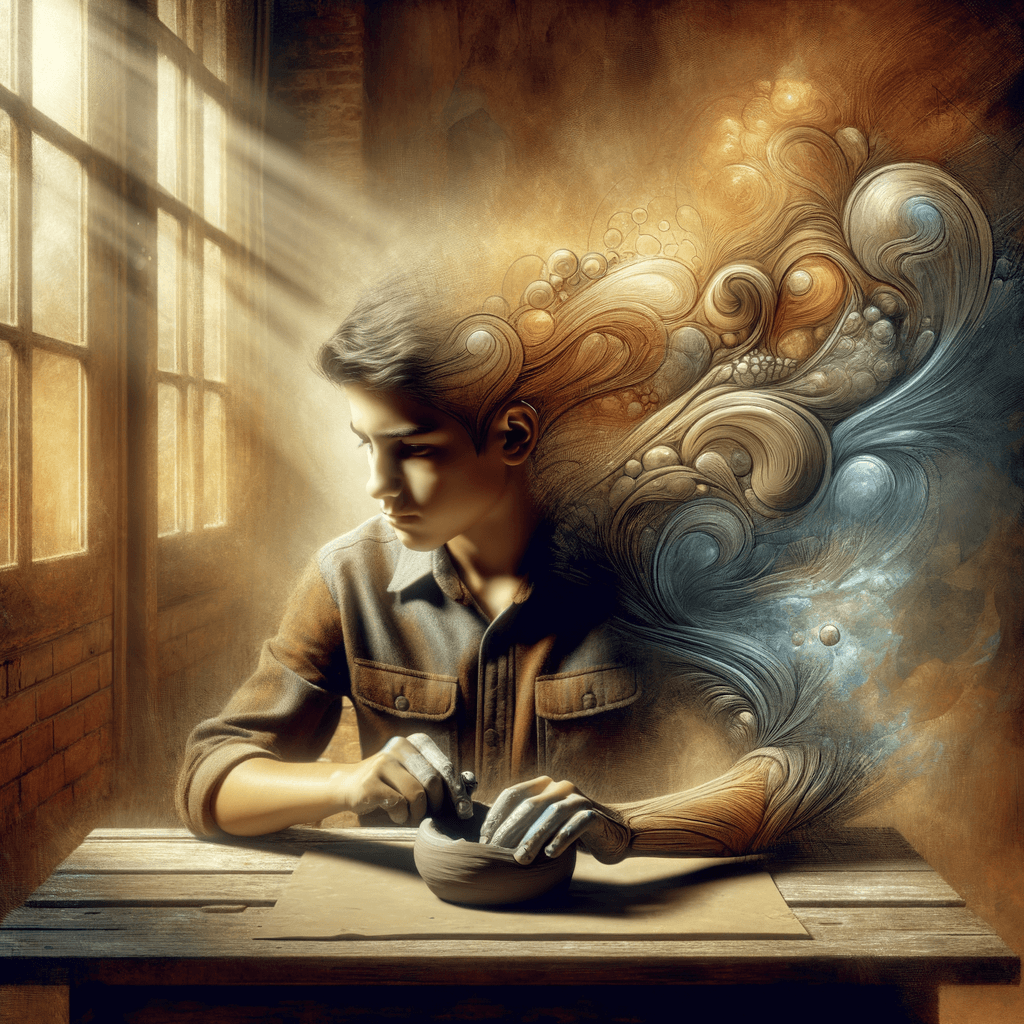
The boy who uses his hands and his head and his heart is an artist. — Louis Nizer
—What lingers after this line?
The Definition of an Artist
This quote broadens the definition of an artist beyond someone who merely creates with their hands. It suggests that true artistry requires not just technical skill but also mental engagement and emotional investment.
Holistic Creativity
To create meaningful work, one must involve their hands for skill, their head for intellect and thought, and their heart for emotion and passion. It emphasizes that creativity comes from a combination of physical effort, intelligence, and emotion.
Integration of Mind and Emotion
The quote stresses the balance between intellect and emotion in artistic expression. An artist must deliberate with their mind but also connect to their emotions and intuitively feel the work they are creating.
Human Potential
It speaks to the potential of every individual to be artistic when they use all parts of themselves—mind, body, and soul. In this sense, artistry is not limited to those with traditional artistic skills but is accessible to anyone who works with purpose, thought, and passion.
Respect for Craftsmanship
The quote underscores that artistry is not confined to famous or professional artists. Even everyday craftsmanship or diligent work can become a form of art if it’s done with skill, thoughtfulness, and heart.
Background of Louis Nizer
Louis Nizer was a notable 20th-century American lawyer and author. He was known for his passion for justice and incisive mind, and this quote reflects his belief in combining intellect and emotion in any type of work.
Recommended Reading
As an Amazon Associate, we earn from qualifying purchases.
One-minute reflection
Where does this idea show up in your life right now?
Related Quotes
6 selectedHe who works with his hands and his head is a craftsman. He who works with his hands and his head and his heart is an artist. — Francis of Assisi
Francis of Assisi
Francis of Assisi draws a graceful line between skill and art by adding one decisive element: the heart. In his view, working with the hands and the head produces competence, discipline, and useful creation—the marks of...
Read full interpretation →Proficiency in a craft is essential to every artist. Therein lies the prime source of creative imagination. — Walter Gropius
Walter Gropius
At first glance, Walter Gropius’s statement may seem to place discipline above inspiration, yet his deeper point is that imagination needs a workable form. An artist who understands materials, structure, and technique ca...
Read full interpretation →The artist is a witness to the present moment, not a slave to the machine that wants to replace it. — bell hooks
bell hooks
At its core, bell hooks’s statement insists that art begins with presence. To be a witness to the present moment is to attend closely to lived reality—its tensions, beauties, wounds, and contradictions—rather than merely...
Read full interpretation →It is not enough to know your craft – you have to have feeling. — Edouard Manet
Edouard Manet
At first glance, Manet’s remark seems simple: skill matters, but skill by itself is incomplete. To know one’s craft is to understand the mechanics—composition, color, timing, form, structure.
Read full interpretation →Craftsmanship is the visible edge of art. — David Bayles
David Bayles
At first glance, David Bayles’s line suggests that craftsmanship is the point where inner vision becomes outward form. Art may begin in imagination, intuition, or feeling, but it only enters the world through skillful ex...
Read full interpretation →The best craftsmanship always leaves holes and gaps... so that something that is not in the poem can creep, crawl, flash or thunder in. — Dylan Thomas
Dylan Thomas
At first glance, Dylan Thomas seems to praise incompleteness, yet his point is more subtle: the finest art is not sealed shut. By leaving “holes and gaps,” a poem makes room for forces beyond the writer’s direct control—...
Read full interpretation →More From Author
More from Louis Nizer →