
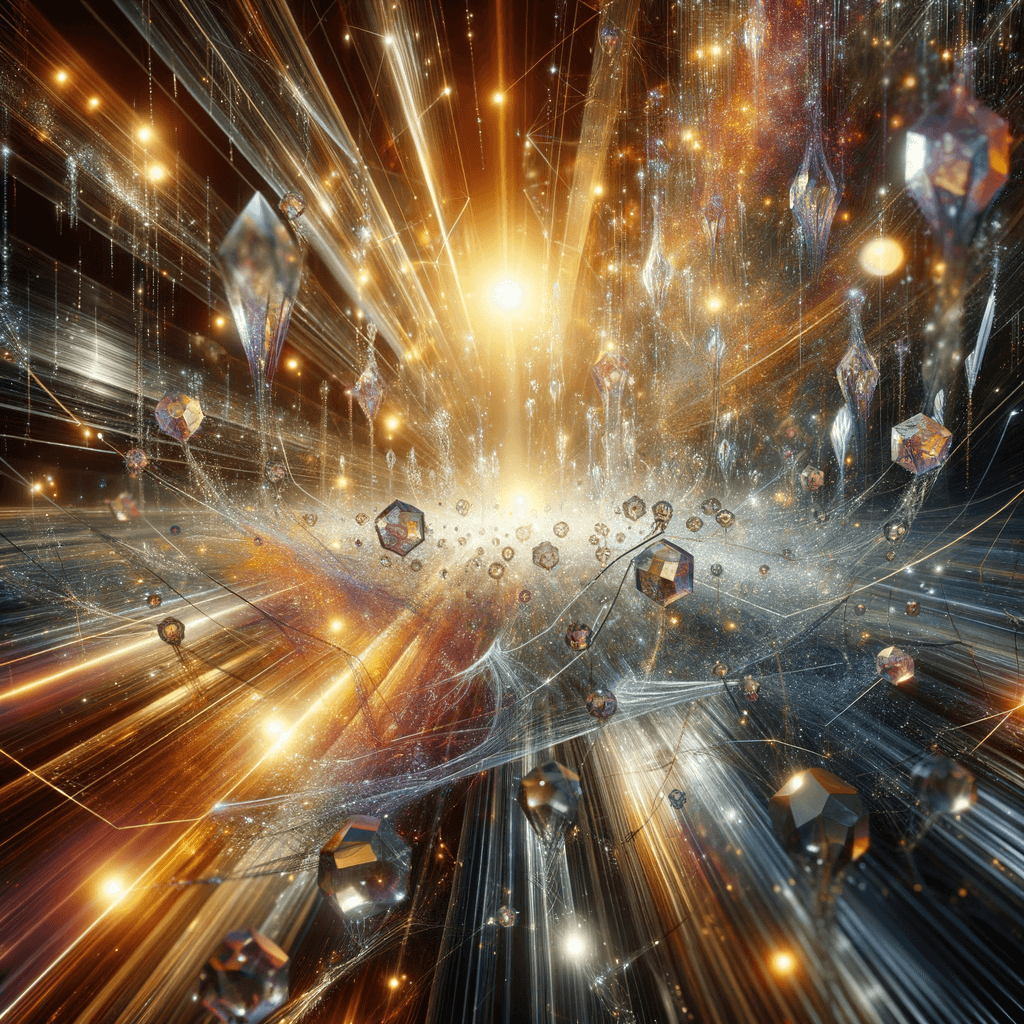
Crystals could be made of rain and gold, yet what we remember is not the crystal; it's the light. — Rainer Maria Rilke
—What lingers after this line?
Transcendence of Light
This quote emphasizes that while physical forms like crystals may appear beautiful, what truly captivates us is the intangible essence they reflect, such as light. The light symbolizes the higher, immaterial qualities that leave a lasting impression.
Focus on the Essence
Rilke suggests that it’s not the material attributes of objects—like the crystal's composition of rain or gold—that linger in our memory, but the immaterial, radiant essence they channel, symbolized by the light.
The Power of Perception
This line highlights our tendency to value experiences and feelings (like seeing the light the crystal refracts) over the mere physical composition of an object.
Symbolism of Light
In many literary traditions, light is a metaphor for enlightenment, truth, and beauty. Rainer Maria Rilke uses this as a way to remind us that it is the intangible qualities of things that truly resonate with the human spirit.
Philosophical Reflection
The quote invites a philosophical reflection on materialism vs. spiritual or immaterial values, prompting us to consider what truly matters in life: the fleeting physical details or the lasting impressions of essence and meaning.
One-minute reflection
Where does this idea show up in your life right now?
Related Quotes
6 selectedTo love beauty is to see light. — Victor Hugo
Victor Hugo
Victor Hugo’s line suggests that beauty is not merely something pleasing to the eye; it is a way of perceiving the world more clearly. To love beauty is to become receptive to illumination, as if the soul gains a new sou...
Read full interpretation →The present changes the past. Looking back you do not find what you left behind. — Kiran Desai
Kiran Desai
At first glance, Desai’s line seems paradoxical, yet it captures a basic truth about human memory: the past is not stored inside us like a sealed archive. Instead, each act of remembering rebuilds events through the lens...
Read full interpretation →The most important milestones are the ones that come to the door of memory unannounced, stray dogs that amble in, sniff around a bit and simply never leave. — Susan B. Anthony
Susan B. Anthony
Susan B. Anthony reframes the idea of a milestone by shifting attention away from public achievements and toward the private moments that linger unexpectedly.
Read full interpretation →If you want to test your memory, try to recall what you were worrying about one year ago. — E. Joseph Cossman
E. Joseph Cossman
E. Joseph Cossman’s remark begins with an almost playful challenge: if you want to test your memory, try recalling what troubled you a year ago.
Read full interpretation →Gratitude is the memory of the heart. — Jean Baptiste Massieu
Jean Baptiste Massieu
Jean Baptiste Massieu’s line transforms gratitude from a simple polite response into something deeper and more enduring. At once, he suggests that the heart keeps its own kind of record, preserving moments of kindness lo...
Read full interpretation →No one should fear shadows. It simply means there's a light shining somewhere nearby. — Gabriel García Márquez
Gabriel García Márquez
Gabriel García Márquez turns a common source of unease into a quiet reassurance: shadows are not threats in themselves, but evidence. When we fear shadows, we often respond to what is vague, enlarged, or half-seen—our mi...
Read full interpretation →More From Author
More from Rainer Maria Rilke →To love is not about merging. It is a noble calling for the individual to ripen, to differentiate, to become a world in oneself in response to another. — Rainer Maria Rilke
At first glance, Rilke challenges one of romance’s most familiar ideals: the desire to ‘become one.’ Instead, he argues that genuine love is not a collapse of boundaries but a deepened encounter between two distinct peop...
Read full interpretation →Everything is blooming most recklessly; if it were voices instead of colors, there would be an unbelievable shrieking into the heart of the night. — Rainer Maria Rilke
At first glance, Rilke turns a peaceful image of blooming nature into something almost overwhelming. Flowers do not merely open; they burst forth “most recklessly,” suggesting a vitality so abundant that it exceeds calm...
Read full interpretation →And now let us believe in a long year that is given to us, new, untouched, full of things that have never been. — Rainer Maria Rilke
Rilke opens by shifting the tone from planning to believing: the year is “given to us,” implying something received rather than conquered. This framing matters because it replaces the pressure of achievement with the hum...
Read full interpretation →The purpose of life is to be defeated by greater and greater things. — Rainer Maria Rilke
Rainer Maria Rilke’s line treats “defeat” not as failure to avoid, but as a destination worth moving toward. The purpose of life, in this view, is measured by what can humble us—truths, beauties, responsibilities, or ide...
Read full interpretation →