
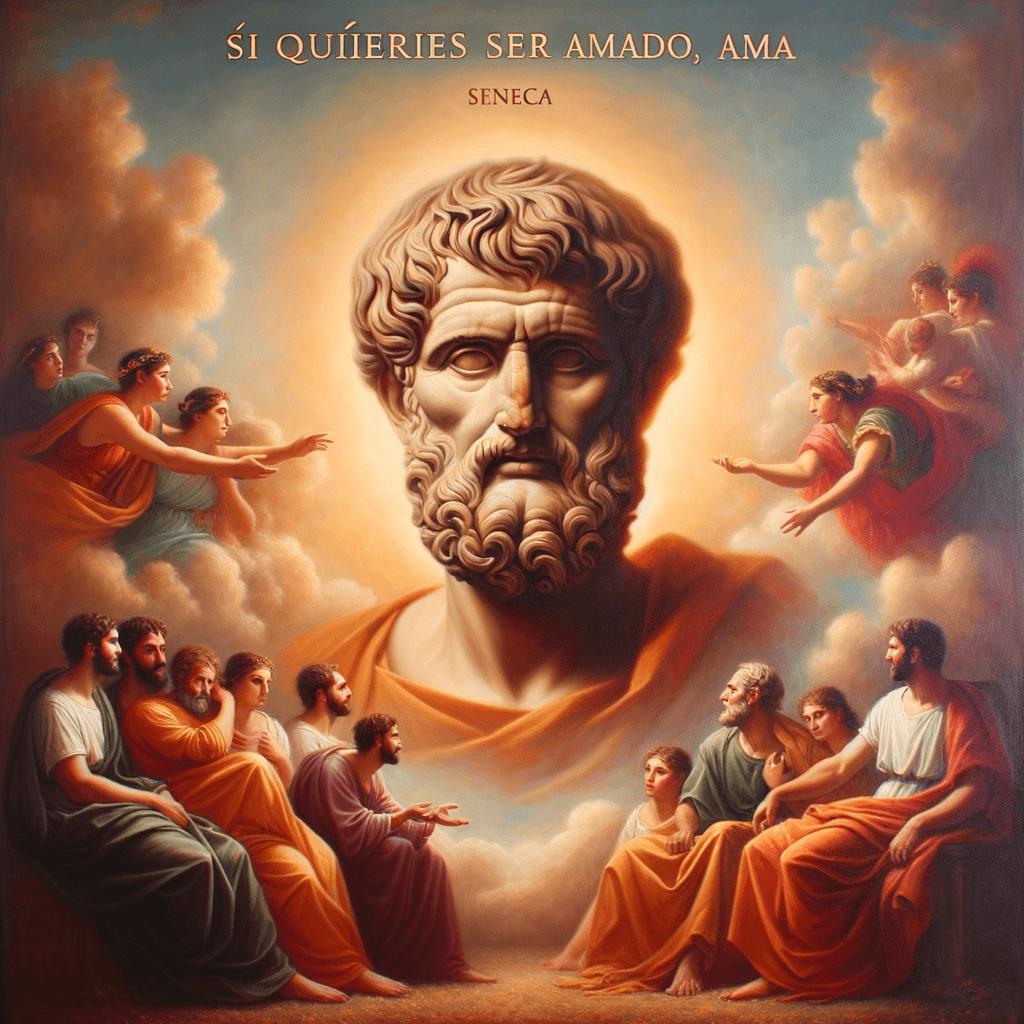
If you want to be loved, love. - Seneca
—What lingers after this line?
Reciprocity in Relationships
This quote highlights the fundamental principle of reciprocity in relationships. To receive love from others, one must first be willing to give love.
Cycle of Kindness
It suggests that love creates a positive feedback loop. By showing love and kindness to others, you encourage them to reciprocate the same feelings and actions towards you.
Initiation of Positive Actions
Seneca emphasizes the importance of taking the initiative. To experience love, one must actively demonstrate love, setting the tone for a mutually affectionate relationship.
Personal Responsibility
The quote underscores the individual's responsibility in fostering relationships. It admonishes people to focus on their own actions as a starting point for building meaningful connections.
Philosophical Context
As a Stoic philosopher, Seneca often wrote about virtues and the importance of inner qualities. This quote reflects his belief in the power of personal virtue (love, in this case) to shape one’s experiences and relationships.
One-minute reflection
Where does this idea show up in your life right now?
Related Quotes
6 selectedWherever there is a human being, there is an opportunity for kindness. — Seneca
Seneca
Seneca’s line distills a core Stoic insight: every encounter offers a moral exercise. Because we share rationality and vulnerability, each person stands as a chance to practice humane action.
Read full interpretation →Where there is no love, put love, and you will draw out love. - Saint John of the Cross
Saint John of the Cross
This quote emphasizes the reciprocative nature of love. By giving love selflessly, even in places where it might be lacking, one can inspire others to respond with love in return.
Read full interpretation →You must love in such a way that the person you love feels free. — Thich Nhat Hanh
Thich Nhat Hanh
At its core, Thich Nhat Hanh’s statement redefines love as an act of care that does not confine. To love someone so that they feel free means offering affection without turning it into control, guilt, or dependence.
Read full interpretation →The sort of fearless openness required to turn toward our suffering is only possible within the spacious receptivity of love. — Frank Ostaseski
Frank Ostaseski
Frank Ostaseski’s statement begins with a striking claim: real courage is not simply toughness or willpower. Instead, the bravery required to face suffering honestly arises from love’s presence.
Read full interpretation →Healing is an art. It takes time, it takes practice, it takes love. — Maza Dohta
Maza Dohta
Maza Dohta’s quote begins by reframing healing as an art rather than a mechanical repair. That distinction matters, because art is rarely instant: it involves sensitivity, patience, revision, and care.
Read full interpretation →The only way to exist in a world that feels increasingly cold is to be the warmth you wish to receive from others. — Maya Angelou
Maya Angelou
At its core, Maya Angelou’s line reframes loneliness as a call to action rather than a verdict on the world. If life feels impersonal, distant, or harsh, she suggests that waiting passively for kindness may only deepen t...
Read full interpretation →More From Author
More from Seneca →The heart is great which shows moderation in the midst of prosperity. — Seneca
Seneca’s observation begins with a quiet but demanding standard: true greatness is not proven by success itself, but by restraint when success arrives. Prosperity can enlarge appetites, inflate pride, and make excess app...
Read full interpretation →Whatever you are doing, do it with a sense of purpose, not merely to pass the time. — Seneca
Seneca’s counsel begins with a simple but demanding idea: life should not be treated as something to be spent carelessly. For the Stoics, time was not a disposable background to action but the very material of character.
Read full interpretation →The strongest person controls the self, not others. — Seneca
Seneca’s statement turns the usual idea of power inside out. Instead of praising the person who dominates rivals, commands attention, or bends others to their will, he locates real strength in self-command.
Read full interpretation →Quiet people are not empty; they are contained. Their power does not seek attention—it waits. — Seneca
At first glance, Seneca’s line overturns a common social assumption: that quietness signals absence, weakness, or lack of thought. Instead, he frames silence as containment, suggesting that some people hold their ideas,...
Read full interpretation →