
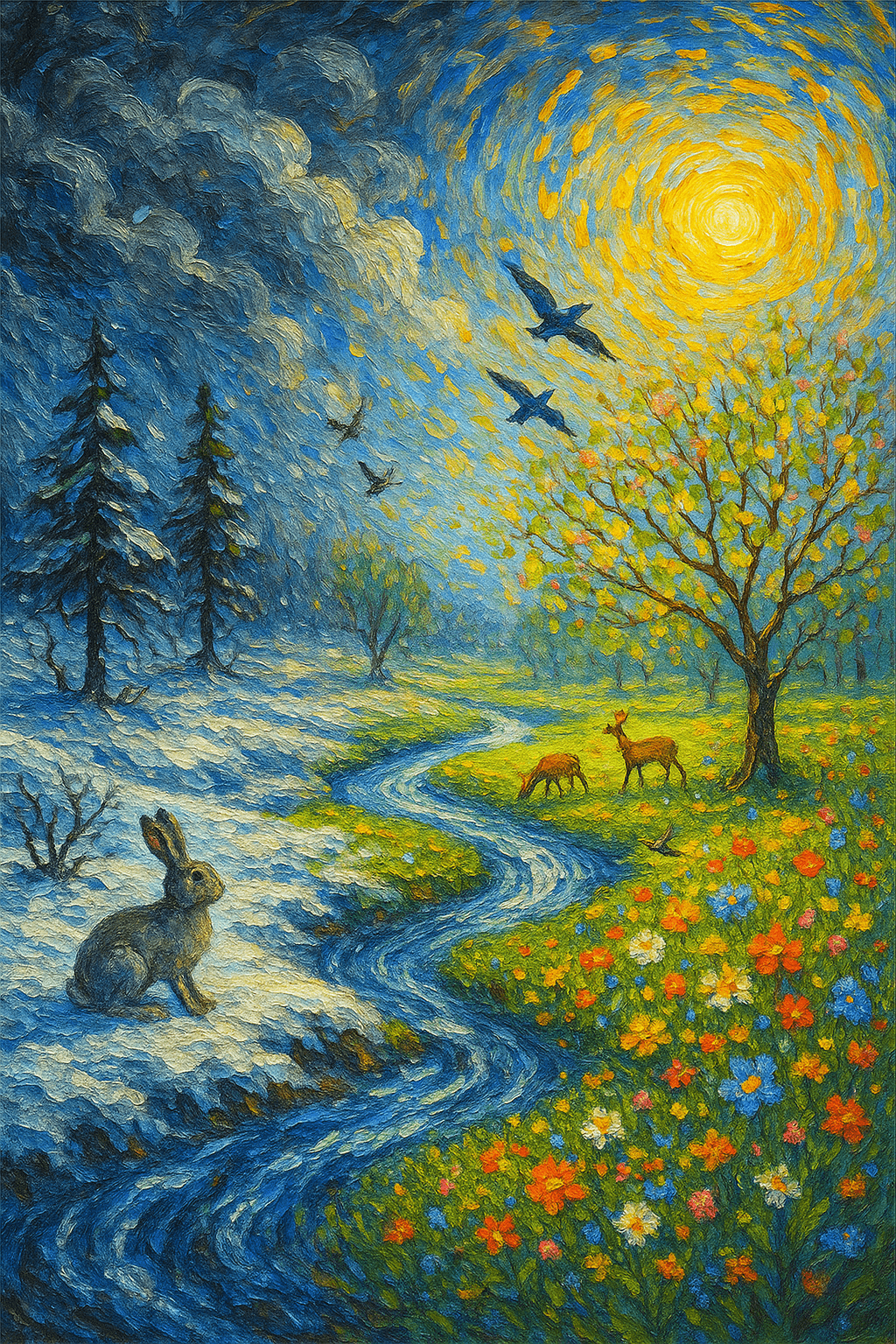
Do not quench your inspiration and your imagination; do not become the slave of your model. — Vincent Van Gogh
—What lingers after this line?
The Spark of Inspiration
Vincent Van Gogh urges artists and thinkers to preserve the flame of their inner inspiration. He cautions against allowing external pressures or self-doubt to extinguish originality. Throughout history, the great leaps in art and science have come from moments when individuals dared to follow their unique visions, even when these visions defied prevailing norms.
Imagination as the Wellspring of Innovation
Building on inspiration, imagination is the fertile ground where new ideas germinate. Van Gogh’s own paintings—like the swirling skies of ‘Starry Night’—demonstrate how imagination can transform the ordinary into the extraordinary. He implies that clinging too tightly to rules or examples leaves little room for the bold experimentation that pushes boundaries.
Dangers of Imitation and Conformity
Importantly, Van Gogh warns against becoming a ‘slave of your model.’ In art education and beyond, there is a risk that over-reliance on imitation stifles individuality. Consider how Renaissance apprentice painters initially copied masters before developing their distinct styles. Remaining a perpetual imitator, however, leads to stagnation, as seen in periods of artistic or cultural decline.
Finding Balance: Learning and Originality
Yet, while models and mentors provide invaluable lessons, true creativity requires transcending them. The journey of Pablo Picasso, for example, illustrates this balance. He mastered classical techniques as a young artist but later shattered conventions with Cubism. His evolution affirms Van Gogh’s belief that lasting impact comes from fusing learned skill with personal vision.
Embracing Risk on the Creative Path
In conclusion, Van Gogh’s advice celebrates risk-taking and vulnerability in the pursuit of authentic expression. Pioneers in any discipline must resist complacency and have the courage to let inspiration guide them, no matter the uncertainty. As Van Gogh’s own legacy shows, it is the refusal to be bound by precedent that allows new worlds of beauty and thought to emerge.
One-minute reflection
Where does this idea show up in your life right now?
Related Quotes
6 selected"I dream my painting and I paint my dream." — Vincent van Gogh
Vincent van Gogh
At first glance, van Gogh’s line fuses intention with action: imagination drafts the plan, and the hand ratifies it on canvas. The saying proposes a circular vow—what he envisions, he renders; what he renders, he then re...
Read full interpretation →Your imagination is the blueprint of your success; dare to design a life that reflects your wildest aspirations and dreams. — Unknown, Global.
Unknown, Global.
This quote emphasizes that imagination is a powerful force that shapes our future. It suggests that our thoughts and creative visions are the foundational elements that can lead to success.
Read full interpretation →Anxiety is just the imagination working overtime, and most of that overtime is completely unpaid. — Alain de Botton
Alain de Botton
At first glance, Alain de Botton’s remark frames anxiety with disarming humor: the mind behaves like an overworked employee, generating scenarios, rehearsing disasters, and collecting no reward for the effort. By calling...
Read full interpretation →Creativity is not the finding of a thing, but the making something out of it after it is found. — James Russell Lowell
James Lowell
James Russell Lowell’s line shifts attention away from the romantic myth of the sudden genius who invents from nothing. Instead, he argues that creativity truly begins after the initial encounter—after an idea, object, p...
Read full interpretation →In art, the hand can never execute anything higher than the heart can imagine. — Ralph Waldo Emerson
Ralph Waldo Emerson
Emerson’s line shifts attention from technique to inner vision. At first glance, he seems to be speaking about painting or sculpture, yet his deeper claim is that craftsmanship cannot surpass the emotional and imaginativ...
Read full interpretation →It is the main earthly business of a human being to make his home, and the immediate surroundings of his home, as symbolic and significant to his own imagination as he can. — G. K. Chesterton
G. K. Chesterton
Chesterton begins with a striking claim: making a home is not a secondary chore but one of our central earthly tasks. By calling it our “main earthly business,” he elevates domestic life into something almost moral and a...
Read full interpretation →More From Author
More from Vincent van Gogh →Learning technique is a way to make your soul grow. So do it. — Vincent van Gogh
Van Gogh’s brief statement turns learning into more than a practical task; it becomes an ethical and spiritual imperative. By saying that learning technique helps the soul grow, he suggests that disciplined study does no...
Read full interpretation →A great fire burns within me, but no one stops to warm themselves at it, and passers-by only see a wisp of smoke. — Vincent van Gogh
Van Gogh’s image begins with a painful contrast: immense inner warmth exists, yet it goes unreceived. The “great fire” suggests passion, generosity, and creative force, while the absence of anyone who “stops to warm them...
Read full interpretation →I cannot rest, I must draw, however poor the result, and when I have a bad time come over me it is a stronger desire than ever. — Vincent van Gogh
Van Gogh’s words present drawing not as a hobby or even a disciplined profession, but as an inner command he cannot silence. The phrase “I must draw” carries the force of survival, suggesting that artistic creation answe...
Read full interpretation →As we advance in life it becomes more and more difficult, but in fighting the difficulties the inmost strength of the heart is developed. — Vincent van Gogh
Van Gogh’s sentence begins with a sober observation: life does not necessarily become simpler as we grow older. Instead, responsibilities deepen, losses accumulate, and choices carry heavier consequences.
Read full interpretation →