
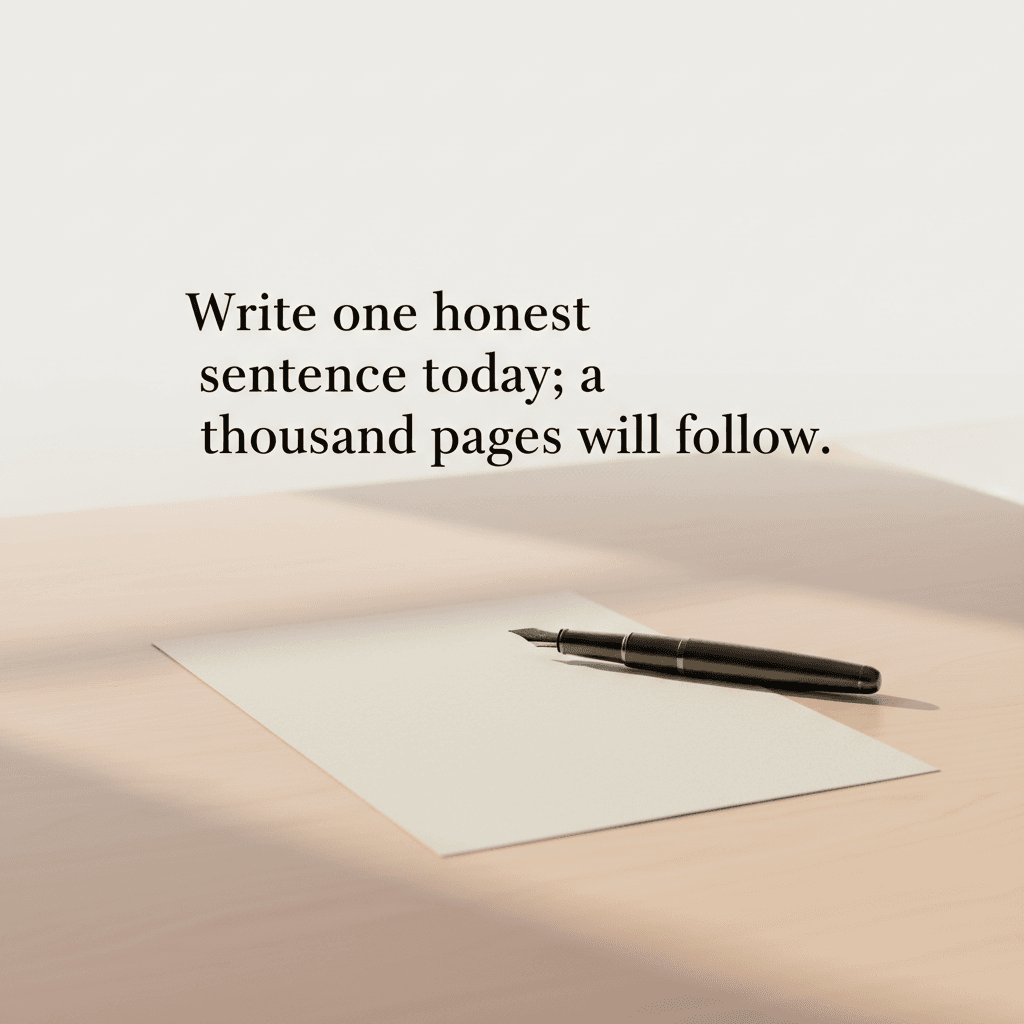
Write one honest sentence today; a thousand pages will follow — Nayyirah Waheed
—What lingers after this line?
The Courage of a Single True Line
Nayyirah Waheed’s quote centers on a deceptively simple act: writing one honest sentence. Rather than demanding brilliance, length, or perfection, it asks only for truth. This shifts the focus from output to integrity, implying that the hardest part of any creative work is not filling pages but daring to be sincere. Just as Hemingway spoke of writing “one true sentence,” Waheed underscores that authenticity is the true catalyst; once a writer commits to saying something real, the rest of the work can begin to unfold.
Honesty as an Antidote to Perfectionism
Seen in this light, the quote directly confronts perfectionism and fear. Many writers stall at the blank page, haunted by the idea that every word must be extraordinary. Waheed offers a different standard: honesty instead of flawlessness. This reframing loosens the grip of self-criticism, making the first step smaller and more humane. By lowering the bar from “a masterpiece” to “a true sentence,” the writer gains permission to move, and movement, however modest, gradually disarms the paralysis that perfectionism creates.
How One Line Opens Emotional Floodgates
Once honesty appears on the page, it rarely arrives alone. A single candid line often exposes a feeling, memory, or question that demands further expression. In this sense, Waheed’s “thousand pages” are not just a measure of length but of depth: one truth leads naturally to related truths. Memoirists frequently report that naming one difficult experience unlocks others, much as opening a single door reveals an entire hallway beyond it. Thus, the first sentence is not a fragment but a key that turns in a larger lock.
Creativity as a Chain Reaction of Truth
The quote also suggests that creativity unfolds incrementally, as a chain reaction rather than a single explosion of inspiration. When the first honest sentence appears, it sets off a sequence of connections in the mind: images, memories, and insights begin to link together. Artists from Virginia Woolf to Ocean Vuong describe how one clear insight often pulls the next into view. Waheed’s image of “a thousand pages” captures this cumulative process, where consistency and sincerity slowly build a body of work that could never have been planned in full from the outset.
A Daily Practice of Showing Up Truthfully
By anchoring the advice in “today,” Waheed emphasizes frequency over intensity. The quote is less about a single breakthrough and more about a daily practice of showing up with honesty, however small. Over weeks and years, that habit can generate a surprising volume of work, much as keeping a brief, candid journal can eventually fill stacks of notebooks. In this way, the sentence becomes both an invitation and a discipline: if you can write one honest line today, you can likely do it again tomorrow, and those accumulated days are where the promised thousand pages are born.
One-minute reflection
What does this quote ask you to notice today?
Related Quotes
6 selectedThere is a quiet power in the ability to simply be, to exist without the need for constant performance. — Eileen Caddy
Eileen Caddy
Eileen Caddy’s words begin with a gentle challenge to modern restlessness: we often feel compelled to prove our worth through productivity, charm, achievement, or constant visibility. Yet her phrase “quiet power” suggest...
Read full interpretation →Be who you are and say what you feel, because those who mind don't matter, and those who matter don't mind. — Bernard M. Baruch
Bernard M. Baruch
Baruch’s quote begins with a simple but demanding instruction: be yourself and speak honestly. At its core, the line argues that authenticity is not merely a personality trait but an act of courage, especially in a world...
Read full interpretation →You're born an original—don't die a copy. — John Mason
John Mason
At its core, John Mason’s line is a sharp reminder that every person begins life with a distinct combination of temperament, talent, and perspective. To be “born an original” suggests that individuality is not something...
Read full interpretation →Authenticity is a habit. It is a road we are comfortable with. — Ai Weiwei
Ai Weiwei
At first glance, Ai Weiwei’s statement shifts authenticity away from dramatic self-revelation and toward repetition. By calling it a habit, he suggests that being genuine is not an occasional act of courage but a pattern...
Read full interpretation →If you want to be a writer, you must write every day. It is the only way to master your craft. — Stephen King
Stephen King
Stephen King’s statement strips writing down to its most practical truth: mastery begins with repetition, not occasional brilliance. In this view, the aspiring writer cannot wait for inspiration to arrive like a rare gue...
Read full interpretation →Quietly persist. The world is loud, but your work only needs to be true. — Anne Lamott
Anne Lamott
Anne Lamott’s line begins with a simple imperative: “Quietly persist.” At once, it rejects the idea that meaningful work must announce itself to be real. Instead, she points toward a steadier form of effort, one rooted i...
Read full interpretation →More From Author
More from Nayyirah Waheed →Trust your personal inventory. How you feel about something is a fact. — Nayyirah Waheed
Nayyirah Waheed’s line begins with a gentle but radical instruction: treat your “personal inventory” as real information, not noise. In a culture that often privileges external proof—grades, metrics, witnesses—she points...
Read full interpretation →Be softer with you. You are a breathing thing. A memory to someone. A gold mine to yourself. — Nayyirah Waheed
Waheed opens with a deceptively simple instruction—“Be softer with you”—that reframes self-talk as an ethical act. Rather than treating harshness as discipline, she suggests softness can be a deliberate practice, like lo...
Read full interpretation →i am my own sanctuary. — Nayyirah Waheed
Nayyirah Waheed’s line distills a radical kind of safety: the idea that refuge is not primarily a place, but a relationship with oneself. A sanctuary is where you can lower your guard, where your inner life is not judged...
Read full interpretation →be easy. take your time. you are coming home to yourself. — Nayyirah Waheed
Nayyirah Waheed’s line reads like guidance offered in a low voice: “be easy. take your time.” Rather than pushing for dramatic change, it reframes growth as something that can unfold without force.
Read full interpretation →