
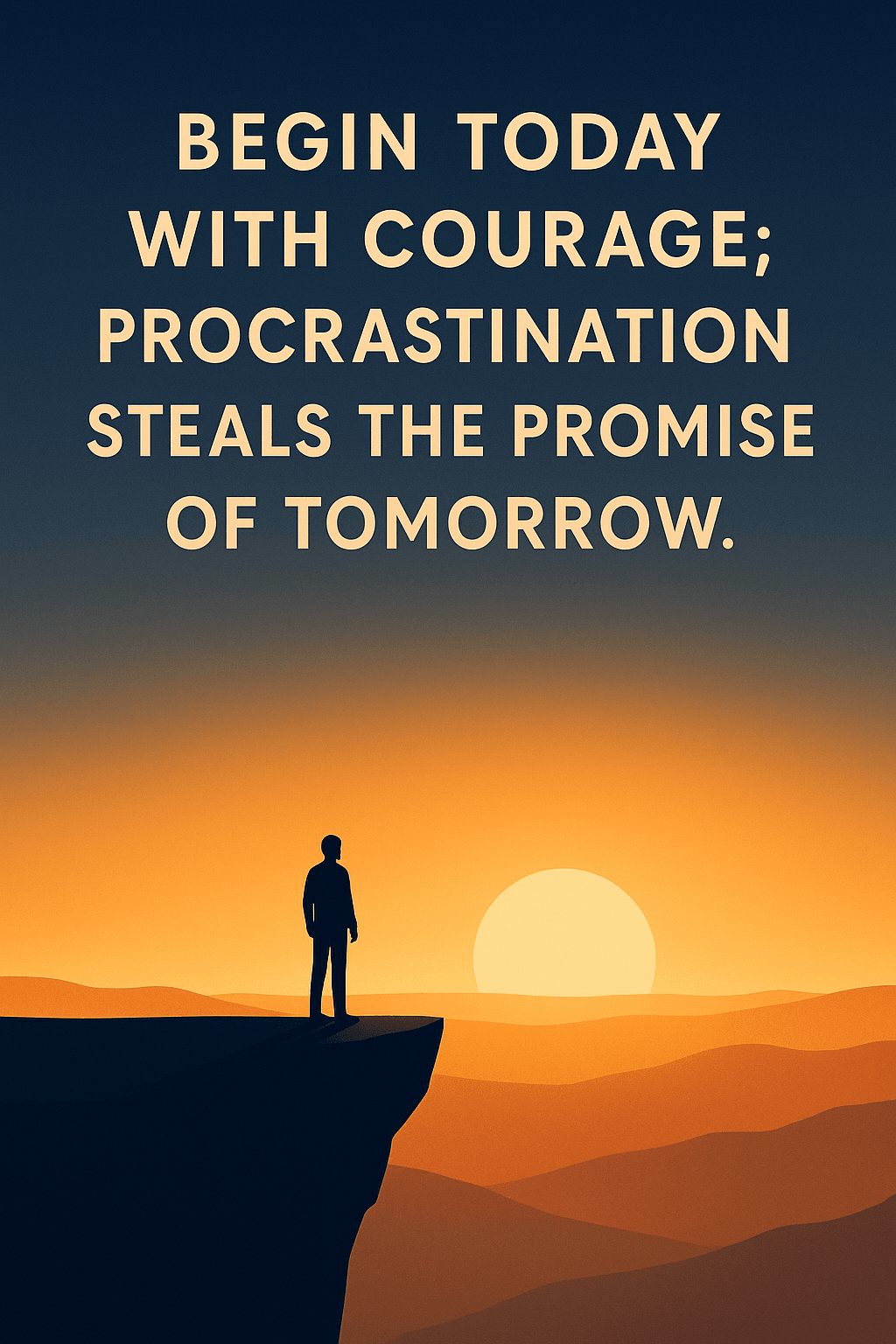
Begin today with courage; procrastination steals the promise of tomorrow — Seneca
—What lingers after this line?
Seneca’s Warning About Lost Tomorrows
Seneca’s injunction to “begin today with courage” captures a core Stoic insight: the future is shaped, and often stolen, by what we fail to do in the present. When he says procrastination “steals the promise of tomorrow,” he is not speaking only of missed deadlines, but of wasted potential. In his letters, especially in *On the Shortness of Life* (c. 49 AD), Seneca argues that life feels short not because we have too little time, but because we squander the time we have. Thus, this quote frames delay not as a harmless habit but as a quiet thief that robs us of the life we might have lived.
Courage as the Antidote to Delay
To understand why courage is placed at the beginning of the sentence, we must see procrastination as a form of fear. We delay difficult conversations, ambitious projects, and necessary changes because they expose us to judgment, failure, or discomfort. By contrast, courage does not eliminate fear; it enables us to act alongside it. The Stoics believed that virtue is revealed in action, not intention, so choosing to start—even imperfectly—becomes a moral act. In this way, courage is not only heroic defiance in crises, but also the quiet decision to write the first page, make the first call, or take the first step today.
The Psychology Behind Procrastination’s Theft
Modern psychology reinforces Seneca’s intuition by describing procrastination as an “emotion regulation problem” rather than a mere time-management flaw. Studies by Piers Steel (*The Procrastination Equation*, 2010) show that we delay tasks that trigger anxiety, boredom, or self-doubt, trading long-term benefits for short-term relief. This emotional bargain makes tomorrow look generous and today unbearably tight, encouraging the illusion that there will always be more time later. Yet, as Seneca would insist, each postponed effort compounds into a future loss—of options, competence, and confidence—quietly eroding the promise that tomorrow once held.
Time, Ownership, and the Stoic Present
For Seneca, the only time we truly own is the present moment. Past time is irretrievable, and future time is uncertain; therefore, to give today away to hesitation is to gamble with the only coin we definitely possess. In *On the Shortness of Life*, he criticizes those who guard their money but freely spend their hours on trivialities, implying that procrastination is a kind of spiritual negligence. By beginning today with courage, we reclaim ownership of our schedule and, more importantly, of our character. Each decisive action affirms that we are stewards—not victims—of our allotted time.
Practical Ways to Begin with Courage
Translating this philosophy into daily practice means reducing the distance between intention and action. One practical approach is to identify a single meaningful task and commit to just five minutes of courageous effort, lowering the emotional barrier to starting. Another is to ask, in Seneca’s spirit, “If today were all I had, what would deserve my energy?” This question shifts focus from vague future hopes to concrete present choices. Over time, small acts of timely bravery—sending the application, initiating reconciliation, starting the routine—accumulate into a life where tomorrow’s promise is preserved rather than plundered by delay.
Redefining Success as Timely Action
Ultimately, Seneca invites us to redefine success not as grand achievement, but as the willingness to act when action is called for. While outcomes are never fully in our control, the decision to start today always is. By measuring ourselves by our readiness to take the next right step, we weaken procrastination’s grip and strengthen our sense of agency. In this light, every courageous beginning—no matter how modest—becomes a quiet victory over the theft of time, ensuring that tomorrow remains a field of possibility rather than a cemetery of postponed intentions.
One-minute reflection
Why might this line matter today, not tomorrow?
Related Quotes
6 selectedGrow courage by practicing small choices that favor your better self — Seneca
Seneca
At the outset, Seneca’s counsel frames courage not as a thunderclap but as an accretion: the result of many minor decisions that, taken together, lean toward one’s better self. Instead of waiting for heroic moments, he s...
Read full interpretation →We grow taller by stretching toward what scares us. — Seneca
Seneca
Seneca’s line suggests growth happens at the edge of fear. In Stoic practice, adversity is not an enemy but a training partner.
Read full interpretation →When I tell my kids I will do something in a minute, what I'm really saying is: Please forget. — Karen Salmansohn
Karen Salmansohn
Karen Salmansohn’s line turns an ordinary parental phrase into a small confession. When a parent says, “in a minute,” the words sound like a promise, but the hidden hope is that the child’s request will quietly vanish.
Read full interpretation →To be courageous is to act with the heart. — Molière
Molière
Molière’s line suggests that courage is not merely the absence of fear, but the decision to move despite it. By connecting courage with the heart, he frames bravery as an emotional and moral act rather than a simple disp...
Read full interpretation →People say nothing is impossible, but I do nothing every day. — A.A. Milne
A. A. Milne
At first glance, A.A. Milne’s line turns a familiar motivational slogan inside out.
Read full interpretation →The best people possess a feeling for beauty, the courage to take risks, the discipline to tell the truth, the capacity for sacrifice. — Ernest Hemingway
Ernest Hemingway
Hemingway’s line presents goodness not as politeness or success, but as a demanding inner code. The “best people” are those who combine sensitivity, bravery, honesty, and self-denial—qualities that do not always coexist...
Read full interpretation →More From Author
More from Seneca →Whatever you are doing, do it with a sense of purpose, not merely to pass the time. — Seneca
Seneca’s counsel begins with a simple but demanding idea: life should not be treated as something to be spent carelessly. For the Stoics, time was not a disposable background to action but the very material of character.
Read full interpretation →The strongest person controls the self, not others. — Seneca
Seneca’s statement turns the usual idea of power inside out. Instead of praising the person who dominates rivals, commands attention, or bends others to their will, he locates real strength in self-command.
Read full interpretation →Quiet people are not empty; they are contained. Their power does not seek attention—it waits. — Seneca
At first glance, Seneca’s line overturns a common social assumption: that quietness signals absence, weakness, or lack of thought. Instead, he frames silence as containment, suggesting that some people hold their ideas,...
Read full interpretation →Our plans miscarry because they have no aim. When a man doesn't know what harbor he's making for, no wind is the right wind. — Seneca
Seneca’s remark begins with a simple but severe diagnosis: plans fail not merely from bad luck, but from the absence of a clear aim. In his view, activity alone is not progress.
Read full interpretation →