
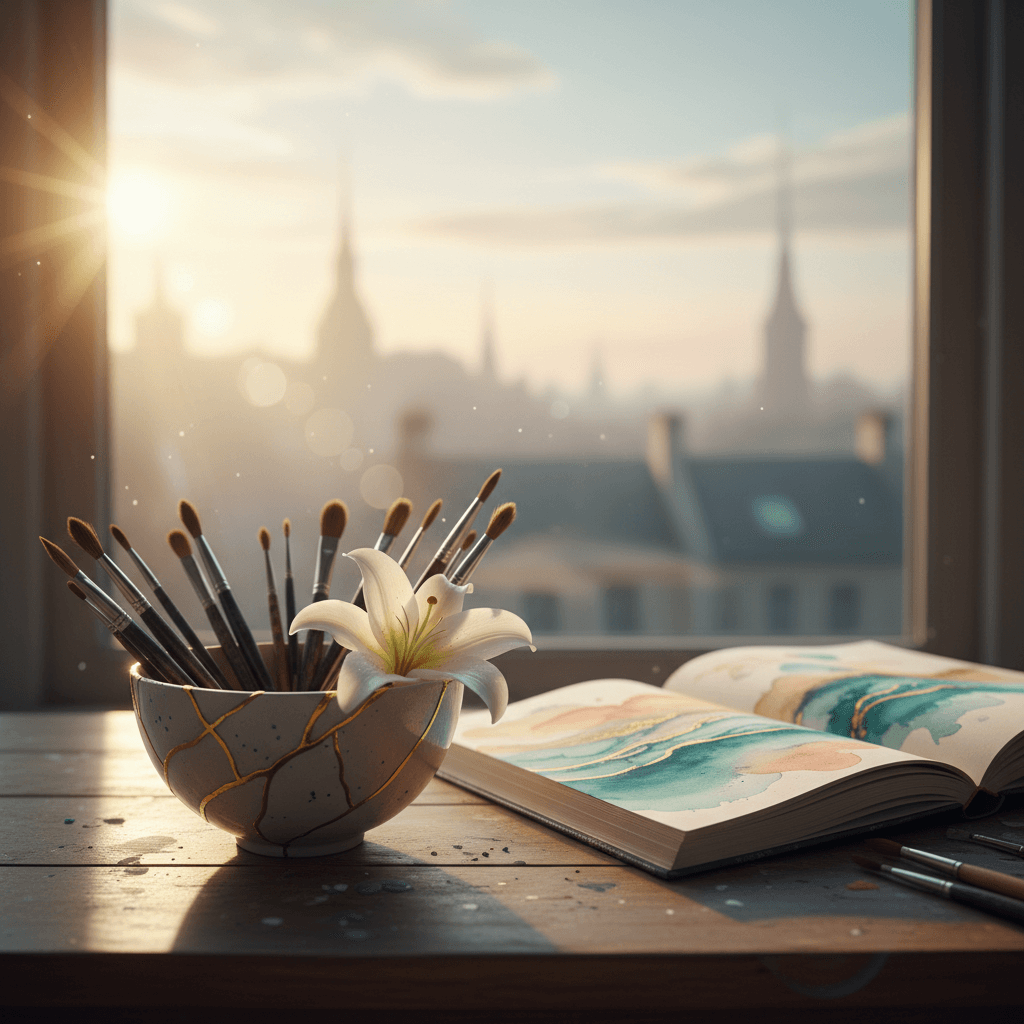
Create from the wound, not in spite of it, and your art will heal others. — Kahlil Gibran
—What lingers after this line?
The Wound as Creative Origin
Gibran’s line reframes suffering as a starting point rather than an obstacle. To “create from the wound” suggests that the raw material of art is not a polished life but an honest one—where loss, shame, grief, or longing become sources of meaning. Instead of waiting to be “over it,” the artist enters the experience and translates it into image, story, rhythm, or form. From this perspective, the wound is not romanticized; it is acknowledged as real, sometimes ongoing. Yet it can still yield insight, because art has the capacity to hold complexity without forcing quick closure. In that holding, creation becomes an act of witness—first for the self, and then for others.
From Confession to Connection
Once the wound is admitted, the next step is transformation: private pain becomes shareable language. This is where healing begins to extend outward, because an audience often recognizes itself in the artist’s specificity. Paradoxically, the more truthful the detail, the more universal the effect, and the viewer or reader feels less isolated in their own inner life. A useful parallel appears in Aristotle’s Poetics (c. 335 BC), which describes tragedy as producing catharsis—an emotional clearing through fear and pity. Gibran’s idea aligns with that arc: art does not erase sorrow, but it can metabolize it into clarity, release, or a renewed capacity to feel.
The Difference Between Using Pain and Exploiting It
However, creating from the wound is not the same as displaying pain for spectacle. The distinction lies in intention and craft: the artist seeks meaning, not merely attention; understanding, not only confession. A poem written in the heat of anguish might be necessary, but shaping it—choosing structure, pacing, and image—turns it into something that can actually carry another person. This is why “not in spite of it” matters. It warns against sanitizing the wound to appear strong, but it also cautions against making suffering a brand. In the middle ground, art remains sincere while also becoming responsible—an offering rather than a performance.
Why Honest Art Can Feel Like Medicine
As the work becomes coherent, it starts to function like a mirror and a map at once. A viewer may not share the artist’s exact experience, but they recognize the emotional logic—betrayal, yearning, dread, relief—and that recognition can soften self-judgment. In this way, art “heals others” not by providing cures but by granting permission to feel what has been hidden. Modern psychology echoes this mechanism through expressive writing research: James W. Pennebaker’s studies beginning in the 1980s found that structured emotional disclosure can improve well-being for many people. While art is broader than a lab protocol, the overlap is striking: naming pain, shaping it, and revisiting it with meaning can change how it lives in the body and mind.
The Artist’s Vulnerability as a Form of Leadership
Gibran also implies a quiet ethic: when artists tell the truth about their wounds, they model courage. This kind of vulnerability is not passivity; it is an act of leadership that invites others to examine their own lives with less fear. The artist becomes someone who goes first, showing that brokenness can coexist with dignity. Over time, this influence can ripple beyond individuals into communities. Songs that articulate collective grief after disaster, murals that honor marginalized histories, or novels that give voice to silenced experiences all demonstrate how personal wounds can expand into social empathy. The healing, then, is both intimate and communal.
Turning Pain Into Craft, Not Just Memory
Finally, the quote points toward a practice: return to the wound with patience, not to relive it endlessly, but to refine what it teaches. As craft grows—through revision, feedback, and distance—the work becomes less about the artist’s injury and more about the human condition it reveals. That shift is often when the piece becomes most helpful to others. In the end, Gibran’s promise is not that suffering is good, but that it can be alchemized. When art emerges from the wound with honesty and form, it offers companionship to strangers, and that companionship—felt in a line, a melody, a scene—can be a genuine kind of healing.
One-minute reflection
Where does this idea show up in your life right now?
Related Quotes
6 selectedBuild beauty from your truths and let the world be your witness. — Kahlil Gibran
Kahlil Gibran
At the outset, Gibran’s imperative urges creation that begins within: beauty is not pasted on but grown from the grain of one’s own truth. In The Prophet (1923), he writes that work is love made visible, implying that ho...
Read full interpretation →Paint your life with the colors of conviction. — Kahlil Gibran
Kahlil Gibran
At the outset, Gibran’s invitation to “paint your life” transforms artful imagery into an ethical directive: choose your colors—your convictions—deliberately. His lines often fuse beauty with duty; in The Prophet (1923)...
Read full interpretation →There is no must in art because art is free. — Wassily Kandinsky
Wassily Kandinsky
At its core, Kandinsky’s statement rejects the idea that art must obey fixed obligations. By saying there is no ‘must’ in art, he frees creation from rigid formulas, academic demands, and social expectation.
Read full interpretation →Often what the artist expresses is unconscious, but we can learn to decode the story by collaboratively finding the pieces to the puzzle that create new possibilities for innovation. — Ben Okri
Ben Okri
At the heart of Ben Okri’s statement is the idea that art often says more than the artist consciously intends. A poem, painting, or song may carry hidden fears, cultural memories, or emotional truths that emerge without...
Read full interpretation →I think that when you create something, you leave a part of yourself in it. — Henri Matisse
Henri Matisse
At its core, Matisse’s reflection suggests that making anything—a painting, a poem, a song, even a room—inevitably transfers something inward into outward form. Creation is not merely the arrangement of materials; rather...
Read full interpretation →There is a deep peace that comes from creating something that didn't exist before. It is your way of telling the universe that you were here, and you felt something. — Maya Angelou
Maya Angelou
At its heart, Maya Angelou’s reflection suggests that creation is not merely productive but restorative. To make something that did not exist before—a poem, a garden, a melody, even a repaired room—is to experience a rar...
Read full interpretation →More From Author
More from Kahlil Gibran →Your home is your larger body. It grows in the sun and sleeps in the stillness of the night. — Kahlil Gibran
At first glance, Gibran transforms the idea of home from a mere structure into something intimate and organic: “your larger body.” In this image, a dwelling is not separate from the person who inhabits it, but an outward...
Read full interpretation →March on. Do not tarry. To go forward is to move toward perfection. — Kahlil Gibran
Gibran’s opening imperative—“March on. Do not tarry.”—sets a tone of disciplined urgency.
Read full interpretation →There must be spaces in your togetherness, and let the winds of the heavens dance between you. — Kahlil Gibran
Gibran’s line opens with a gentle paradox: he speaks to people who are already “together,” yet insists that togetherness is healthiest when it includes room. Rather than portraying love as fusion, he frames it as a relat...
Read full interpretation →Our anxiety does not come from thinking about the future, but from wanting to control it. — Kahlil Gibran
Kahlil Gibran reframes anxiety as something more specific than mere anticipation. The future itself—uncertain, unfolding, and not yet real—doesn’t automatically distress us; rather, distress appears when we demand certai...
Read full interpretation →