
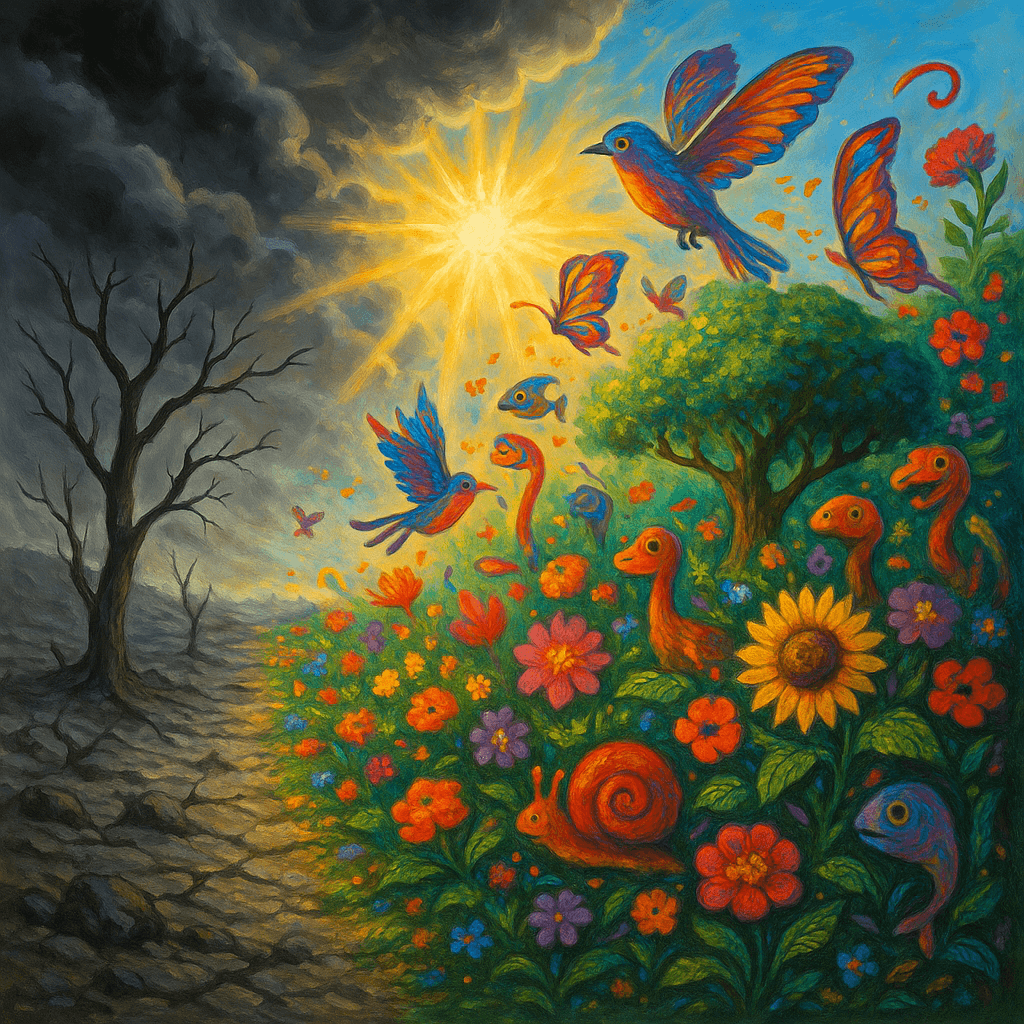
Creativity is the greatest rebellion in existence. — Osho
—What lingers after this line?
Defining Creativity and Its Subversive Power
Osho’s claim frames creativity as inherently rebellious, setting the stage for a reexamination of its role in personal and cultural development. Creativity, in its essence, involves the birth of something new—a thought, an artwork, a way of seeing the world. This newness challenges the status quo, subtly or overtly defying the limits imposed by tradition and expectation.
Historical Movements Driven by Creative Defiance
Looking back, creativity has often been the driving force behind history’s most significant turning points. For example, the Renaissance exploded established medieval worldviews, ushering in art and ideas that contradicted centuries of orthodoxy. Leonardo da Vinci’s notebooks, brimming with inventions and anatomical sketches, stand as silent testaments to the power of imagination to undermine accepted truths and inspire progress.
Art as Resistance and Transformation
Artistic expression, in particular, frequently assumes the mantle of rebellion. From Picasso’s ‘Guernica,’ a searing anti-war statement, to the clandestine poetry of dissidents in Soviet Russia, art challenges silence and conformity. Such acts of creation not only resist oppression but also radically envision alternative realities, highlighting Osho’s assertion that creativity and rebellion walk hand in hand.
Creativity in Everyday Life: Small Acts of Liberation
Yet, the spirit of creative rebellion need not be confined to grand historical moments. In daily life, people break free from restrictive routines through small innovations—finding new solutions at work, cooking inventive meals, or educating children in unconventional ways. These micro-rebellions refresh and renew, subtly defying the inertia of habit and institutional authority.
Towards a Culture That Embraces Creative Dissent
Ultimately, societies flourish when they nurture rather than stifle this rebellious creativity. Educational reformers like Sir Ken Robinson argue that fostering creativity in classrooms is vital for progress and well-being. Embracing this ethos, individuals and communities unlock their potential for transformation, echoing Osho’s vision: true rebellion is less about destruction and more about the courageous act of creating something new.
One-minute reflection
Why might this line matter today, not tomorrow?
Related Quotes
6 selectedOriginality is the best form of rebellion. — Mike Sasso
Mike Sasso
Mike Sasso’s line reframes rebellion in a striking way: instead of imagining protest only as noise, confrontation, or spectacle, it presents originality as a subtler but often more enduring act of defiance. To create som...
Read full interpretation →The act of creation is the act of rebellion against stagnation. — Simone de Beauvoir
Simone de Beauvoir
Simone de Beauvoir’s assertion roots itself in the philosophy that true creation is inherently disruptive. To create is not merely to produce; it is to challenge the established order, shaking loose the bonds of complace...
Read full interpretation →Impose meaning on your days; rebellion against despair is the most creative gesture. — Albert Camus
Albert Camus
Camus frames human life as an encounter with the Absurd: the mind’s hunger for meaning meets a silent universe. In The Myth of Sisyphus (1942), he refuses nihilism and instead counsels revolt—an ongoing refusal to capitu...
Read full interpretation →If you have not been called a defiant, incorrigible, unmannerly woman, there is still time. — Clarissa Pinkola Estés
Clarissa Pinkola Estés
Clarissa Pinkola Estés turns a familiar set of accusations—“defiant,” “incorrigible,” “unmannerly”—into a kind of initiation rather than a shame sentence. The line suggests that these labels often appear not when someone...
Read full interpretation →I have no desire to fit in. I've always been a bit of a weirdo. — Erykah Badu
Erykah Badu
Erykah Badu’s line begins with a clean refusal: she doesn’t merely fail to fit in—she has no desire to. That distinction matters because it frames difference as a choice, not a shortcoming.
Read full interpretation →The world is not a rectangle. — Zaha Hadid
Zaha Hadid
Zaha Hadid’s line sounds almost childlike at first—of course the world isn’t a rectangle—but its force comes from what it rejects: the quiet assumption that life should be organized into right angles and tidy grids. In o...
Read full interpretation →More From Author
More from Osho →The ultimate mysteries are opened only to those who have immense patience. — Osho
Osho’s statement begins with a simple but demanding premise: the deepest truths do not yield to force. In this view, mystery is not a puzzle to be solved quickly but a reality that unfolds on its own terms.
Read full interpretation →Sadness gives depth. Happiness gives height. Sadness gives roots. Happiness gives branches. Both are needed, and the higher a tree goes, the deeper it goes. — Osho
At the heart of Osho’s image is a simple but powerful metaphor: a person grows like a tree. Happiness lifts life upward, opening it into lightness, expansion, and possibility, while sadness pulls experience downward into...
Read full interpretation →To be creative means to be in love with life. You can be creative only if you love life enough that you want to enhance its beauty. — Osho
At its core, Osho’s statement proposes that creativity does not begin with technique, talent, or originality, but with affection for existence itself. In this view, a person creates because life feels precious enough to...
Read full interpretation →The essence of your being is determined by what you choose to become. — Osho
This quote emphasizes that individuals are not defined solely by their past or innate traits but by the conscious choices they make to grow and evolve into the person they wish to become.
Read full interpretation →