
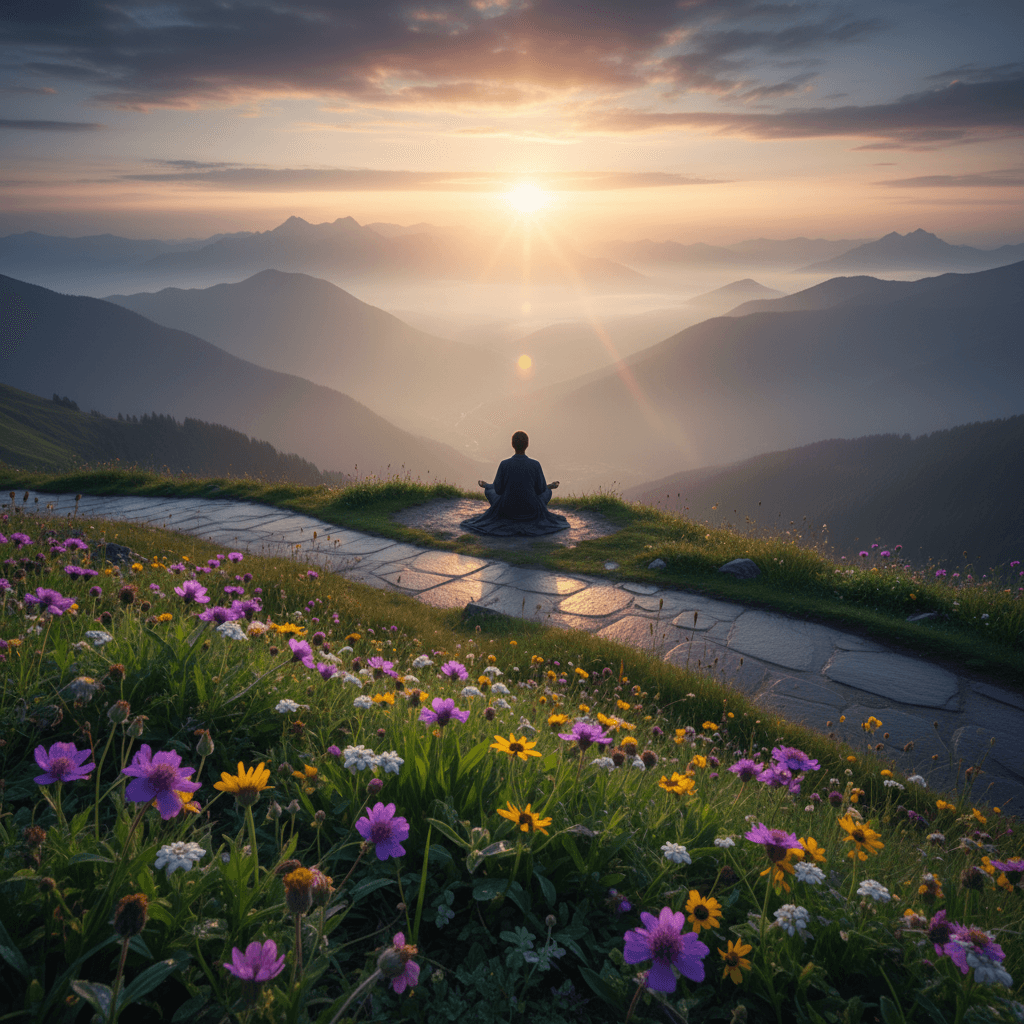
Cultivate compassion and courage every morning until both are your nature. — Dalai Lama
—What lingers after this line?
Morning as Moral Rehearsal
Each dawn offers a clean slate, and the Dalai Lama’s counsel asks us to script it with intention. Traditions have long treated mornings as a moral warm‑up: Marcus Aurelius begins Meditations (c. 180) by instructing himself at daybreak to meet difficult people with steadiness, while Buddhist practitioners renew refuge and bodhisattva vows upon waking. By preloading the day with chosen qualities, we stop outsourcing character to mood or circumstance. In this way, morning becomes rehearsal for the hardest scenes to come, not merely a prelude to them. Having set the stage, we can now consider why the verb “cultivate” is crucial.
Cultivation Over Inspiration
The quote rejects the myth of sudden transformation and replaces it with patient practice. Aristotle’s Nicomachean Ethics II (c. 350 BC) argues that we become just by doing just acts—virtues are acquired through repeated choices until they feel natural. William James, in The Principles of Psychology (1890), called habit the “enormous fly-wheel” of society, stabilizing our better intentions. Thus, compassion and courage are not lightning strikes but gardens: watered daily, pruned when wild, replanted when frost hits. This agricultural metaphor prepares us to see why these two virtues must grow together, not in isolation.
Twin Virtues in Balance
Compassion without courage risks sentimentality; courage without compassion drifts into aggression. Buddhist texts pair them as mutually corrective strengths: Shantideva’s Bodhisattva’s Way of Life (c. 8th century) links boundless compassion with vīrya, the joyful perseverance to act despite fear. Likewise, the Heart Sutra’s “no fear” is not bravado but clarity that enables kindness even under pressure. When cultivated in tandem, compassion directs courage toward protection rather than conquest, and courage gives compassion a spine. With this ethical alignment in view, we can turn to evidence that daily training literally reshapes us.
Neuroscience of Daily Practice
Modern research suggests that regular practice engrains both mindset and behavior. Long-term meditators show sustained gamma synchrony associated with attention and integration (Lutz et al., PNAS, 2004), while compassion training increases altruistic behavior and emotion regulation (Singer et al., ReSource Project, 2016). Habit science adds the mechanism: stable cues and repetitions shift control to efficient neural loops (Wood & Rünger, Annual Review of Psychology, 2016). Morning, a consistent cue, becomes the on-ramp to automaticity. To translate insight into action, we next sketch simple rituals that stack compassion and courage into the first minutes of the day.
Simple Rituals That Build Both
Begin with five calm breaths and a brief kindness practice—such as silently offering “May I and others be safe and at ease,” or tonglen’s in-breath of suffering, out-breath of relief. Then set one courageous micro‑commitment: a difficult call, honest feedback, or a boundary you’ll keep. Seal it with an if‑then plan (Gollwitzer, Psychological Review, 1999): “If I notice avoidance, then I’ll take one small step within 60 seconds.” Finally, preview the day’s likely friction points and pre-choose a compassionate response. As these acts stack, we can widen their sphere beyond the self.
From Self to Society
Personal practice radiates outward through norms. Empathy‑driven concern predicts helping across contexts (Batson, The Altruism Question, 1991), and courage expressed as speaking up thrives where psychological safety exists (Edmondson, Administrative Science Quarterly, 1999). Morning commitments—listening before rebutting, naming hard truths kindly—can shift team climates over time. Singer’s compassion training even showed increased prosocial redistribution in economic games (2014), suggesting that inner cultivation alters public behavior. Having traced this ripple effect, we still need a way to sustain progress without self-importance.
Staying Humble, Staying Consistent
As habits strengthen, pride can creep in. Lojong teachings caution, “Don’t expect applause” (Chekawa, The Seven Points of Mind Training, 12th c.), reminding us that virtue is measured in relief given, not credit claimed. Track practice lightly—streaks help, but recovery after a missed day matters more. Each morning, return to the garden: water compassion, prune fear with small brave acts, and compost yesterday’s failures into today’s resolve. Over time, the work becomes the worker—until compassion and courage feel less like choices and more like your nature.
One-minute reflection
What does this quote ask you to notice today?
Related Quotes
6 selectedTo be courageous is to act with the heart. — Molière
Molière
Molière’s line suggests that courage is not merely the absence of fear, but the decision to move despite it. By connecting courage with the heart, he frames bravery as an emotional and moral act rather than a simple disp...
Read full interpretation →The best people possess a feeling for beauty, the courage to take risks, the discipline to tell the truth, the capacity for sacrifice. — Ernest Hemingway
Ernest Hemingway
Hemingway’s line presents goodness not as politeness or success, but as a demanding inner code. The “best people” are those who combine sensitivity, bravery, honesty, and self-denial—qualities that do not always coexist...
Read full interpretation →You must love in such a way that the person you love feels free. — Thich Nhat Hanh
Thich Nhat Hanh
At its core, Thich Nhat Hanh’s statement redefines love as an act of care that does not confine. To love someone so that they feel free means offering affection without turning it into control, guilt, or dependence.
Read full interpretation →If you are not willing to look stupid, nothing great is ever going to happen to you. — Julia Cameron
Julia Cameron
Julia Cameron’s remark begins with a hard truth: many people do not fail because they lack talent, but because they fear embarrassment. In that sense, ‘looking stupid’ becomes shorthand for being seen trying, stumbling,...
Read full interpretation →You don't have to bully yourself out of feeling fear. You just have to move while it's still there. — Annie Wright
Annie Wright
At its core, Annie Wright’s quote challenges the common belief that courage begins only after fear has disappeared. Instead, it reframes fear as something that can accompany action rather than prevent it.
Read full interpretation →For what matters in life is not whether we receive a round of applause; what matters is whether we have the courage to venture forth despite the uncertainty of acclaim. — Amor Towles
Amor Towles
At its core, Amor Towles shifts attention away from public approval and toward private resolve. The quote argues that a life’s value is not determined by applause—those visible signs of recognition—but by the willingness...
Read full interpretation →More From Author
More from Dalai Lama →Whatever challenge you might find yourself in has a solution. It is very much possible that it is not an obvious one, but it is an opportunity—to grow, to create, to transform. — Dalai Lama
At its core, this reflection insists that no challenge is entirely closed off from resolution. The Dalai Lama does not promise that every answer will be easy or immediate; instead, he shifts attention toward possibility...
Read full interpretation →You yourself, as much as anybody in the entire universe, deserve your love and affection. — Dalai Lama
At its core, this Dalai Lama quotation insists that self-love is not vanity but fairness. We often extend patience, kindness, and forgiveness to friends while withholding the same warmth from ourselves.
Read full interpretation →Sleep is the best meditation. — Dalai Lama
At first glance, the Dalai Lama’s remark appears disarmingly simple, yet its force lies in how it collapses the distance between spiritual practice and biological need. By calling sleep the best meditation, he suggests t...
Read full interpretation →Do not let the behavior of others destroy your inner peace. — Dalai Lama
The Dalai Lama’s line begins with a quiet but radical claim: other people’s actions do not have to become your internal weather. Their impatience, criticism, or chaos can be real and consequential, yet you still retain t...
Read full interpretation →