
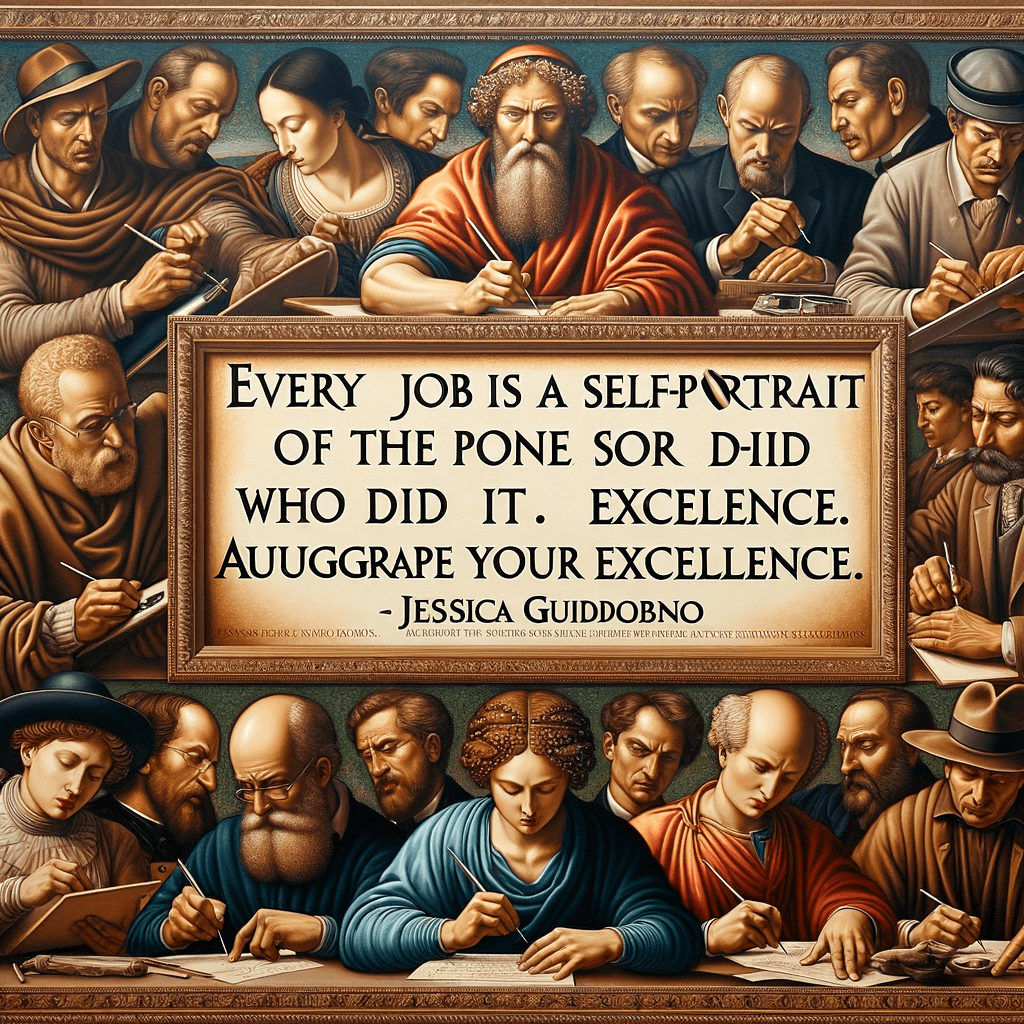
Every job is a self-portrait of the person who did it. Autograph your work with excellence. — Jessica Guidobono
—What lingers after this line?
Reflection of Personal Values
This quote suggests that the quality of one’s work reflects their character and values. The effort and care put into a job serve as a representation of who they are as an individual.
Pride in Craftsmanship
By encouraging individuals to 'autograph' their work with excellence, it emphasizes the importance of taking pride in the quality of what one produces, indicating that every task should be completed to the best of their abilities.
Accountability and Responsibility
This statement also highlights the need for personal accountability in one’s work. Each job completed carries the weight of the individual's professionalism and commitment to excellence.
Impact of Work on Reputation
The quote implies that the work one does contributes significantly to their reputation. A dedication to excellence creates a positive image and encourages others to view them favorably.
Jessica Guidobono's Insight
Jessica Guidobono is recognized for her motivational insights. Her work often emphasizes personal and professional development, highlighting how individual actions have far-reaching consequences in life and career.
One-minute reflection
Why might this line matter today, not tomorrow?
Related Quotes
6 selectedIn the end, you win through superior craftsmanship, not marketing. — Robert Greene
Robert Greene
Robert Greene’s statement cuts through the glamour of promotion by placing true advantage in the work itself. Marketing may attract attention, but craftsmanship earns trust, loyalty, and endurance.
Read full interpretation →The beauty of a finely worked object points to the beauty of the craftsmanship. — Paul Klee
Paul Klee
Paul Klee’s statement begins with a simple but powerful observation: a beautiful object does not merely please the eye; it points beyond itself to the intelligence, patience, and skill that shaped it. The object becomes...
Read full interpretation →Quality, manual labor, and a lot of time: that is the essence of craftsmanship. — Katarzyna Maniak
Katarzyna Maniak
At its core, Katarzyna Maniak’s statement reduces craftsmanship to three inseparable elements: quality, manual labor, and time. Rather than treating a finished object as merely a product, the quote frames it as the visib...
Read full interpretation →I would almost prefer the word 'craftsman'. He is like one of those old-fashioned ship builders who conceived the build of the boat in their mind and after that touched every single piece. — William Golding
William Golding
At first glance, Golding’s preference for the word “craftsman” shifts attention away from the romantic image of effortless genius and toward disciplined making. The term suggests someone who does not merely imagine a wor...
Read full interpretation →The object with visible human error, with a maker behind it, with time baked into its surface, is the luxury of the AI age. — Venkatesh Rao
Venkatesh Rao
At first glance, Venkatesh Rao’s line reframes luxury in a striking way: instead of rarity defined by price or exclusivity, he points to objects that visibly carry human touch. In an age when AI can generate flawless tex...
Read full interpretation →Proficiency in a craft is essential to every artist. Therein lies the prime source of creative imagination. — Walter Gropius
Walter Gropius
At first glance, Walter Gropius’s statement may seem to place discipline above inspiration, yet his deeper point is that imagination needs a workable form. An artist who understands materials, structure, and technique ca...
Read full interpretation →More From Author
More from Jessica Guidobono →