
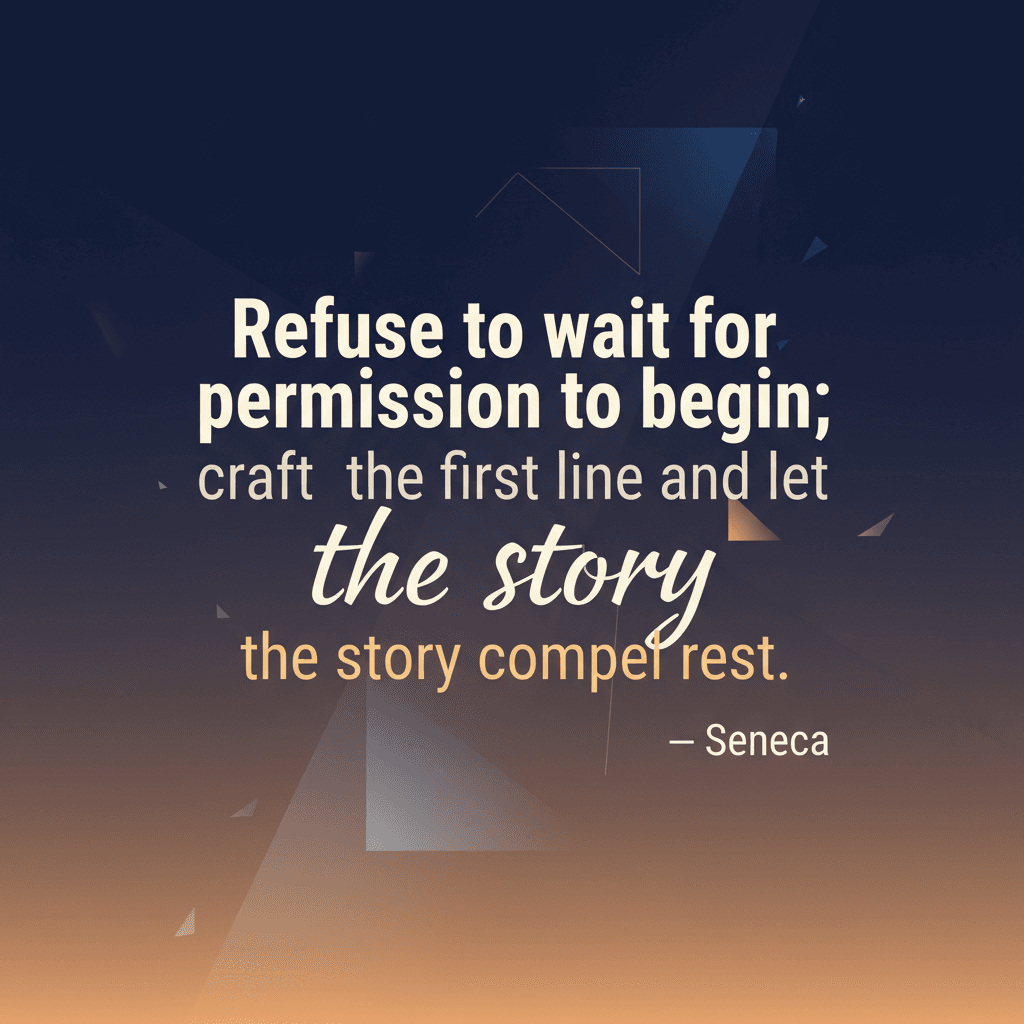
Refuse to wait for permission to begin; craft the first line and let the story compel the rest. — Seneca
—What lingers after this line?
The Courage To Start Uninvited
Seneca’s line urges us to stop asking life for a formal invitation before we begin. Rather than waiting for a boss’s approval, a degree, or the mythical ‘right moment,’ he suggests we simply start. This refusal to wait is not about arrogance; it is about recognizing that most gates are imaginary, held up by fear and habit more than by real barriers. By taking the first step, we convert vague intention into tangible trajectory, moving from passive hoping to active making.
The Power Of A Single Strong Opening
From there, Seneca highlights the special role of the first line—literal or metaphorical. A strong opening sentence anchors a story; similarly, the first concrete action anchors a project, career, or new habit. Just as the opening of Homer’s *Odyssey* propels readers into a long journey, your first email, sketch, or prototype can set momentum in motion. The initial gesture does not need to be perfect; it needs to be bold enough to exist, so that everything else has something to follow.
Letting The Story Take Over
Once that beginning is made, Seneca imagines the story ‘compelling’ the rest. This reflects an ancient Stoic belief: action reshapes character and circumstance. After a first move, new constraints, opportunities, and questions arise, nudging the next move almost automatically. A musician who books a small performance suddenly has a deadline that forces practice; an aspiring writer who publishes a short essay feels drawn—sometimes pressured—into writing the next. The narrative gains its own inertia, carrying the creator along.
Stoic Roots Of Creative Momentum
This advice aligns with Seneca’s broader Stoic ethic, in which virtue expresses itself through timely, decisive action. In letters like *Epistulae Morales ad Lucilium*, he warns against the paralysis of endless preparation and theoretical planning. Instead, he commends ‘living immediately,’ which today might mean launching a minimal version of an idea rather than waiting for flawless readiness. The story you are meant to live, he implies, becomes legible only once you move inside it, not while you stand outside drafting plans.
From Fear Of Judgment To Responsibility For Voice
Underlying the need for permission is often a fear of judgment: the sense that others must validate our talent before we dare to speak. Seneca counters this by shifting responsibility back onto the individual. Your task is not to secure universal approval beforehand, but to contribute your line to the broader human story. In doing so, you may inspire others to write their own beginnings. Thus, refusing to wait is not merely a personal productivity hack; it is an ethical stance that treats one’s potential as a duty, not a negotiable luxury.
Practicing Small, Relentless First Lines
Finally, Seneca’s thought can be practiced on a modest scale each day. Instead of vowing to ‘write a book,’ you draft a single paragraph; instead of ‘changing careers,’ you have one exploratory conversation. Each is a first line that invites a larger narrative. Over time, these repeated beginnings weave into a sustained story of action and growth. In this way, the habit of starting without permission transforms life from a series of deferred ambitions into an unfolding work in progress, authored from within rather than dictated from outside.
One-minute reflection
What feeling does this quote bring up for you?
Related Quotes
6 selectedBegin, therefore, from little things. — Seneca
Seneca
Seneca’s brief instruction, drawn from his Stoic outlook, turns attention away from grand ambitions and toward manageable first steps. By saying, “Begin, therefore, from little things,” he suggests that progress is rarel...
Read full interpretation →Do not wait to be ready; take the first step. Every journey begins with a single step. — Unknown
Unknown
This quote emphasizes the importance of taking the first step toward your goals instead of waiting for the perfect moment. It encourages immediate action to start the journey.
Read full interpretation →Begin anywhere. — John Cage
John Cage
This quote suggests that waiting for the perfect moment or having the 'right' starting point is unnecessary. It encourages taking action without being hindered by the desire for ideal conditions.
Read full interpretation →Begin, be bold, and venture to be wise. — Horace
Horace
This quote encourages individuals to take the first step towards their goals. It suggests that the hardest part of any journey is often just beginning, and taking that initial step requires courage.
Read full interpretation →Do not wait to be inspired. Begin, and inspiration will find you. — H. Jackson Brown Jr.
H. Jackson Brown Jr.
This quote encourages taking a proactive approach to tasks and projects. Instead of waiting for inspiration to strike, start working, and the act of doing will eventually ignite creativity.
Read full interpretation →The flame doesn't appear before the match. It is always action that creates the fire. — Napoleon Hill
Napoleon Hill
Napoleon Hill’s image is simple but forceful: a flame does not mysteriously appear on its own; it requires the friction of a struck match. In the same way, desire, talent, and intention remain dormant until they are tran...
Read full interpretation →More From Author
More from Seneca →The heart is great which shows moderation in the midst of prosperity. — Seneca
Seneca’s observation begins with a quiet but demanding standard: true greatness is not proven by success itself, but by restraint when success arrives. Prosperity can enlarge appetites, inflate pride, and make excess app...
Read full interpretation →Whatever you are doing, do it with a sense of purpose, not merely to pass the time. — Seneca
Seneca’s counsel begins with a simple but demanding idea: life should not be treated as something to be spent carelessly. For the Stoics, time was not a disposable background to action but the very material of character.
Read full interpretation →The strongest person controls the self, not others. — Seneca
Seneca’s statement turns the usual idea of power inside out. Instead of praising the person who dominates rivals, commands attention, or bends others to their will, he locates real strength in self-command.
Read full interpretation →Quiet people are not empty; they are contained. Their power does not seek attention—it waits. — Seneca
At first glance, Seneca’s line overturns a common social assumption: that quietness signals absence, weakness, or lack of thought. Instead, he frames silence as containment, suggesting that some people hold their ideas,...
Read full interpretation →