
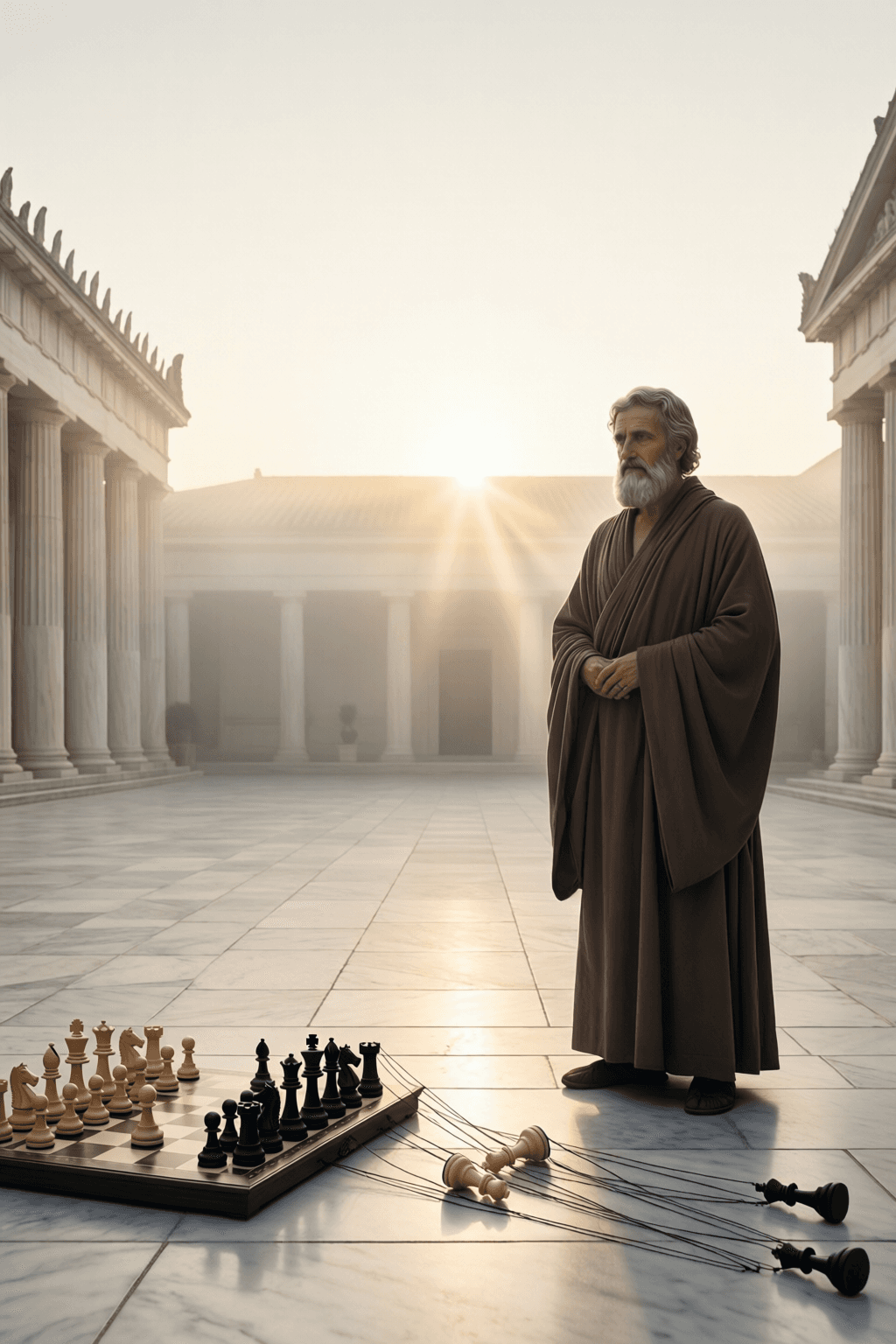
The strongest person controls the self, not others. — Seneca
—What lingers after this line?
Strength Reimagined
Seneca’s statement turns the usual idea of power inside out. Instead of praising the person who dominates rivals, commands attention, or bends others to their will, he locates real strength in self-command. In this view, the strongest person is not the loudest figure in the room, but the one who can govern anger, desire, fear, and pride.
The Stoic Foundation
This insight grows directly from Stoic philosophy, which taught that external events are never fully under our control, but our judgments and responses can be trained. Seneca’s letters, especially *Letters from a Stoic* (c. AD 65), repeatedly return to this discipline: freedom begins when a person stops being ruled by impulse.
Power Without Inner Rule
From there, the quote also warns against confusing authority with strength. A ruler, employer, parent, or public figure may control others while remaining enslaved to vanity or resentment. History offers many examples of powerful people undone not by enemies, but by appetites they never learned to master.
Everyday Tests of Character
In ordinary life, self-control appears in smaller but equally revealing moments. It is the pause before an angry reply, the refusal to retaliate when insulted, or the patience to keep a promise when convenience tempts us away. These quiet victories rarely receive applause, yet they form the foundation of mature character.
Freedom Through Discipline
Moreover, Seneca’s idea suggests that self-mastery is not repression but liberation. When emotions dictate every action, a person is pulled in many directions at once. By contrast, discipline creates space between feeling and response, allowing reason, values, and wisdom to guide behavior.
A Lasting Measure of Strength
Ultimately, Seneca invites us to measure strength by inward steadiness rather than outward dominance. To control others may produce temporary influence, but to control oneself creates lasting dignity. In that sense, the strongest person is the one who can meet the world without surrendering command of the soul.
One-minute reflection
What feeling does this quote bring up for you?
Related Quotes
6 selectedQuiet people are not empty; they are contained. Their power does not seek attention—it waits. — Seneca
Seneca
At first glance, Seneca’s line overturns a common social assumption: that quietness signals absence, weakness, or lack of thought. Instead, he frames silence as containment, suggesting that some people hold their ideas,...
Read full interpretation →Do not mistake my calm for passivity. True power is often the most still thing in the room. — Seneca
Seneca
At first glance, Seneca’s statement separates outward quiet from inward weakness. A calm person may appear passive to those who equate strength with volume, speed, or visible force, yet the quote insists that composure c...
Read full interpretation →Restraint is not fear. It is control. — Seneca
Seneca
At first glance, Seneca’s line separates two behaviors that can look similar from the outside: stepping back and shrinking away. Fear retreats because it feels overpowered, whereas restraint pauses because it possesses c...
Read full interpretation →If you would live your life with ease, you must learn to command your impulses rather than be governed by them. — Seneca
Seneca
At its core, Seneca’s statement argues that ease in life does not come from controlling circumstances, but from governing oneself. The Stoic philosopher redirects attention inward, suggesting that peace depends less on l...
Read full interpretation →Strength lies in restraint. — Seneca
Seneca
At first glance, Seneca’s line seems simple, yet it overturns a common assumption: that strength must be loud, forceful, or visibly dominant. Instead, he suggests that genuine power reveals itself most clearly when a per...
Read full interpretation →Strength is quiet; only insecurity shouts. — Seneca
Seneca
At its core, Seneca’s line draws a sharp contrast between genuine power and performative force. Real strength does not need applause, intimidation, or constant display; instead, it rests securely in itself.
Read full interpretation →More From Author
More from Seneca →Quiet people are not empty; they are contained. Their power does not seek attention—it waits. — Seneca
At first glance, Seneca’s line overturns a common social assumption: that quietness signals absence, weakness, or lack of thought. Instead, he frames silence as containment, suggesting that some people hold their ideas,...
Read full interpretation →Our plans miscarry because they have no aim. When a man doesn't know what harbor he's making for, no wind is the right wind. — Seneca
Seneca’s remark begins with a simple but severe diagnosis: plans fail not merely from bad luck, but from the absence of a clear aim. In his view, activity alone is not progress.
Read full interpretation →We must take care to live not merely a long life, but a full one; for living a long life requires only good fortune, but living a full life requires character. — Seneca
Seneca begins by drawing a sharp distinction between duration and depth. A long life, he says, may depend largely on luck—health, safety, and circumstances beyond our control.
Read full interpretation →Society can only remain healthy through the mutual protection and love of its parts. — Seneca
At the heart of Seneca’s statement lies a simple but powerful image: society is not a loose collection of isolated individuals, but a living whole whose parts depend on one another. In his Letters and essays, Seneca repe...
Read full interpretation →