
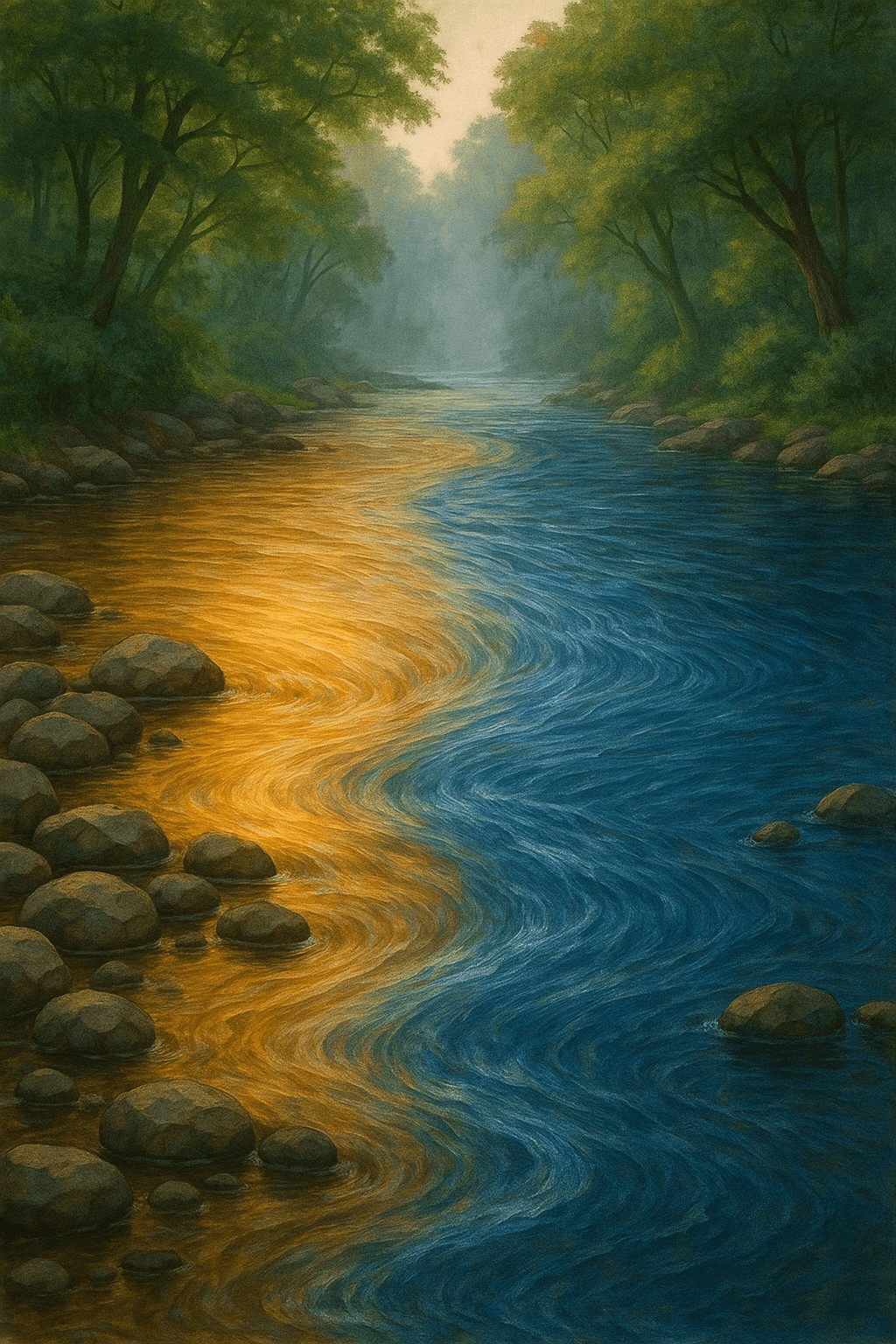
The water you touch in a river is the last of that which has passed and the first of that which is coming. — Leonardo da Vinci
—What lingers after this line?
Da Vinci’s Metaphor of the River
Leonardo da Vinci’s observation transcends mere description of water’s movement; it elegantly employs the river as a metaphor for the flow of time itself. By noting that each touch meets both the last of what has gone and the first of what arrives, da Vinci encapsulates the transitory nature of every moment. This insight invites us to reflect on the fleeting quality of our experiences, much like Heraclitus’ assertion that 'you cannot step into the same river twice.'
Philosophical Views on Impermanence
Building on da Vinci’s metaphor, philosophers throughout history have grappled with impermanence. Heraclitus, writing centuries earlier, famously stated that all is flux, emphasizing the impossibility of permanence in both nature and human life. In Eastern philosophy, Buddhist teachings similarly underscore the ever-changing character of existence, urging mindfulness about attachment to transient states. Da Vinci’s river thus parallels longstanding wisdom about the inevitability of change.
Personal Encounters With Change
This theme of impermanence resonates personally as well. Consider watching a sunset—each instant is unique, never to be repeated, yet inseparable from the moments before and after. Similarly, everyday interactions evolve subtly over time; the friend you greet today is not exactly the same as yesterday, nor are you. Da Vinci’s river reminds us that every experience carries a trace of what was, mingled with what will be.
The Creative Process in Nature and Life
Transitioning from philosophy to creativity, da Vinci’s reverence for the river aligns with his larger worldview. In notebooks and sketches, he marveled at natural patterns—eddies, currents, fingerprints—seeing them as manifestations of continuous process. Art, science, and invention flourish within this constant renewal; like the river, creativity is never static but always becoming, dissolving, and re-forming in new configurations.
Embracing the Present Moment
Ultimately, da Vinci’s reflection serves as an invitation to mindfulness. By recognizing the ephemeral quality of each encounter—every river touched, every moment lived—we are encouraged to embrace the present fully. As with the moving water, our lives consist not of fixed entities but of moments in motion, each precious precisely because it is unrepeatable, yet always part of a greater, ongoing flow.
One-minute reflection
What's one small action this suggests?
Related Quotes
6 selectedTime does not wait, the seasons flow like a stream.
Unknown
This statement emphasizes that time is relentless and unstoppable. It moves forward without waiting for anyone, much like the continuous flow of water in a stream.
Read full interpretation →Time is like a river that swiftly carries away all that is born. - Marcus Aurelius
Marcus Aurelius
This quote likens time to a relentless, flowing river, emphasizing its unstoppable and ever-moving nature. Just as a river carries everything in its path towards an inevitable destination, time continuously progresses an...
Read full interpretation →Everything in our life keeps changing—our inner moods, our bodies, our work. We can't hold on to anything. — Tara Brach
Tara Brach
At its heart, Tara Brach’s reflection points to impermanence as the basic condition of human life. Our feelings rise and fall, our bodies age and heal, and even the work that structures our days shifts in ways we cannot...
Read full interpretation →Few words accord with nature; therefore a whirlwind does not last all morning, and a sudden rain does not last all day. -- Laozi
Laozi
Laozi begins with a simple observation: even nature’s fiercest displays are temporary. A whirlwind burns itself out, and a sudden downpour cannot sustain its intensity for long.
Read full interpretation →We don't need to learn how to let things go; we just need to learn to recognize when they are already gone. — Suzuki Roshi
Suzuki Roshi
At first glance, Suzuki Roshi’s remark gently overturns a familiar self-help idea. We often imagine letting go as a difficult skill, something we must force ourselves to do through discipline or emotional effort.
Read full interpretation →You are the sky. Everything else—it's just the weather. — Pema Chödrön
Pema Chödrön
Pema Chödrön’s line hinges on a simple but expansive metaphor: awareness is the sky, while thoughts, emotions, and circumstances are weather. The sky is vast enough to hold anything without being permanently altered by i...
Read full interpretation →More From Author
More from Leonardo da Vinci →You will never have a greater or lesser dominion than that over yourself. The height of a man's success is gauged by his self-mastery. — Leonardo da Vinci
Leonardo da Vinci’s statement begins by redefining power itself. Rather than pointing to wealth, rank, or influence over others, he insists that the greatest dominion a person can possess is mastery over the self.
Read full interpretation →When the spirit does not work with the hand, there is no art. — Leonardo da Vinci
Leonardo da Vinci’s statement begins with a simple but profound claim: art is never merely the product of manual skill. The hand may shape stone, guide a brush, or draft a line, yet without the animating force of spirit—...
Read full interpretation →You cannot expect the level of excitement of your audience to be greater than your own. If you want a life that is alive, lead it with purpose. — Leonardo da Vinci
Leonardo da Vinci’s insight begins with a simple but demanding truth: people rarely rise above the emotional energy of the person leading them. Whether in art, teaching, or daily life, enthusiasm is contagious precisely...
Read full interpretation →It is not possible to control the outside of yourself until you have mastered your breathing space. — Leonardo da Vinci
At its core, this saying argues that self-governance must begin within. Before a person can hope to influence events, relationships, or circumstances beyond themselves, they must first steady their own internal state.
Read full interpretation →