
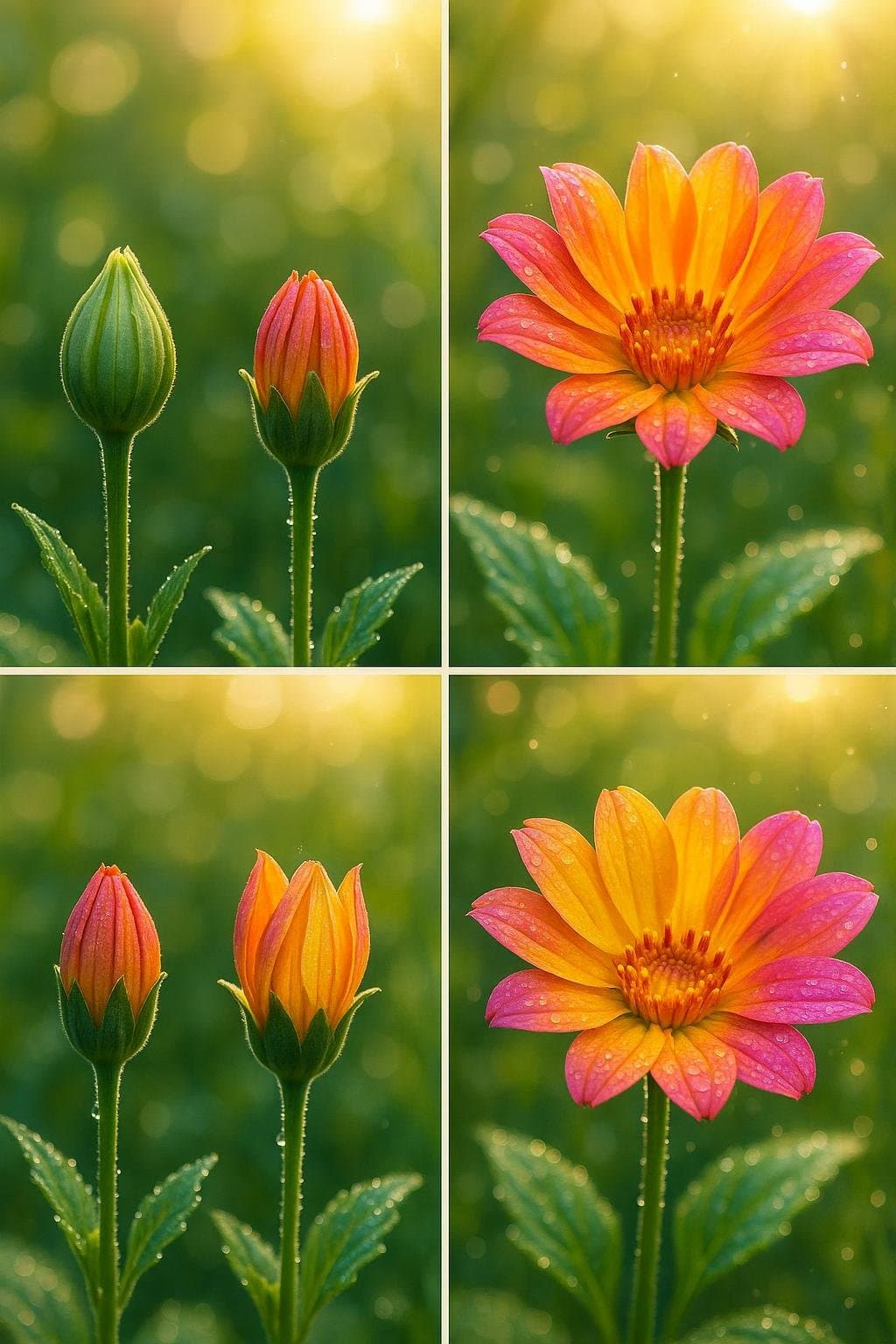
To blossom means to show what we are; to blossom beautifully means to show it in an attractive way. — Suze Orman
—What lingers after this line?
Unpacking the Meaning of Blossoming
Suze Orman’s quote draws a distinction between merely blossoming and blossoming beautifully. At its core, to blossom is to reveal our authentic selves—much like a flower opening to the world. This metaphor suggests that personal growth isn’t about transforming into something we’re not but about finally letting the world witness who we’ve always been inside.
The Art of Attractive Self-Presentation
Orman extends the metaphor, noting that blossoming beautifully is about displaying our true selves in an attractive manner. This brings to mind the notion that authenticity is only half the equation; how we present our uniqueness also matters. For instance, Maya Angelou often spoke of her struggles and triumphs, transforming personal truth into universal appeal by expressing it with grace and conviction.
From Potential to Expression
Transitioning from self-awareness to self-expression is rarely effortless. Many struggle to move beyond internal growth to external demonstration. In personal development classics like Carl Rogers' 'On Becoming a Person' (1961), the ability to express one’s true feelings and thoughts is highlighted as a hallmark of psychological maturity—a process akin to a bud finally becoming a blossom.
Cultural Celebrations of Authenticity
Across cultures, this idea of blooming into one’s identity recurs. Japanese cherry blossom festivals, for example, celebrate transient beauty and the courage of full disclosure. In art and literature, figures like Frida Kahlo used self-portraiture to display both pain and strength, thus showing how revealing one’s true nature can be both compelling and empowering.
Embracing Our Unique Appeal
To conclude, blossoming beautifully challenges us not only to be real but to put effort and care into how we unfold ourselves. Just as a well-tended flower is more likely to thrive, nurturing our talents and communicating our essence with kindness and creativity can make authenticity captivating. Ultimately, Orman's insight invites us to value both who we are and the art of sharing that self with the world.
One-minute reflection
Where does this idea show up in your life right now?
Related Quotes
6 selectedBe who you are and say what you feel, because those who mind don't matter, and those who matter don't mind. — Bernard M. Baruch
Bernard M. Baruch
Baruch’s quote begins with a simple but demanding instruction: be yourself and speak honestly. At its core, the line argues that authenticity is not merely a personality trait but an act of courage, especially in a world...
Read full interpretation →Confidence is silent. Insecurities are loud. — Unknown (Wait—skip/replace with: True nobility is being superior to your former self. — Ernest Hemingway)
Ernest Hemingway
At its core, Hemingway’s line redefines nobility as an inward achievement rather than a social rank. Instead of measuring worth by wealth, pedigree, or dominance over others, it points to a quieter standard: becoming bet...
Read full interpretation →You are under no obligation to be consistent with the person you were yesterday. — James McCrae
James McCrae
At its core, James McCrae’s line challenges the quiet pressure to remain legible to others. Many people feel bound to opinions, habits, or identities simply because they once claimed them, as though consistency were a mo...
Read full interpretation →Growth often looks like slowing down, reassessing, and rebuilding with intention. — Erin Gregory
Erin Gregory
At first glance, growth is often imagined as constant acceleration—more output, faster decisions, visible momentum. Erin Gregory’s quote gently overturns that assumption by suggesting that real development may appear qui...
Read full interpretation →You're born an original—don't die a copy. — John Mason
John Mason
At its core, John Mason’s line is a sharp reminder that every person begins life with a distinct combination of temperament, talent, and perspective. To be “born an original” suggests that individuality is not something...
Read full interpretation →The most important, difficult, and rewarding thing to work on is yourself. — Sven Schnieders
Sven Schnieders
At its heart, Sven Schnieders’ statement argues that self-development is the most valuable project a person can undertake. Unlike external goals—career success, status, or possessions—the work done on one’s character, ha...
Read full interpretation →More From Author
More from Suze Orman →When you honor your time, you honor your value. — Suze Orman
At its core, Suze Orman’s statement links time to self-respect. To honor your time is not merely to stay busy or organized; rather, it is to recognize that your hours are a finite expression of your life itself.
Read full interpretation →When you understand that your self-worth is not determined by your net-worth, then you'll have financial freedom. — Suze Orman
Suze Orman’s line begins by challenging a quiet assumption many people carry: that the number in a bank account doubles as a verdict on personal value. When net worth becomes the main scoreboard, every expense, setback,...
Read full interpretation →