
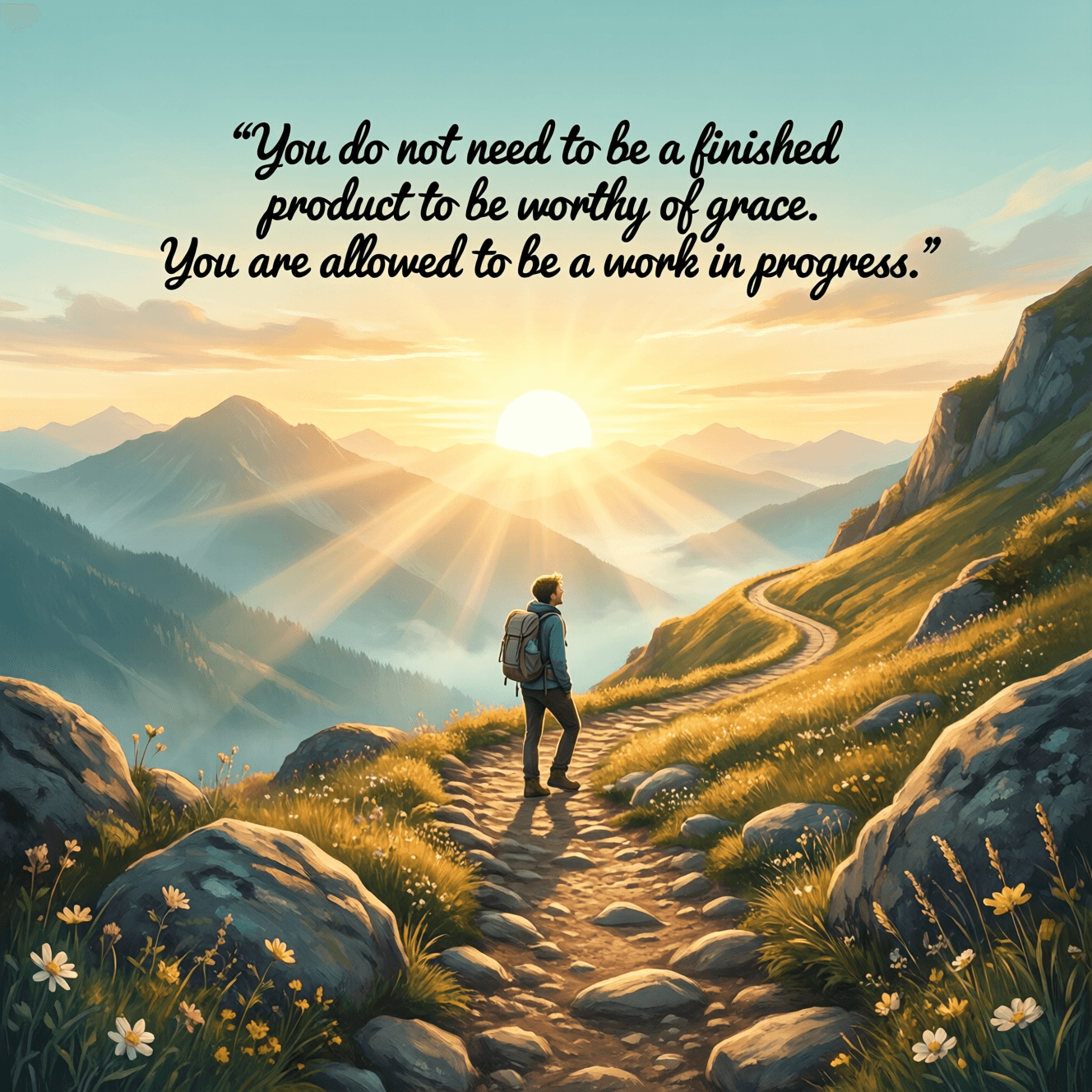
You do not need to be a finished product to be worthy of grace. You are allowed to be a work in progress. — Yung Pueblo
—What lingers after this line?
Worth Before Completion
At its heart, Yung Pueblo’s quote dismantles the harsh belief that value must be earned through perfection. It insists that grace is not a prize reserved for the polished or the fully healed; rather, it belongs equally to those still learning, stumbling, and becoming. In that sense, worth is presented as something inherent, not conditional. This idea feels especially urgent in cultures obsessed with achievement and self-optimization. Instead of asking whether we have finished the journey, the quote asks whether we can honor ourselves while still on the road. That shift changes everything, because it replaces judgment with patience.
The Meaning of Grace
From there, the word “grace” becomes central. Grace suggests compassion offered without strict calculation, much like the spiritual traditions that frame mercy as a gift rather than a transaction. In Christian theology, for instance, St. Augustine’s writings on divine grace emphasize that love can meet people before they are transformed, not only after they become worthy in society’s eyes. Applied to everyday life, this means we do not have to wait until we are more disciplined, less anxious, or more accomplished to treat ourselves gently. Instead, grace enters precisely where the rough edges still remain.
Growth Without Shame
Equally important, the phrase “work in progress” reframes imperfection as movement rather than failure. A draft is not a mistake; it is evidence that something living is still being shaped. In that light, personal growth becomes less about fixing what is broken and more about participating in an ongoing process of becoming. This echoes psychological ideas around self-compassion, especially in Kristin Neff’s research (2003), which shows that people often grow more effectively when they respond to setbacks with kindness instead of shame. Thus, the quote does not excuse stagnation; it simply argues that growth happens best in an atmosphere of mercy.
A Quiet Rebellion Against Perfectionism
Seen another way, the quote is a rebellion against perfectionism’s cruelty. Perfectionism whispers that mistakes disqualify us from love, belonging, and rest. Yung Pueblo counters that narrative by granting permission: you are “allowed” to be unfinished. That word matters because so many people move through life as if they need moral authorization to be human. Literature has long carried this tension. Mary Oliver’s “Wild Geese” (1986) famously tells readers, “You do not have to be good,” offering a similar release from impossible standards. Both voices invite us to step out of self-punishment and into a gentler, more honest humanity.
Healing as an Ongoing Practice
As the quote unfolds in the mind, it also speaks directly to healing. Emotional repair rarely arrives in a dramatic, final moment; more often, it comes in cycles, with relapses, insights, and slow changes in perspective. To accept oneself as unfinished is not resignation but realism. It acknowledges that healing has seasons and that setbacks do not erase progress. Many people know this intuitively through lived experience: someone learning boundaries may still overextend, and someone recovering confidence may still hear the old inner critic. Yet those moments do not cancel the work already done. Rather, they reveal that transformation is layered, not linear.
The Freedom of Humane Self-Regard
Ultimately, the quote offers a more humane way to live with oneself. If grace can coexist with incompleteness, then identity no longer depends on appearing flawless. That creates room for humility, honesty, and sustained effort without despair. We can admit our fractures without treating them as verdicts. In the end, Yung Pueblo’s message is both tender and demanding: tender because it comforts, and demanding because it asks us to abandon the familiar harshness of self-rejection. What follows is a quieter kind of strength—the ability to keep growing while believing, even now, that we are already deserving of care.
One-minute reflection
Where does this idea show up in your life right now?
Related Quotes
6 selectedA person who is growing will never be able to fit back into their old life. — Yung Pueblo
Yung Pueblo
Yung Pueblo’s line frames personal development as a physical transformation: when you grow, you take up more inner space, and the old container can’t hold you. This isn’t arrogance or rejection for its own sake; it’s sim...
Read full interpretation →The growth you want is on the other side of the habit you're avoiding. — Yung Pueblo
Yung Pueblo
Yung Pueblo’s line frames personal development as a geographic truth: what we most want lies just past what we most resist. The “habit you’re avoiding” is rarely a random task; it is often the precise behavior that would...
Read full interpretation →Real growth is when you finally realize that taking care of yourself is a necessity, not a luxury. — Yung Pueblo
Yung Pueblo
Yung Pueblo’s line pivots on a simple but radical reframing: self-care isn’t a reward you earn after everything else is done; it’s the condition that makes everything else sustainable. In many lives, care for the self ge...
Read full interpretation →Real growth is when you no longer feel the need to explain your evolution to people who are committed to understanding you only from their old perspective. — Yung Pueblo
Yung Pueblo
Yung Pueblo frames “real growth” not as a visible milestone but as an internal shift: the moment you stop rehearsing your reasons for changing. At first, many people experience growth as something to justify—new boundari...
Read full interpretation →Learning to love yourself is like learning to walk – essential, life-changing, and the only way to stand tall. — Vironika Tugaleva
Vironika Tugaleva
Vironika Tugaleva’s comparison begins with a simple but powerful truth: self-love is not a luxury, but a basic human necessity. Just as walking allows a child to move through the world with growing independence, learning...
Read full interpretation →Recovery is not a race. You don't have to feel guilty if it takes you longer than you thought it would. — Anne Lamott
Anne Lamott
Anne Lamott’s reminder begins by challenging one of the quiet cruelties of recovery: the belief that healing should follow a predictable schedule. Whether the wound is physical, emotional, or spiritual, people often comp...
Read full interpretation →More From Author
More from Yung Pueblo →To move forward, you must first give yourself permission to be still. — Yung Pueblo
At first glance, Yung Pueblo’s line seems contradictory: how can stillness help us move forward? Yet that tension is precisely the point.
Read full interpretation →Your peace is louder than your defense. — Yung Pueblo
At first glance, Yung Pueblo’s line suggests a reversal of what many people assume about power. We often think strength appears in arguments, explanations, or swift rebuttals.
Read full interpretation →You do not need to earn the right to breathe, to rest, or to exist. — Yung Pueblo
At its core, Yung Pueblo’s line dismantles a belief many people quietly carry: that basic human needs must be earned through productivity, perfection, or approval. By saying we do not need to earn the right to breathe, r...
Read full interpretation →A real sign of progress is when we stop trying to outrun our past and start learning how to sit with it, breathe through it, and let it go. — Yung Pueblo
Yung Pueblo reframes progress as something quieter than achievement or constant motion. Instead of measuring growth by how far we’ve run from painful memories, he points to a more intimate metric: our ability to remain p...
Read full interpretation →