
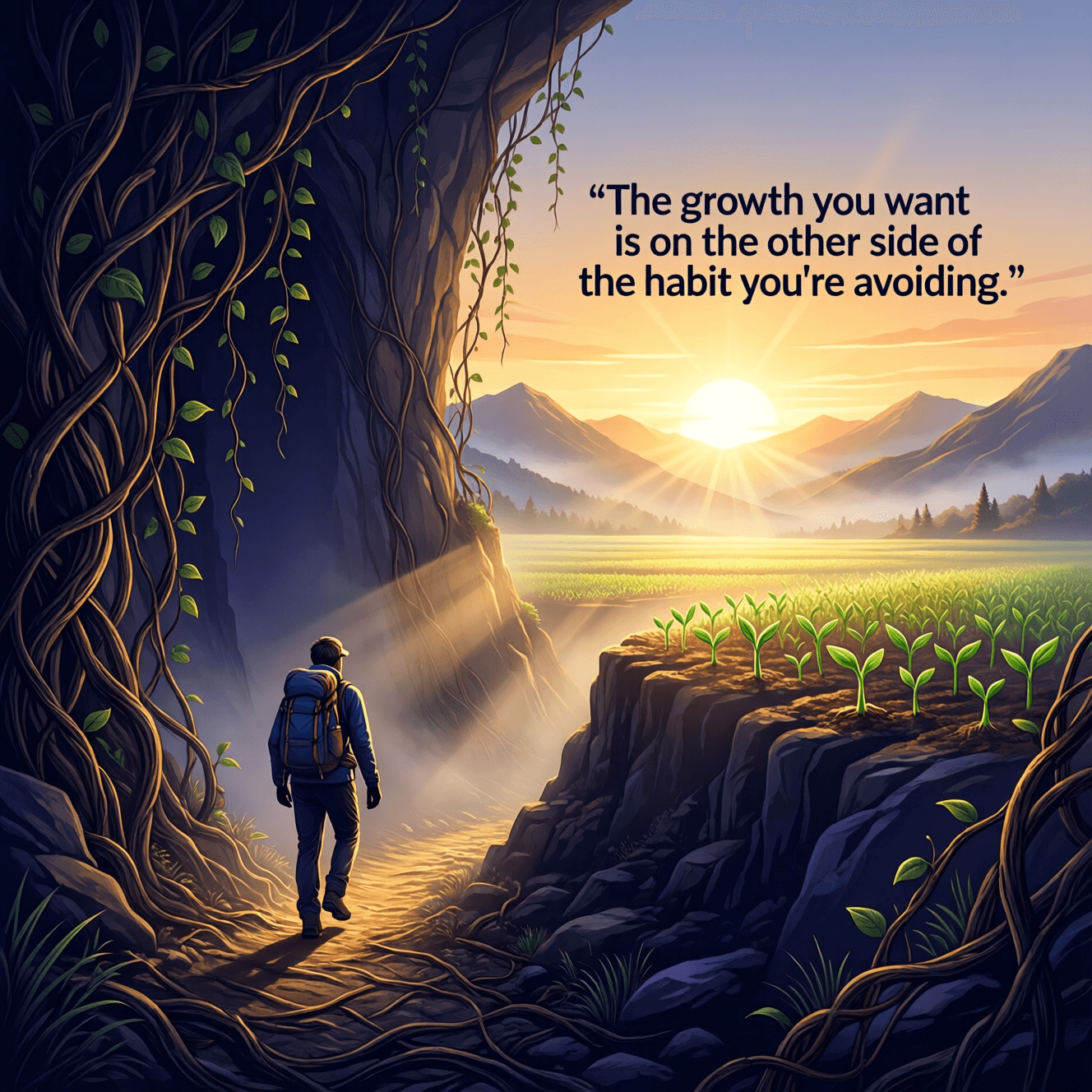
The growth you want is on the other side of the habit you're avoiding. — Yung Pueblo
—What lingers after this line?
A Simple Map of Resistance
Yung Pueblo’s line frames personal development as a geographic truth: what we most want lies just past what we most resist. The “habit you’re avoiding” is rarely a random task; it is often the precise behavior that would change your identity, your skills, or your emotional range. In that sense, avoidance becomes a compass, pointing directly toward the next edge of your evolution. From there, the quote invites an honest inventory: not only what goals you have, but what routines you consistently postpone. When the same habit keeps getting dodged—journaling, exercising, initiating difficult conversations—it usually signals that it carries psychological weight, and therefore transformative potential.
Avoidance as a Protective Strategy
To understand why the avoided habit matters, it helps to see avoidance as protection rather than laziness. People often dodge habits that threaten comfort, ego, or belonging: studying risks discovering limits, setting boundaries risks conflict, and practicing a craft risks producing imperfect work. The mind chooses short-term relief over long-term reward, keeping you safe from embarrassment, uncertainty, or grief. However, this protection comes with a hidden cost. By continually stepping away from the habit, you reinforce the belief that you cannot handle it. Over time, the avoided action becomes larger than it is, and the life you want remains permanently “over there,” just out of reach.
The Psychology Behind “The Other Side”
The “other side” of avoidance aligns with well-studied behavioral patterns. In psychology, avoidance learning and negative reinforcement show how escaping discomfort can strengthen the avoidance itself; you feel better immediately, so the brain repeats the pattern. Meanwhile, exposure-based approaches in cognitive behavioral therapy rely on the opposite motion: approaching the feared or resisted stimulus in manageable steps until it loses its power. Seen this way, growth is not a mysterious breakthrough but a predictable outcome of approach behavior. Each time you practice the habit you avoid, you teach your nervous system a new fact: discomfort is survivable, and progress is possible.
Identity Change Through Repetition
Transitioning from theory to lived experience, the avoided habit often represents an identity shift. A person who writes daily becomes “a writer,” someone who trains consistently becomes “an athlete,” and someone who speaks honestly becomes “a direct communicator.” The habit is not just a means to an outcome; it is evidence you are becoming a different kind of person. This is why avoided habits can feel emotionally charged. They demand you release an older self-concept—perhaps the one that stays agreeable, plays small, or waits to feel ready. On the other side, the reward is not only achievement but a more coherent identity built through repeated action.
Friction, Not Motivation, Is the Battlefield
Because avoidance thrives on immediate discomfort, the most effective response is often to reduce friction rather than to summon motivation. If you avoid reading, leave the book open where you sit. If you avoid workouts, prepare clothing the night before. If you avoid difficult conversations, write a two-sentence script to begin. These small changes shrink the moment of initiation—the point where avoidance usually wins. As you lower the barrier, you create a bridge to the “other side” that is sturdy enough to cross daily. Gradually, the habit stops feeling like a referendum on your worth and starts feeling like a normal part of your routine.
Turning Avoided Habits into Growth Rituals
Finally, the quote suggests a practical way to choose your next step: follow what you avoid. Pick one resisted habit and make it tiny, specific, and repeatable—ten minutes of practice, one honest message, one page of writing. Track completion rather than perfection, because the real win is building trust with yourself. Over weeks, the “other side” becomes visible: skills compound, fear decreases, and self-respect grows. In that sense, Yung Pueblo’s insight reads like a promise with a condition: if you regularly meet the habit you’ve been avoiding, you will eventually meet the growth you’ve been seeking.
One-minute reflection
What does this quote ask you to notice today?
Related Quotes
6 selectedYou do not need to be a finished product to be worthy of grace. You are allowed to be a work in progress. — Yung Pueblo
Yung Pueblo
At its heart, Yung Pueblo’s quote dismantles the harsh belief that value must be earned through perfection. It insists that grace is not a prize reserved for the polished or the fully healed; rather, it belongs equally t...
Read full interpretation →A person who is growing will never be able to fit back into their old life. — Yung Pueblo
Yung Pueblo
Yung Pueblo’s line frames personal development as a physical transformation: when you grow, you take up more inner space, and the old container can’t hold you. This isn’t arrogance or rejection for its own sake; it’s sim...
Read full interpretation →Real growth is when you finally realize that taking care of yourself is a necessity, not a luxury. — Yung Pueblo
Yung Pueblo
Yung Pueblo’s line pivots on a simple but radical reframing: self-care isn’t a reward you earn after everything else is done; it’s the condition that makes everything else sustainable. In many lives, care for the self ge...
Read full interpretation →Real growth is when you no longer feel the need to explain your evolution to people who are committed to understanding you only from their old perspective. — Yung Pueblo
Yung Pueblo
Yung Pueblo frames “real growth” not as a visible milestone but as an internal shift: the moment you stop rehearsing your reasons for changing. At first, many people experience growth as something to justify—new boundari...
Read full interpretation →Learning to love yourself is like learning to walk – essential, life-changing, and the only way to stand tall. — Vironika Tugaleva
Vironika Tugaleva
Vironika Tugaleva’s comparison begins with a simple but powerful truth: self-love is not a luxury, but a basic human necessity. Just as walking allows a child to move through the world with growing independence, learning...
Read full interpretation →The most gifted members of the human species are at their creative best when they cannot have their way, and must compensate for what they miss by realizing and cultivating their capacities. — Bryant H. McGill
Bryant H. McGill
Bryant H. McGill’s observation begins with a striking reversal: gifted people may not reach their highest potential when everything comes easily, but when something blocks their path.
Read full interpretation →More From Author
More from Yung Pueblo →To move forward, you must first give yourself permission to be still. — Yung Pueblo
At first glance, Yung Pueblo’s line seems contradictory: how can stillness help us move forward? Yet that tension is precisely the point.
Read full interpretation →Your peace is louder than your defense. — Yung Pueblo
At first glance, Yung Pueblo’s line suggests a reversal of what many people assume about power. We often think strength appears in arguments, explanations, or swift rebuttals.
Read full interpretation →You do not need to earn the right to breathe, to rest, or to exist. — Yung Pueblo
At its core, Yung Pueblo’s line dismantles a belief many people quietly carry: that basic human needs must be earned through productivity, perfection, or approval. By saying we do not need to earn the right to breathe, r...
Read full interpretation →You do not need to be a finished product to be worthy of grace. You are allowed to be a work in progress. — Yung Pueblo
At its heart, Yung Pueblo’s quote dismantles the harsh belief that value must be earned through perfection. It insists that grace is not a prize reserved for the polished or the fully healed; rather, it belongs equally t...
Read full interpretation →