
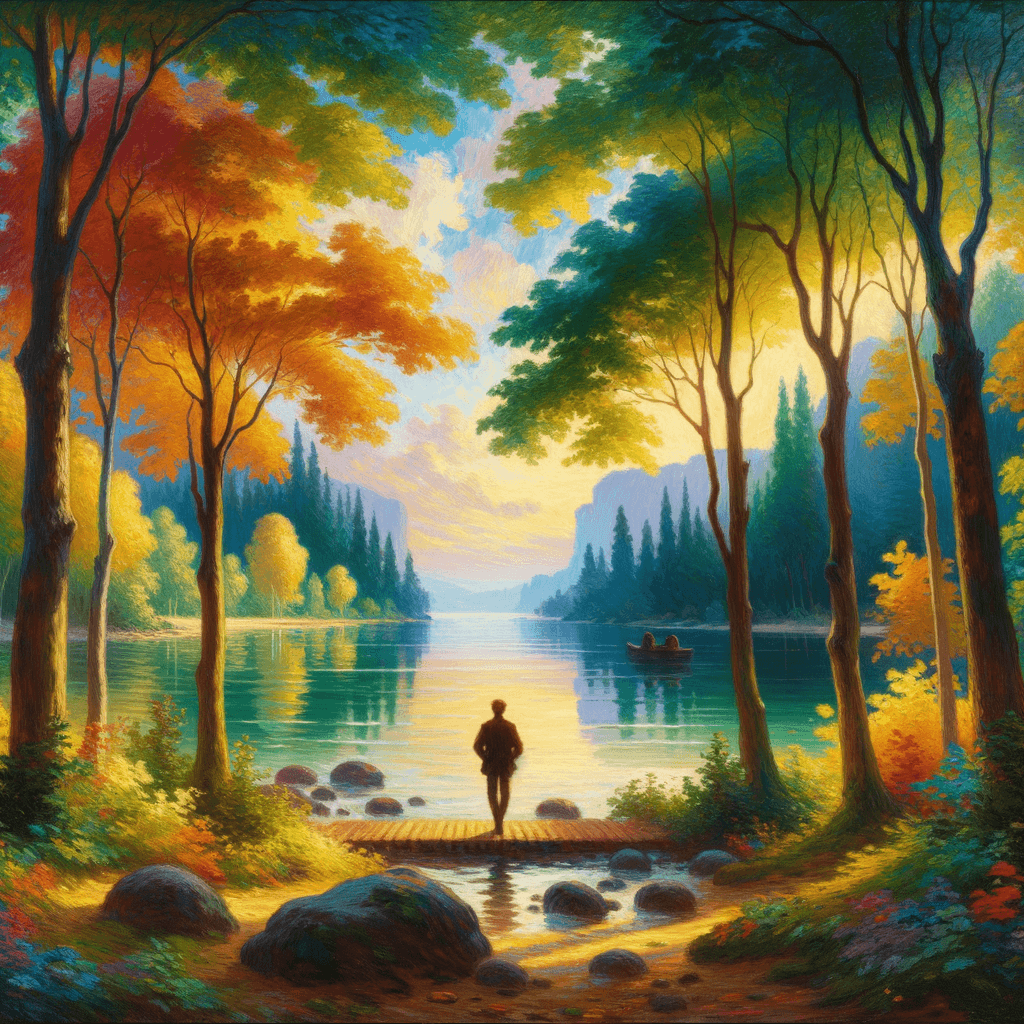
What would life be if we had no courage to attempt anything? — Vincent Van Gogh
—What lingers after this line?
Value of Courage
This quote highlights the crucial role courage plays in our lives. It suggests that without the bravery to pursue our goals and dreams, life would lack meaningful experiences and opportunities.
Embracing Challenges
Van Gogh implies that taking risks is essential for personal growth. Facing fears and challenges allows individuals to explore their potential and gain new insights.
Overcoming Fear of Failure
The quote also points to the necessity of overcoming fear. Fear can paralyze us, preventing us from trying new things and leading to a stagnant life devoid of fulfillment.
Creative Expression
As an artist, Van Gogh's own life was a testament to the importance of courage in creative expression. He faced rejection and mental struggles yet continued to create, illustrating that courage fuels artistic endeavors.
Historical Context
Vincent Van Gogh, a post-impressionist painter from the late 19th century, faced numerous challenges, both personal and professional. His struggles with mental health and societal acceptance amplify the significance of this quote in understanding the human condition.
One-minute reflection
What's one small action this suggests?
Related Quotes
6 selectedFor what matters in life is not whether we receive a round of applause; what matters is whether we have the courage to venture forth despite the uncertainty of acclaim. — Amor Towles
Amor Towles
At its core, Amor Towles shifts attention away from public approval and toward private resolve. The quote argues that a life’s value is not determined by applause—those visible signs of recognition—but by the willingness...
Read full interpretation →Courage is the daily practice of showing up for what matters. — Toni Morrison
Toni Morrison
Toni Morrison’s line shifts courage away from grand, cinematic heroics and into the realm of repetition. Rather than a single decisive moment, courage becomes something you rehearse—like a craft—through ordinary choices...
Read full interpretation →To be courageous is to act with the heart. — Molière
Molière
Molière’s line suggests that courage is not merely the absence of fear, but the decision to move despite it. By connecting courage with the heart, he frames bravery as an emotional and moral act rather than a simple disp...
Read full interpretation →The best people possess a feeling for beauty, the courage to take risks, the discipline to tell the truth, the capacity for sacrifice. — Ernest Hemingway
Ernest Hemingway
Hemingway’s line presents goodness not as politeness or success, but as a demanding inner code. The “best people” are those who combine sensitivity, bravery, honesty, and self-denial—qualities that do not always coexist...
Read full interpretation →You can be cautious or you can be creative, but there's no such thing as a cautious creative. — George Lois
George Lois
George Lois draws a sharp line between two mindsets: caution protects what already exists, while creativity risks making something new. At first glance, the statement sounds absolute, yet that severity is exactly its poi...
Read full interpretation →If you are not willing to look stupid, nothing great is ever going to happen to you. — Julia Cameron
Julia Cameron
Julia Cameron’s remark begins with a hard truth: many people do not fail because they lack talent, but because they fear embarrassment. In that sense, ‘looking stupid’ becomes shorthand for being seen trying, stumbling,...
Read full interpretation →More From Author
More from Vincent van Gogh →Learning technique is a way to make your soul grow. So do it. — Vincent van Gogh
Van Gogh’s brief statement turns learning into more than a practical task; it becomes an ethical and spiritual imperative. By saying that learning technique helps the soul grow, he suggests that disciplined study does no...
Read full interpretation →A great fire burns within me, but no one stops to warm themselves at it, and passers-by only see a wisp of smoke. — Vincent van Gogh
Van Gogh’s image begins with a painful contrast: immense inner warmth exists, yet it goes unreceived. The “great fire” suggests passion, generosity, and creative force, while the absence of anyone who “stops to warm them...
Read full interpretation →I cannot rest, I must draw, however poor the result, and when I have a bad time come over me it is a stronger desire than ever. — Vincent van Gogh
Van Gogh’s words present drawing not as a hobby or even a disciplined profession, but as an inner command he cannot silence. The phrase “I must draw” carries the force of survival, suggesting that artistic creation answe...
Read full interpretation →As we advance in life it becomes more and more difficult, but in fighting the difficulties the inmost strength of the heart is developed. — Vincent van Gogh
Van Gogh’s sentence begins with a sober observation: life does not necessarily become simpler as we grow older. Instead, responsibilities deepen, losses accumulate, and choices carry heavier consequences.
Read full interpretation →