
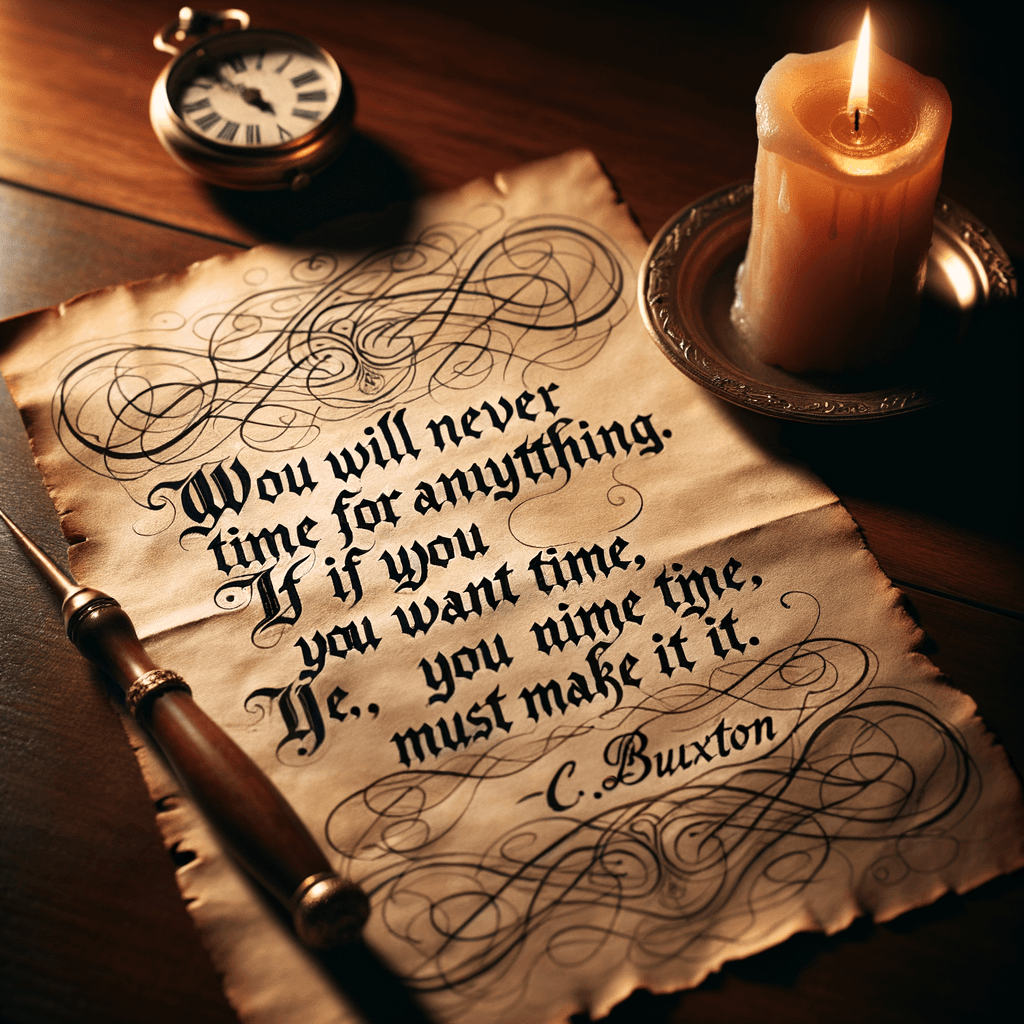
You will never find time for anything. If you want time, you must make it. — Charles Buxton
—What lingers after this line?
Proactivity and Ownership
This quote highlights the importance of taking initiative. Instead of waiting for time to appear, individuals should actively create opportunities for their commitments and aspirations.
Time Management
It emphasizes the necessity of effective time management. Making time involves prioritizing tasks, setting aside dedicated moments for interests, and being deliberate about how one spends their hours.
Value of Time
The quote underscores the preciousness of time. Instead of passively hoping to find extra time, one must recognize that time itself is a finite resource that requires intentional allocation.
Mindset Shift
Buxton encourages a shift in mindset. Instead of seeing time as something to find or stumble upon, it should be viewed as something that requires planning and effort to harness effectively.
Historical Context
Charles Buxton was a British politician and author in the 19th century, known for his reflections on society and personal development. His observations on time remain relevant in today's fast-paced world.
One-minute reflection
What feeling does this quote bring up for you?
Related Quotes
6 selectedYou can do anything but you can't do everything. Prioritize what truly matters, and allow yourself some breathing room. It's okay to pace yourself. — Blurt It Out
Blurt It Out
At its core, this quote begins with a simple but liberating truth: capability is not the same as endless capacity. A person may be talented, willing, and hardworking, yet still unable to carry every task, obligation, and...
Read full interpretation →We don't drift into good directions. We discipline and prioritize ourselves there. — Andy Stanley
Andy Stanley
Andy Stanley’s quote challenges a comforting illusion: that a meaningful life will naturally sort itself out if we simply keep moving. Instead, he argues that good directions are rarely accidental.
Read full interpretation →The most productive thing you can do is learn to manage your energy, not just your time. — Arianna Huffington
Arianna Huffington
Arianna Huffington’s quote reframes productivity at its foundation. Instead of treating time as the only scarce resource, she points to energy as the real force that determines whether hours become meaningful work or mer...
Read full interpretation →Instead of saying 'I don't have time,' try saying 'it's not a priority,' and see how that feels. — Laura Vanderkam
Laura Vanderkam
Laura Vanderkam’s quote works by replacing a familiar excuse with a more revealing truth. “I don’t have time” sounds objective, as if the day itself has failed us; however, “it’s not a priority” returns the matter to cho...
Read full interpretation →Don't count the years. Make every year count. — Medium Collective
Medium Collective
At its core, “Don’t count the years. Make every year count” challenges the habit of measuring life by duration alone.
Read full interpretation →Self-discipline is the ability to do what you should do, when you should do it. — Brian Tracy
Brian Tracy
Brian Tracy’s definition strips self-discipline down to its practical essence: not merely knowing the right thing, but doing it at the right moment. In other words, discipline is less about inspiration than about obedien...
Read full interpretation →More From Author
More from Charles Buxton →