
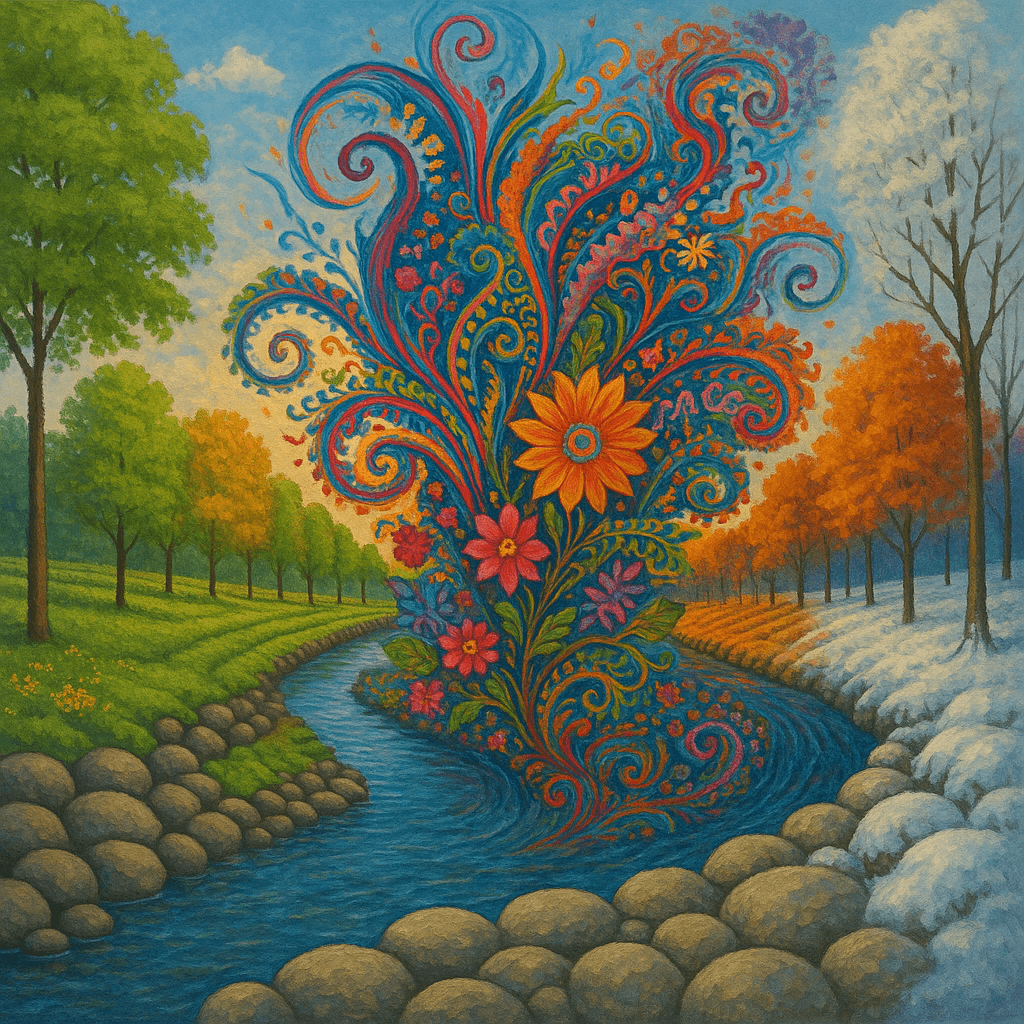
Be steady and well-ordered in your life so that you can be fierce and original in your work. — Gustave Flaubert
—What lingers after this line?
The Duality of Discipline and Creativity
Gustave Flaubert's advice points to a compelling dichotomy: stability in personal affairs lays the groundwork for daring innovation in one’s work. Rather than viewing discipline and creativity as opposing forces, Flaubert suggests they are synergistic. In everyday routines—consistent schedules, tidy environments—we create a sanctuary, a controlled space from which bold, unrestrained ideas can emerge undistracted.
Historical Applications Among Artists
Examining the habits of prolific artists bears out Flaubert’s insight. Consider the composer Ludwig van Beethoven, whose strict daily rituals—scheduled walks, precise coffee measurements—were famous. Yet, within this rigidity, Beethoven composed music that revolutionized classical norms. The contrast highlights how ordered living can unlock unprecedented artistic freedom.
Mental Clarity Through Organization
Order is not only external. By organizing our personal lives, we reduce mental clutter, freeing cognitive resources for imaginative tasks. Psychologist Mihaly Csikszentmihalyi’s research on ‘flow’ demonstrates that creativity flourishes best when distractions are minimized. Thus, Flaubert’s wisdom finds support in modern science: tranquility becomes fertile ground for originality.
Guarding Originality Against Chaos
Without discipline, creative impulses can dissolve into chaos. Flaubert’s own painstaking revision of *Madame Bovary*—rewriting passages countless times—testifies to how harnessed energy can be channeled into lasting originality. This self-imposed order acts as a bulwark, protecting one’s work from ephemeral flashes of inspiration that lack depth or coherence.
Cultivating a Sustainable Creative Practice
Ultimately, the balance Flaubert proposes ensures longevity and evolution in creative pursuits. By being ‘steady and well-ordered’ in life, we nurture the resilience required for continual invention. In this way, routine and rigor do not stifle imagination; rather, they enable us to be ‘fierce and original,’ sustaining boldness not just in isolated bursts, but throughout a lifetime’s work.
One-minute reflection
Where does this idea show up in your life right now?
Related Quotes
6 selectedEvery great and original writer, in proportion as he is great and original, must himself create the taste by which he is to be relished. — William Wordsworth
William Wordsworth
Wordsworth’s claim begins with a bold premise: truly original writers cannot be fully judged by old measures because their work changes the very standards of appreciation. In other words, greatness is not simply a matter...
Read full interpretation →The most original writers borrowed one from another. — Voltaire
Voltaire
At first glance, Voltaire’s remark seems to undermine originality by tying it to borrowing. Yet that tension is precisely his point: great writing rarely appears from a vacuum.
Read full interpretation →The merit of originality is not novelty; it is sincerity. — Thomas Carlyle
Thomas Carlyle
At first glance, Carlyle overturns a common assumption: that originality means producing something no one has ever seen before. Instead, he argues that the true value of original work lies in sincerity—the honest express...
Read full interpretation →It is necessary to any originality to have the courage to be an amateur. — Wallace Stegner
Wallace Stegner
Wallace Stegner’s remark suggests that originality does not emerge from perfect polish at the beginning, but from a willingness to enter unfamiliar territory without guarantees. To be an amateur, in this sense, is not me...
Read full interpretation →Originality — A target best hit when not aimed at. — Charles Searle
Charles Searle
At first glance, Charles Searle’s remark seems contradictory: how can originality be achieved by not trying to achieve it? Yet that is precisely his point.
Read full interpretation →Even in literature and art, no man who bothers about originality will ever be original: whereas if you simply try to tell the truth, you will, nine times out of ten, become original without ever having noticed it. — C.S. Lewis
C.S. Lewis
At first glance, C.S. Lewis presents a paradox: the harder an artist chases originality, the less likely it is to appear.
Read full interpretation →More From Author
More from Gustave Flaubert →You don't make art out of good intentions. — Gustave Flaubert
At first glance, Gustave Flaubert’s remark sounds severe, yet its force lies in its refusal to confuse moral sincerity with artistic achievement. Good intentions may motivate a person to create, but intention by itself d...
Read full interpretation →Everything that is beautiful and noble is the result of long dedication and painstaking effort. — Gustave Flaubert
Flaubert’s sentence rejects the fantasy of effortless brilliance. At its heart, it argues that whatever we call beautiful or noble does not simply appear through talent or inspiration; rather, it is shaped slowly through...
Read full interpretation →Talent is a long patience, and originality an effort of will and intense observation. — Gustave Flaubert
Gustave Flaubert’s statement begins by challenging the popular view of talent as a mystical gift. Instead, he frames talent as 'a long patience'—suggesting that what we often interpret as innate ability is, in reality, e...
Read full interpretation →The heart, like the stomach, wants a varied diet. — Gustave Flaubert
Flaubert’s witty comparison likens emotional fulfillment to physical nourishment, suggesting that just as our stomachs require a range of foods, our hearts crave a spectrum of feelings and experiences. This metaphor not...
Read full interpretation →