
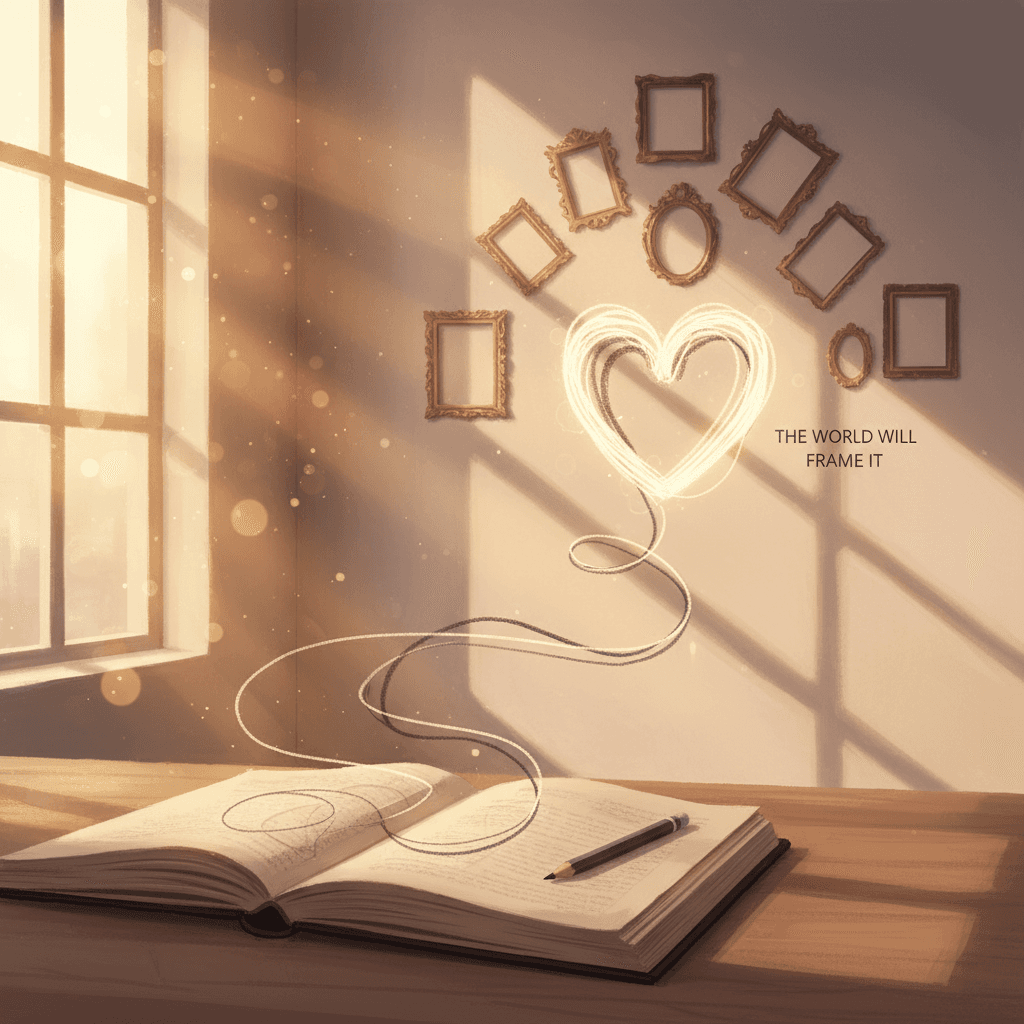
Do the work your heart sketches, and the world will frame it. — Elizabeth Gilbert
—What lingers after this line?
The Inner Blueprint of Calling
Elizabeth Gilbert’s creative ethos in Big Magic (2015) urges makers to trust the quiet instructions of curiosity. In that spirit, the “heart’s sketch” is the inner blueprint—imperfect, hand-drawn, alive. The “frame” is everything the world later adds: context, audience, resources, and interpretation. Thus the line is not a promise of instant acclaim but of alignment: when work springs from an authentic pulse, it becomes frameable. Because frames are built around what exists, the first task is to make the sketch visible. That shift—from private impulse to public artifact—leads naturally to the social life of creativity.
Art as a Cooperative Ecology
Building on that, sociologist Howard S. Becker’s Art Worlds (1982) shows that artworks are collective achievements: printers, gallerists, critics, and audiences all supply the “frame.” Similarly, Roland Barthes’s “The Death of the Author” (1967) argues that meaning is completed by readers, not decreed by creators. In other words, the world does not write your lines, but it supplies the matting and gallery wall. Seeing creativity as cooperative reframes success: our job is to supply the most honest line possible so the network can recognize it and rally around it.
Turning Vision into Habit and Drafts
In practice, honest lines arrive through habit, not waiting. Twyla Tharp’s The Creative Habit (2003) prescribes ritualized work as the doorway to inspiration, while Toni Morrison wrote at dawn before her day jobs, turning thin slivers of time into finished pages. By drafting, revising, and shipping work, we give the world something to hold. Moreover, discipline protects the heart’s sketch from perfectionism; rough edges are not flaws but handholds that make framing easier.
Risk, Vulnerability, and the Courage to Share
With visibility comes risk, yet vulnerability is the bridge to resonance. Brené Brown’s Daring Greatly (2012) shows that shared uncertainty fosters connection because it signals truth over performance. Martha Graham told Agnes de Mille—recorded in Dance to the Piper (1952)—that there is a “queer, divine dissatisfaction,” urging artists to keep the channel open rather than judge it. History echoes this pattern: the Salon des Refusés (1863) gathered rejected painters whose work Impressionist dealers like Paul Durand-Ruel later championed, proving that courageous exposure often precedes the right frame.
Flow and Intrinsic Joy as Compass
Consequently, an internal compass is essential. Mihaly Csikszentmihalyi’s Flow (1990) describes the absorbing state where challenge meets skill; Teresa Amabile’s research (1985) finds that intrinsic motivation most reliably predicts creative quality. When your process feels like absorbed play, you are tracing the heart’s true lines. Because that joy is legible to others, it becomes a signal; audiences sense coherence and respond with attention, resources, and advocacy.
How Communities Build the Frame
Once the work is out, framing accelerates through feedback loops. Critics, curators, and communities contextualize; platforms and patrons provide infrastructure. Émile Zola championed Manet in the 1860s, while Durand-Ruel organized shows that taught the public how to see Monet—an education in framing as much as in painting. Today, open studios, newsletters, and small releases function similarly. By inviting conversation, you let the world help title, place, and carry your work farther than you could alone.
A Compact for Makers
Finally, the credo becomes simple: begin with curiosity, keep a daily appointment, publish before you feel ready, and learn in public. Protect the tenderness of the sketch, yet welcome the world’s steady hands. Do this long enough and a virtuous cycle forms: your heart keeps sketching, the world keeps framing, and together you make a picture neither could complete alone.
One-minute reflection
What's one small action this suggests?
Related Quotes
6 selectedThere is no must in art because art is free. — Wassily Kandinsky
Wassily Kandinsky
At its core, Kandinsky’s statement rejects the idea that art must obey fixed obligations. By saying there is no ‘must’ in art, he frees creation from rigid formulas, academic demands, and social expectation.
Read full interpretation →Often what the artist expresses is unconscious, but we can learn to decode the story by collaboratively finding the pieces to the puzzle that create new possibilities for innovation. — Ben Okri
Ben Okri
At the heart of Ben Okri’s statement is the idea that art often says more than the artist consciously intends. A poem, painting, or song may carry hidden fears, cultural memories, or emotional truths that emerge without...
Read full interpretation →I think that when you create something, you leave a part of yourself in it. — Henri Matisse
Henri Matisse
At its core, Matisse’s reflection suggests that making anything—a painting, a poem, a song, even a room—inevitably transfers something inward into outward form. Creation is not merely the arrangement of materials; rather...
Read full interpretation →There is a deep peace that comes from creating something that didn't exist before. It is your way of telling the universe that you were here, and you felt something. — Maya Angelou
Maya Angelou
At its heart, Maya Angelou’s reflection suggests that creation is not merely productive but restorative. To make something that did not exist before—a poem, a garden, a melody, even a repaired room—is to experience a rar...
Read full interpretation →The creative act is not an escape from reality, but a way to encounter it more deeply. — bell hooks
bell hooks
At first glance, creative work can look like withdrawal: a painter disappears into a studio, a writer vanishes into pages, a musician closes the door and listens inward. Yet bell hooks reverses that assumption.
Read full interpretation →The best use of imagination is creativity. The worst use of imagination is anxiety. — Deepak Chopra
Deepak Chopra
Deepak Chopra frames imagination as a neutral force whose value depends on its direction. In one sense, imagination is the mind’s simulator: it can invent possibilities that do not yet exist, letting us rehearse outcomes...
Read full interpretation →More From Author
More from Elizabeth Gilbert →A good-enough novel violently written now is better than a perfect novel meticulously written never. — Elizabeth Gilbert
Elizabeth Gilbert’s line immediately shifts the argument from artistic purity to artistic existence. A “good-enough” novel, even one “violently written,” has entered the world and can move, provoke, or comfort someone; b...
Read full interpretation →A calm heart is a creative heart. When we release the frantic need to prove our worth, we finally make space for the life we were meant to live. — Elizabeth Gilbert
At its core, Elizabeth Gilbert’s quote proposes that creativity does not flourish in inner chaos but in emotional steadiness. A calm heart is not an empty or passive one; rather, it is a mind cleared of constant self-def...
Read full interpretation →You don't need a massive platform to change the world; you just need to be a decent human to the three people you see every day. — Elizabeth Gilbert
Elizabeth Gilbert reframes social change in strikingly modest terms: impact does not begin with fame, scale, or public recognition, but with ordinary decency practiced at close range. Rather than imagining the world as s...
Read full interpretation →Sometimes you have to stop and be bored, because boredom is the dream-killer's worst enemy. — Elizabeth Gilbert
At first glance, Elizabeth Gilbert’s remark sounds counterintuitive, because boredom is usually treated as something to escape. Yet her point turns that assumption upside down: when we stop filling every empty moment, we...
Read full interpretation →