
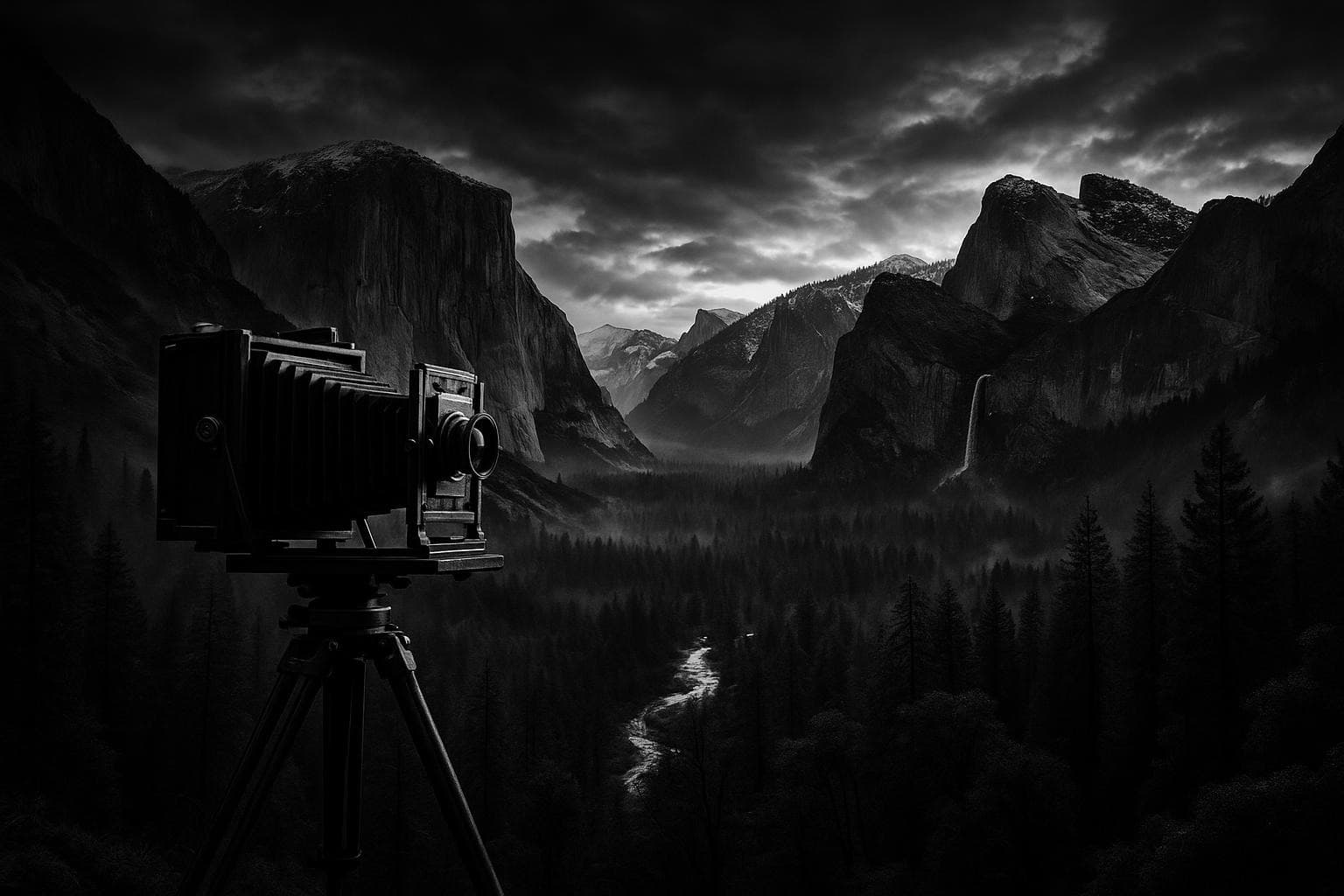
You don't take a photograph, you make it. — Ansel Adams
—What lingers after this line?
Intention Over Accident
Adams’s claim reframes the camera from a passive recorder to an instrument of authorship. To “make” a photograph is to decide what the picture will communicate before the shutter clicks. He called this previsualization—the mental image of the final print that guides every choice in the field. In Examples: The Making of 40 Photographs (1983), he walks readers through this process, showing how vision, not chance, shapes the result. Thus, the photograph becomes the culmination of decisions rather than the residue of an encounter.
The Zone System: Shaping Light as Material
Building on this intention, Adams and Fred Archer devised the Zone System (c. 1939) to translate scene brightness into planned tones. By matching exposure and development to a previsualized print, photographers “place” shadows and “control” highlights, effectively sculpting light. The method comes alive in Adams’s account of Moonrise, Hernandez, New Mexico (1941), where he calculated exposure from the moon’s known luminance, then later developed and printed to reveal luminous crosses and a brooding sky. As The Negative (1954) makes clear, such control is not technical fussiness—it is the grammar of making.
Composition and Time as Design
Likewise, composition transforms seeing into structure. Vantage point, foreground–background relationships, leading lines, and negative space are chosen to steer attention and meaning. Time, too, is a design element: waiting for a cloud’s edge to reveal a ridge, or a passerby to complete a geometry, is an act of construction. Even Henri Cartier-Bresson’s The Decisive Moment (1952), often invoked as spontaneous, depends on anticipation and framing; the moment is not found so much as prepared for.
From Negative to Print: Performance and Interpretation
In the darkroom, Adams treated printing as interpretation: dodging and burning, paper choice, and contrast controls refined the emotional weight of forms. He famously quipped, “The negative is the score, the print is the performance,” emphasizing that execution completes intention. The same ethos persists today in RAW processing and local adjustments—Lightroom’s masks or curves echo the darkroom’s hands. When guided by previsualized goals rather than gimmickry, post-production becomes the final movement of making, not an afterthought.
Authorship, Truth, and Ethical Boundaries
Yet authorship carries responsibility. Every choice—lens, angle, crop—argues for a particular truth. In art, transforming reality is part of expression; in journalism, it risks misleading. The controversy over National Geographic’s February 1982 cover, where the pyramids were digitally moved to fit the vertical format, illustrates how “making” can cross a line. Clear intent and honest context help reconcile craft with credibility: captions, transparency about methods, and genre awareness signal whether a photograph is evidence, interpretation, or both.
Modern Tools, Same Mindset
Today’s computational cameras stack exposures, align stars, and smooth noise, but the maker’s mindset still governs meaning. Planning apps like PhotoPills help place the sun or moon; drones expand vantage; focus stacking extends detail. Nevertheless, light quality, story, and sequencing remain decisive. Technology broadens the palette, yet the photograph is still made in the alignment of purpose with conditions—an old discipline in new clothing.
Practicing the Maker’s Eye
Consequently, craft is cultivated through habits: scout and sketch compositions; study light at different hours; bracket with intention rather than fear; keep contact sheets or digital selects that reveal patterns; and sequence images into coherent bodies of work. Rehearse the final print in your mind, then let each choice serve that vision. As Adams’s performance metaphor suggests, making a photograph is less a single act than a practiced score—composed in the field, refined in the print, and completed in the viewer’s eye.
One-minute reflection
What does this quote ask you to notice today?
Related Quotes
6 selectedThe painting has a life of its own. I try to let it come through. — Jackson Pollock
Jackson Pollock
At first glance, Jackson Pollock’s remark gives the painting an almost independent existence, as though the canvas carries its own pulse before the artist fully understands it. Rather than describing painting as pure con...
Read full interpretation →The creative process is not a straight line, but a labyrinth. To get lost in it is not a failure; it is the only way to find the hidden things worth saying. — M.C. Richards
M.C. Richards
At its core, M.C. Richards rejects the comforting myth that creative work unfolds through orderly steps.
Read full interpretation →To create something new, one must first learn to be comfortable with the mess of the process. — Yayoi Kusama
Yayoi Kusama
At first glance, Yayoi Kusama’s insight reframes creativity as something far less polished than people often imagine. To create something truly new, she suggests, one must stop fearing confusion, failed attempts, and unf...
Read full interpretation →The creative process is a sanctuary for healing, a space where resilience is transformed into art that speaks to our shared humanity. — Ben Okri
Ben Okri
At its heart, Ben Okri’s statement imagines the creative process as more than production; it becomes a refuge. A sanctuary is a place of shelter, and by choosing that word, Okri suggests that making art offers protection...
Read full interpretation →It is through the process of creating that we discover who we are, not by waiting for a finished masterpiece to tell us. — Twyla Tharp
Twyla Tharp
Twyla Tharp’s insight begins with a reversal of a common assumption: we often imagine that identity arrives fully formed and then expresses itself through art, work, or achievement. Instead, she argues that we come to kn...
Read full interpretation →The craft is not in holding tight, but in release: letting the work reveal its own nature. — Lloyd Alexander
Lloyd Alexander
At first glance, Lloyd Alexander’s line reframes craftsmanship in a surprising way: the maker’s skill does not lie in controlling every outcome, but in knowing when to loosen the grip. Rather than forcing a work into a p...
Read full interpretation →More From Author
More from Ansel Adams →No man has the right to dictate what other men should perceive, create or produce, but all should be encouraged to reveal themselves. — Ansel Adams
At its core, Ansel Adams’s statement rejects artistic authoritarianism. He insists that no individual has the moral authority to prescribe what others must see, make, or express.
Read full interpretation →It is not about having all the answers or knowing exactly what you are doing—it is about trusting yourself enough to take the leap anyway. — Ansel Adams
At its core, Ansel Adams’s statement rejects the comforting myth that action must wait for perfect clarity. Instead, it argues that growth begins when we move forward despite incomplete knowledge.
Read full interpretation →In wisdom gathered over time I have found that every experience is a form of exploration. — Ansel Adams
Ansel Adams' reflection underscores a profound truth: wisdom arises from accumulation, not instant revelation. Over time, each experience we encounter helps shape our understanding of ourselves and the world.
Read full interpretation →