
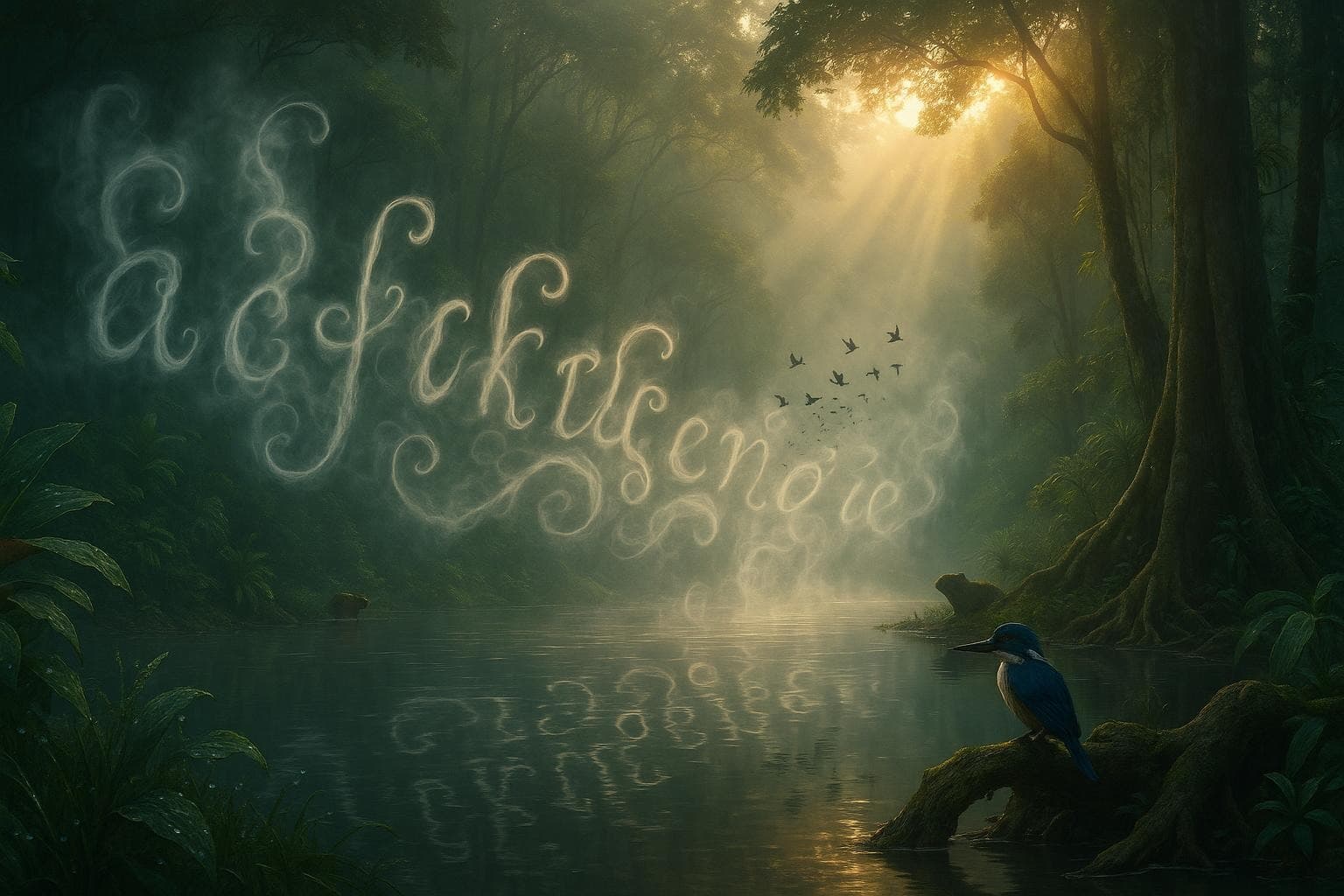
I write to know what I think. — Clarice Lispector
—What lingers after this line?
Discovery Through the Act of Writing
Clarice Lispector’s line asserts that writing is not the transcription of settled ideas but a method of inquiry. Instead of arriving with conclusions, the writer enters a page-sized laboratory where intuition is tested, refined, or discarded. Thought, in this view, does not precede language; it unfolds through it. Fittingly, Lispector’s own novels enact this process. In Agua Viva (1973) and The Passion According to G.H. (1964), consciousness appears midstream, as if the sentence were a net thrown into moving water. We watch awareness take shape in real time, which is precisely her point: by writing, the mind discovers what it means to mean.
A Tradition of Thinking-on-the-Page
Lispector’s insight joins a long lineage. Montaigne titled his works Essais (1580) — attempts — to signal that the page is a place to try thinking out. Later, Joan Didion echoed the sentiment in Why I Write (1976): she did not know what she thought until she wrote it. This continuity reveals that discovery-by-writing is not a quirk but a tradition. Moreover, diaries and notebooks preserve this exploratory mode. Virginia Woolf’s A Writer’s Diary (1953) shows ideas germinating in private, then maturing into essays and novels. The movement from notes to finished form illustrates how provisional sentences can incubate lasting insight.
How Language Clarifies Cognition
From a cognitive angle, writing externalizes thought, freeing scarce mental resources for analysis. Working memory has tight limits, and writing reduces load while enabling structure; Nelson Cowan (2001) estimates a capacity of about four chunks. Once on the page, fragments can be rearranged, compared, and questioned without overtaxing attention. Furthermore, the extended mind thesis (Clark and Chalmers, 1998) argues that tools become part of our cognitive system. A notebook or screen is not merely a record; it is a thinking partner. By iterating drafts, the writer creates feedback loops in which the text talks back, exposing assumptions and contradictions that were invisible in silent rumination.
Methods that Turn Writing into Knowing
Certain practices make discovery more likely. Peter Elbow’s freewriting (Writing Without Teachers, 1973) suspends judgment for a timed burst, letting latent connections surface. Julia Cameron’s morning pages (The Artist’s Way, 1992) similarly collect unfiltered thoughts, which later yield patterns worth pursuing. In both cases, speed and regularity disarm the inner censor so knowledge can emerge. Then comes the pivot from exploration to explanation. Outlining after drafting, not before, helps writers see the shape of what they have found. A simple sequence — freewrite, distill, structure, revise — turns nebulous impressions into claims, evidence, and implications. Thus process becomes epistemology in action.
Limits and Risks of Linguistic Framing
Yet language clarifies by constraining. The Sapir-Whorf hypothesis, even in moderate forms, warns that available words may channel perception, tempting us to mistake the describeable for the real. Similarly, Wittgenstein’s closing remark in Tractatus suggests that what cannot be spoken may still matter. To counter premature closure, writers can hold multiple phrasings, switch genres (notes, dialogue, metaphor), and revise after time has passed. Such tactics reopen possibility and prevent the first framing from ossifying into dogma. In this way, acknowledging language’s limits sustains the very curiosity that writing seeks to serve.
From Private Clarity to Shared Understanding
Finally, writing’s epistemic power scales when thinking meets an audience. Peer feedback, footnotes, and counterarguments turn solitary insight into communal knowledge. Charles Darwin’s notebooks (1837–38) trace evolving observations that later crystallized as natural selection, a shift made possible by iterative writing and review. Thus the circle closes: we write to know what we think, and then we refine what we know by writing for others. In returning to Lispector, we see that the page is not a mirror only; it is also a bridge, carrying a nascent thought from interior murmur to articulated understanding.
One-minute reflection
Why might this line matter today, not tomorrow?
Related Quotes
6 selectedThe most fundamental aggression to ourselves is to not have the courage to look at ourselves honestly and gently. — Pema Chödrön
Pema Chödrön
Pema Chödrön reframes “aggression” in a startling way: not as something we do outwardly, but as a subtle violence we direct inward when we refuse to face our own experience. Instead of fists or harsh words, the harm come...
Read full interpretation →The way to redeem your past is not to run from it, but to try to understand it. — Jay-Z
Z
Jay-Z’s line reframes redemption as something earned internally rather than granted externally. Instead of treating the past as a stain to hide, he suggests it can become raw material for growth once it is faced with hon...
Read full interpretation →All of humanity's problems stem from man's inability to sit quietly in a room alone. — Blaise Pascal
Blaise Pascal
Pascal’s line compresses an entire moral psychology into a single image: one person, one room, and the unnerving demand to be alone with oneself. Rather than blaming politics, fate, or scarcity first, he points to an inn...
Read full interpretation →Maybe you are searching among the branches, for what only appears in the roots. — Rumi
Rumi
Rumi’s line opens with a quiet diagnosis: we often look for solutions where they are most visible—among the “branches,” the outward symptoms of a life—rather than where causes actually begin. In practice, this can mean c...
Read full interpretation →Being entirely honest with oneself is a good exercise. — Sigmund Freud
Sigmund Freud
Freud’s remark that “being entirely honest with oneself is a good exercise” sounds deceptively simple, yet it points to one of the hardest forms of psychological work. Rather than referring to ordinary truth-telling, he...
Read full interpretation →Not until we are lost do we begin to understand ourselves. - Henry David Thoreau
Henry David Thoreau
This quote suggests that it is only when we face significant challenges or confusion that we truly start to understand our own capabilities, values, and identities.
Read full interpretation →More From Author
More from Clarice Lispector →Ask the world a question and let wonder answer with a path — Clarice Lispector
Clarice Lispector’s line begins with an outward gesture: “Ask the world a question.” Rather than treating reality as a fixed set of facts to be cataloged, she frames it as something we can address—almost like a conversat...
Read full interpretation →Dreams die when you wake, but action revives them. — Clarice Lispector
Lispector suggests that dreams—our nocturnal hopes or daytime aspirations—are ephemeral, vanishing in the harsh light of reality. Like Coleridge’s 'Kubla Khan' (1816), inspired by an interrupted dream, the fleeting natur...
Read full interpretation →To act or not to act, that is my question. — Clarice Lispector
Clarice Lispector's adaptation of the iconic Hamlet phrase reframes the existential debate: should we step boldly into action, or remain in thoughtful hesitation? This question lies at the heart of human experience, echo...
Read full interpretation →When you stir your spirit’s waters, unexpected tides will follow. — Clarice Lispector
Clarice Lispector’s evocative imagery of stirring the 'spirit’s waters' serves as a potent metaphor for self-exploration. Much like the surface of a still pond disrupted by a single stone, our inner world reacts powerful...
Read full interpretation →