
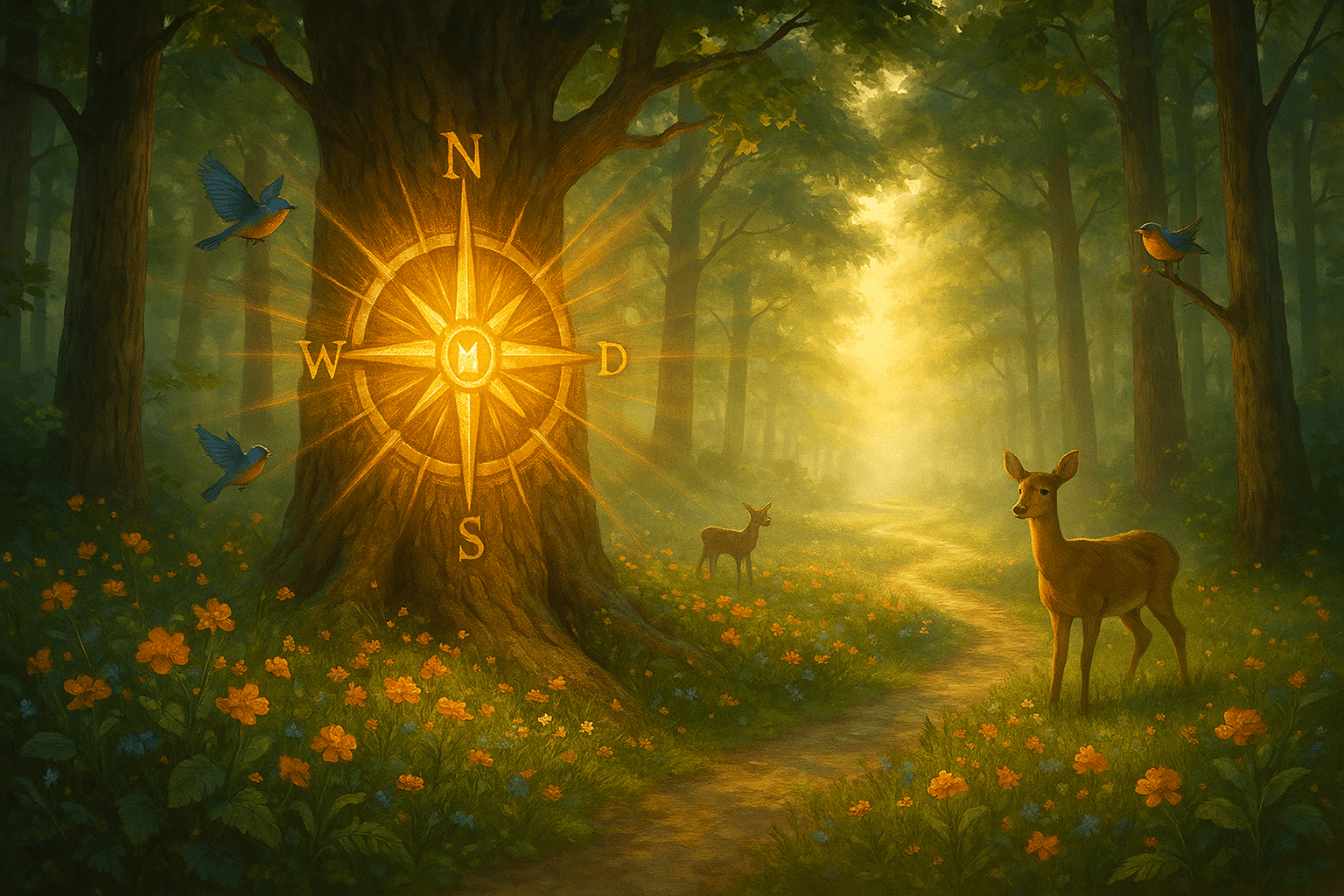
Joy is the compass pointing to your true north. — Rainer Maria Rilke
—What lingers after this line?
Joy as an Inner Navigational Tool
Rainer Maria Rilke’s metaphor positions joy as a personal compass, suggesting that the truest direction for a person’s life is revealed through what brings genuine happiness. Unlike fleeting pleasure, joy is presented here as a reliable signal—subtle, but persistent—indicating alignment with one’s values and passions. Just as a compass needle points north irrespective of surroundings, authentic joy remains a steady guide amidst life’s complexities.
Rilke’s Spiritual Perspective
Transitioning from metaphor to spiritual philosophy, Rilke’s works frequently advocate for a life lived from the inside out. In his Letters to a Young Poet (1903–1908), he urges listening to one’s inner experience as the truest authority. Here, joy isn’t mere euphoria; it’s the resonance felt when actions and aspirations harmonize with the soul’s purpose, gently nudging us toward our unique destinies.
Finding ‘True North’ in Uncertainty
When facing uncertainty, the idea of ‘true north’ offers both reassurance and direction. Travelers rely on the north star for orientation; similarly, seeking out what brings joy can provide clarity in moments of confusion or change. This approach reframes uncertainty—not as a void to fear, but as terrain navigable by following the emotional signals of fulfillment and enthusiasm.
Modern Psychology’s Affirmation
Bridging philosophy and science, positive psychology champions a similar principle. Researchers like Mihaly Csikszentmihalyi, in defining the concept of ‘flow,’ emphasize how engagement in intrinsically rewarding activities directs individuals toward meaning and accomplishment. These studies affirm Rilke’s wisdom: our most profound satisfaction often hints at the paths best suited to our authentic selves.
Cultivating a Joy-Focused Life
Returning to daily practice, embracing joy as a compass requires self-awareness and courage. It means honoring small sparks of delight—even in a world that favors practicality or external validation. Those who follow Rilke’s advice often report greater resilience and satisfaction, finding that, as they align with what feels true, life’s purpose becomes clearer, and challenges become more navigable.
One-minute reflection
What feeling does this quote bring up for you?
Related Quotes
6 selectedResistance is the secret to joy. — Rainer Maria Rilke
Rainer Maria Rilke
Rainer Maria Rilke’s assertion that ‘resistance is the secret to joy’ presents a compelling paradox. At first glance, resistance might conjure images of struggle or adversity—hardly the direct path to happiness.
Read full interpretation →Let your heart be your compass, your mind your map, your soul your guide, and you will never get lost. — Unknown
Unknown
This quote suggests that emotions and intuition, symbolized by the heart, are crucial in navigating life's journey. Trusting in your feelings can often lead to authentic and fulfilling choices.
Read full interpretation →We need joy as we need air. We need love as we need water. We need each other as we need the earth we share. — Maya Angelou
Maya Angelou
Maya Angelou’s words turn emotional needs into elemental ones, placing joy beside air, love beside water, and human connection beside the earth itself. By doing so, she refuses to treat happiness, affection, and communit...
Read full interpretation →Joy is a net of love by which you can catch souls. — Mother Teresa
Mother Teresa
Mother Teresa’s saying begins with a striking metaphor: joy is not merely a private feeling, but an instrument that reaches outward. By calling it a “net of love,” she suggests that joy gathers people in without force, p...
Read full interpretation →Adults can benefit from play as much as children. Go ahead and dance with your dog or build something just for fun. — Dr. Elinore McCance-Katz
Katz
At first glance, Dr. Elinore McCance-Katz’s quote sounds almost disarmingly simple, yet it challenges a common adult assumption: that play belongs mainly to childhood.
Read full interpretation →There is no true joy in a life lived closed up in the little shell of the self. — The Dalai Lama
The Dalai Lama
At its core, the Dalai Lama’s statement argues that a life centered only on personal comfort, status, or protection becomes emotionally cramped. The image of a ‘little shell’ suggests not strength but confinement: when p...
Read full interpretation →More From Author
More from Rainer Maria Rilke →To love is not about merging. It is a noble calling for the individual to ripen, to differentiate, to become a world in oneself in response to another. — Rainer Maria Rilke
At first glance, Rilke challenges one of romance’s most familiar ideals: the desire to ‘become one.’ Instead, he argues that genuine love is not a collapse of boundaries but a deepened encounter between two distinct peop...
Read full interpretation →Everything is blooming most recklessly; if it were voices instead of colors, there would be an unbelievable shrieking into the heart of the night. — Rainer Maria Rilke
At first glance, Rilke turns a peaceful image of blooming nature into something almost overwhelming. Flowers do not merely open; they burst forth “most recklessly,” suggesting a vitality so abundant that it exceeds calm...
Read full interpretation →And now let us believe in a long year that is given to us, new, untouched, full of things that have never been. — Rainer Maria Rilke
Rilke opens by shifting the tone from planning to believing: the year is “given to us,” implying something received rather than conquered. This framing matters because it replaces the pressure of achievement with the hum...
Read full interpretation →The purpose of life is to be defeated by greater and greater things. — Rainer Maria Rilke
Rainer Maria Rilke’s line treats “defeat” not as failure to avoid, but as a destination worth moving toward. The purpose of life, in this view, is measured by what can humble us—truths, beauties, responsibilities, or ide...
Read full interpretation →