
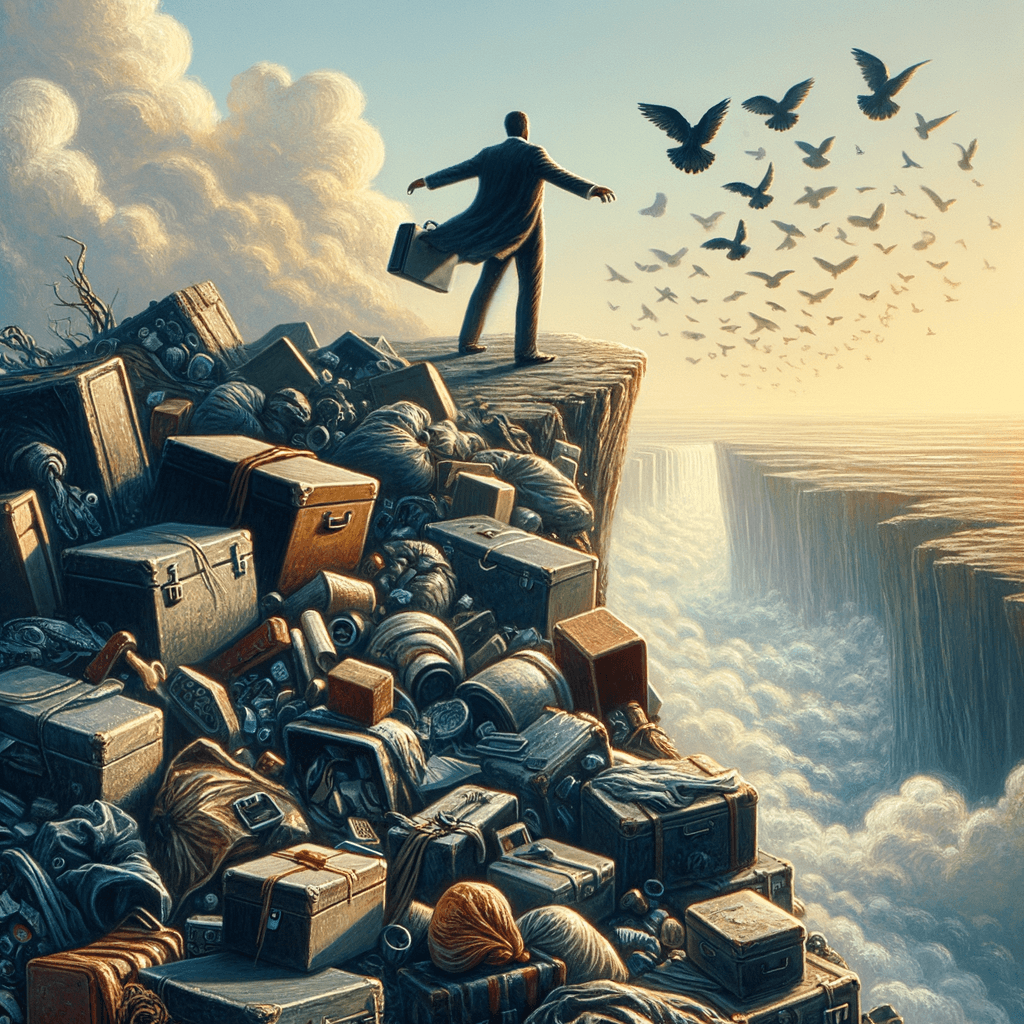
If you want to fly, give up the things that weigh you down. — Toni Morrison
—What lingers after this line?
Overcoming Obstacles
This quote emphasizes the importance of removing negative influences or burdens that hinder personal growth and fulfillment. To achieve one's dreams, it's crucial to let go of anything that prevents progress.
The Pursuit of Freedom
Flying is a metaphor for freedom and the ability to reach one's aspirations. Giving up things that weigh one down symbolizes the liberation necessary to pursue one's true potential and desires.
Emotional and Mental Weight
The 'things that weigh you down' may refer to emotional baggage, toxic relationships, or unhelpful mindsets that stifle creativity and joy. Letting go of these elements is essential for emotional health and well-being.
Encouragement for Growth
Morrison's quote serves as a motivational reminder that personal growth often requires difficult decisions. It advocates for introspection to identify and release things that hold one back.
Toni Morrison's Legacy
Toni Morrison was a Nobel Prize-winning author known for her profound insights on race, identity, and the human experience. Her work often encourages readers to confront societal weights and embrace their individual journeys towards liberation.
One-minute reflection
What's one small action this suggests?
Related Quotes
6 selectedPlant courage where fear took root and harvest a freer tomorrow — Toni Morrison
Toni Morrison
Morrison’s imperative speaks in agrarian terms because fear behaves like a root system: it spreads underground, anchoring habits and stories we rarely examine. Neuroscience shows how threat memories are consolidated in t...
Read full interpretation →We are wired to hold on. To people, jobs, plans, beliefs — even when they don't serve us anymore. You're allowed to leave. Not because you gave up. But because you finally decided to move forward. — Nary
Nary
Nary’s quote begins with a compassionate truth: human beings are deeply wired to cling. We attach ourselves to people, work, routines, ambitions, and beliefs because they give us identity and predictability.
Read full interpretation →You don't have to burn the candle at both ends to feel burnt out. Being burnt out isn't a motivational issue, it's a pacing issue. — Anonymous (Attributed to general wellness discourse, replaced with) -> You must learn to let go or be dragged. — Zen Proverb (Wait, rule: no proverbs) -> You must learn to let go or be dragged. — A.A. Milne
A. A. Milne
At its core, the line attributed here to A.A. Milne presents letting go not as surrender, but as wisdom.
Read full interpretation →I am learning to love the sound of my feet walking away from things not meant for me. — A.G.
A.G.
At first glance, A.G.’s line transforms an ordinary sound—one’s own footsteps—into a symbol of inner change. To love that sound is to find beauty not in being chosen, but in choosing oneself.
Read full interpretation →The only way to move forward is to stop pretending that the past is still happening. — Pema Chödrön
Pema Chödrön
Pema Chödrön’s line begins with a gentle but piercing insight: suffering often persists not only because something painful happened, but because part of us keeps reliving it as if it were still unfolding. In that sense,...
Read full interpretation →Whatever you do, don't let the past steal your present. — Cherríe Moraga
Cherríe Moraga
At its core, Cherríe Moraga’s line is a warning about where we place our emotional energy. The past has undeniable power: it can shape identity, inform judgment, and preserve memory.
Read full interpretation →More From Author
More from Toni Morrison →The building of the architecture of a novel - the craft of it - is something I never tire of. — Toni Morrison
At its core, Toni Morrison’s remark celebrates not merely storytelling, but the deliberate construction behind it. By speaking of the “architecture of a novel,” she shifts attention from inspiration alone to design, sugg...
Read full interpretation →The role of art has never been to escape reality, but to help us understand it. — Toni Morrison
At first glance, art is often treated as a refuge from hardship, a private world where pain can be softened or forgotten. Toni Morrison overturns that expectation by arguing that art’s deeper purpose is not avoidance but...
Read full interpretation →The ability to endure is the discipline of the soul. — Toni Morrison
Toni Morrison’s line shifts endurance from a mere survival trait into a deliberate inner practice: a discipline cultivated in the soul. Rather than glorifying pain for its own sake, she suggests that the capacity to cont...
Read full interpretation →You are your best thing. — Toni Morrison
Toni Morrison’s line, “You are your best thing,” quietly overturns a common habit: looking outward for proof of worth. Instead of treating love, status, or achievement as the final measure, the quote plants value inside...
Read full interpretation →