
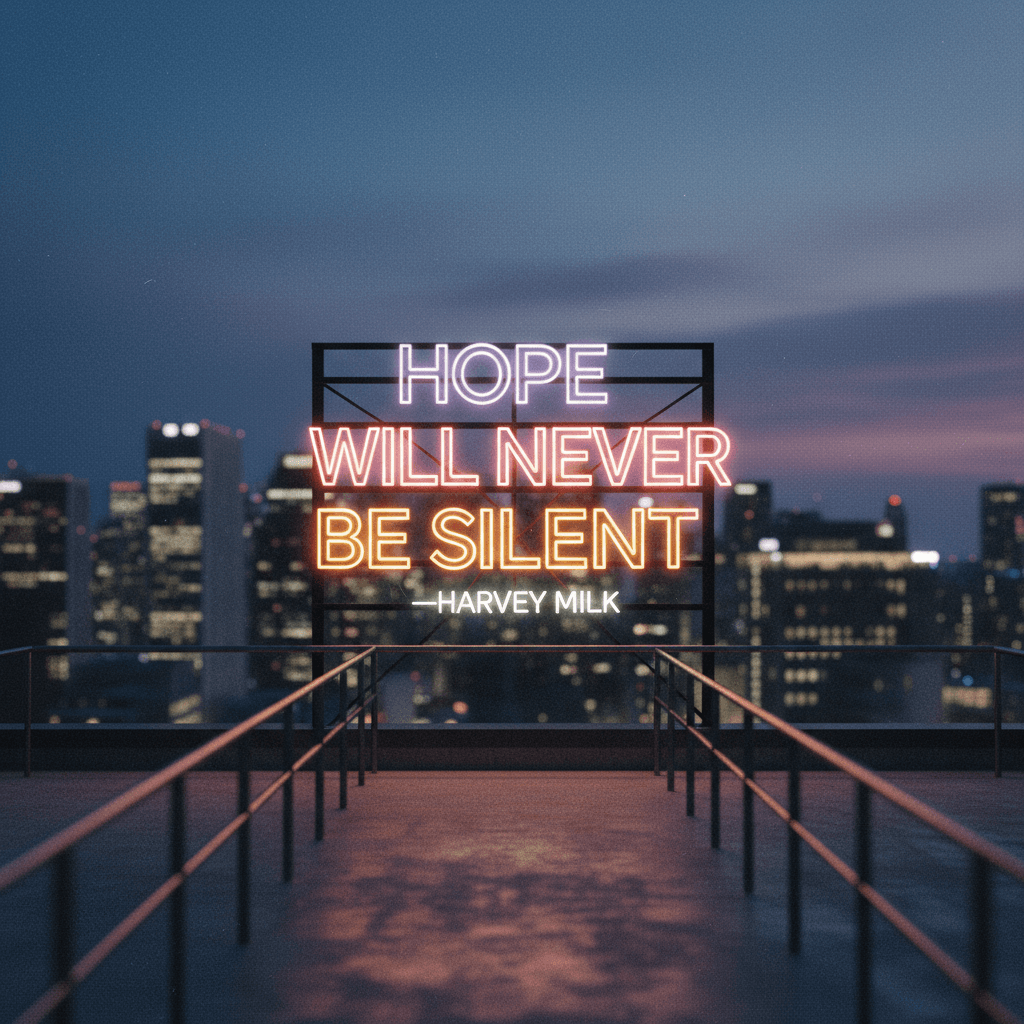
Hope will never be silent. — Harvey Milk
—What lingers after this line?
The Sound of Enduring Hope
Harvey Milk’s declaration insists that hope is not a private sentiment but a public act. To say hope will never be silent is to claim that it necessarily speaks—through testimony, visibility, and the steady courage of saying “we are here.” Because despair isolates while hope connects, its voice becomes the bridge between fear and collective possibility, turning individual longing into shared momentum.
Milk’s Moment and Message
Set against 1970s San Francisco, Milk’s refrain—“You’ve got to give them hope”—framed his campaigns and his service as one of the first openly gay elected officials in the United States. He helped defeat California’s Proposition 6 in 1978 by persuading ordinary people to come out and speak up. Even after his assassination that same year, a candlelight march of thousands carried his message forward, embodying the idea that hope’s voice endures beyond any single life (The Times of Harvey Milk, 1984).
Why Silence Sustains Injustice
Sociologist Elisabeth Noelle-Neumann’s Spiral of Silence (1974) shows how people conceal views they think are unpopular, allowing repression to harden. Milk’s strategy directly countered that spiral: public visibility normalizes presence. Moreover, Gordon Allport’s contact hypothesis (The Nature of Prejudice, 1954) suggests that authentic contact reduces bias—precisely the effect of coming out. Milk’s recorded words—“If a bullet should enter my brain, let that bullet destroy every closet door”—underline how breaking silence was, for him, a moral imperative.
Echoes Across Movements
The AIDS activism of ACT UP crystallized Milk’s logic with the 1987 slogan “Silence = Death,” translating private grief into life-saving pressure for research and policy. Earlier and later movements echoed the same cadence: spirituals of the U.S. civil rights era carried hope into the streets; the Women’s Social and Political Union’s “Deeds Not Words” (c. 1903) turned suffrage into spectacle. Across struggles, the through-line is clear—hope amplifies itself by refusing secrecy.
Hope Beyond Optimism
Importantly, Milk’s hope was not wishful thinking but disciplined resolve. Václav Havel’s Disturbing the Peace (1990) clarifies the distinction: hope is not the conviction that things will turn out well, but that they make sense to pursue. In a similar vein, C. R. Snyder’s Hope Theory (1991) defines hope as agency plus pathways—the will and the ways. Thus, voice becomes both a signal of commitment and a method for creating routes where none seem to exist.
How Hope Learns to Speak
From this perspective, voice is a craft: storytelling that names harm and imagines repair; testimonies that convert statistics into neighbors; and rituals—marches, songs, vigils—that turn solitary courage into shared capacity. Milk’s Castro camera shop doubled as a listening post and loudspeaker, his bullhorn converting local stories into civic argument. In practice, every honest story told aloud becomes an invitation for the next voice to join.
Carrying the Voice Forward
Finally, the digital age multiplies both reach and responsibility. While platforms can distort attention, they also enable rapid coalitions that echo Milk’s imperative: give them hope, out loud. Sustainable movements pair audacity with care—verifying facts, protecting the vulnerable, and celebrating incremental wins as proof that speaking works. In that ongoing chorus, Milk’s line remains a directive and a promise: hope, once voiced, teaches others how to answer.
One-minute reflection
What does this quote ask you to notice today?
Related Quotes
6 selectedJust because your light flickers does not mean it is about to go out. — Yohancé Salimu
Yohancé Salimu
At first glance, Yohancé Salimu’s line separates appearance from reality. A flicker suggests instability, fatigue, or interruption, yet it does not automatically signal extinction.
Read full interpretation →Today's tears water tomorrow's gardens. — Matshona Dhliwayo
Matshona Dhliwayo
At first glance, Matshona Dhliwayo’s line transforms grief into something unexpectedly fertile. Tears, usually seen as signs of pain or loss, become water for a future garden, suggesting that suffering is not merely endu...
Read full interpretation →Hope is passion for the possible. — Søren Kierkegaard
Søren Kierkegaard
At first glance, Kierkegaard’s line transforms hope from a passive feeling into an active force. To call hope “passion for the possible” means that hope is not mere daydreaming; rather, it is an inward energy that leans...
Read full interpretation →A ship should not ride on a single anchor, nor life on a single hope. — Epictetus
Epictetus
At first glance, Epictetus turns a practical image into a moral lesson: a ship secured by only one anchor is vulnerable to shifting winds, rough tides, and hidden strain. In the same way, a life fastened to a single hope...
Read full interpretation →We need never be hopeless because we can never be irreparably broken. — John Green
John Green
At its core, John Green’s line reframes hope not as naive optimism but as a durable truth about being human. To say we need never be hopeless is to suggest that no injury, failure, or grief fully cancels the possibility...
Read full interpretation →Hope is a star in the darkness, illuminating the path ahead when you need it most. Every fall and every drop of sweat contribute to the crowning of ultimate victory. As long as you have dreams in your heart, you will have strength under your feet.
Unknown
This metaphor compares hope to a star that provides light in dark times. It implies that hope helps to navigate through challenges by offering direction and clarity.
Read full interpretation →More From Author
More from Harvey Milk →