
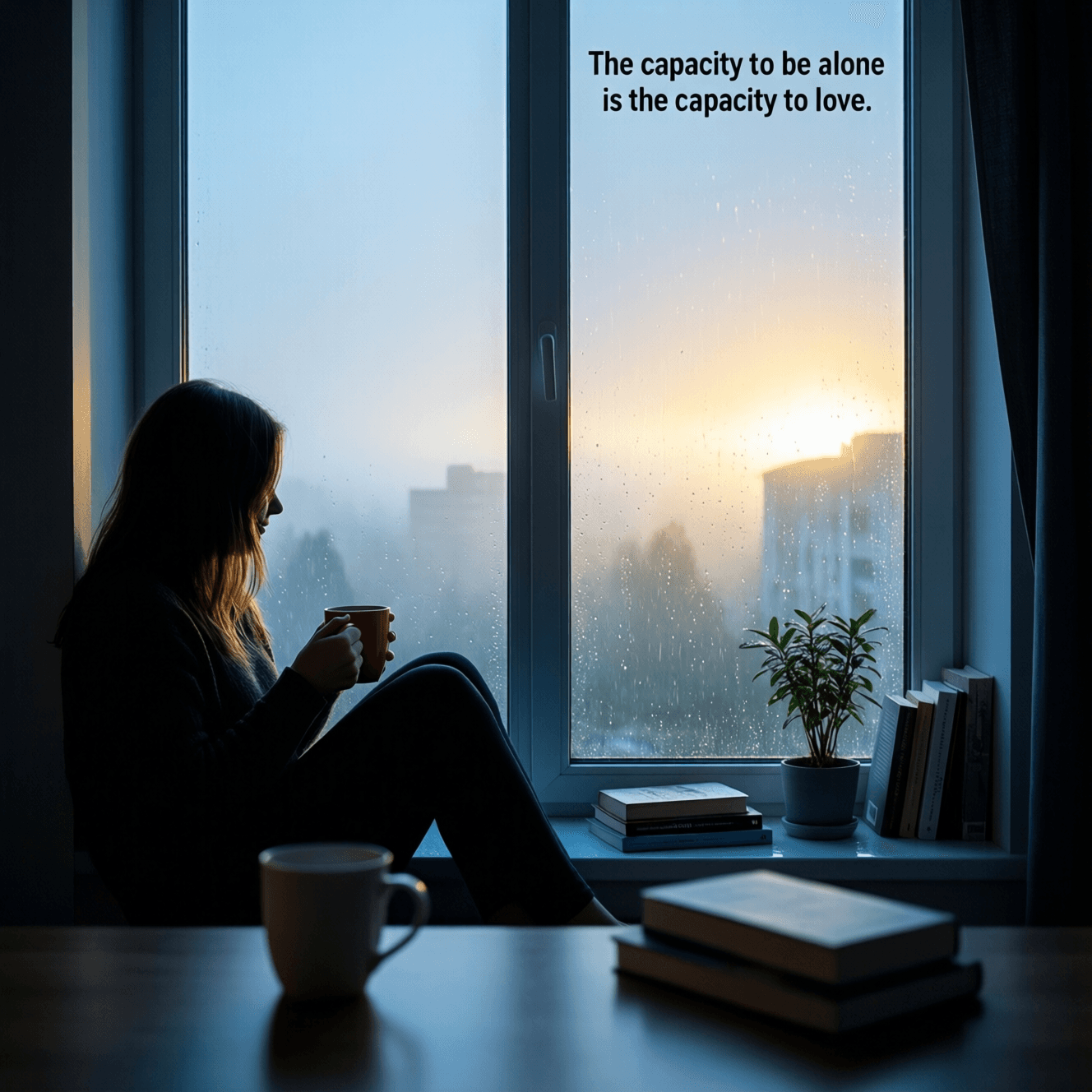
The capacity to be alone is the capacity to love. — Bell Hooks
—What lingers after this line?
What Hooks Connects: Aloneness and Love
Bell hooks links two abilities that people often treat as opposites: being alone and loving well. Her claim suggests that love is not primarily a remedy for loneliness; instead, it’s a skill that becomes more possible when a person can remain emotionally steady without constant companionship. From there, the quote reframes solitude as a kind of inner competence. If you can tolerate your own company—your thoughts, doubts, and needs—then you are less likely to treat another person as a crutch, and more likely to meet them as an equal.
Why Fear of Solitude Distorts Relationships
If aloneness feels unbearable, relationships can become driven by urgency rather than care. In that state, affection easily turns into clinging, monitoring, or settling—behaviors that may look like devotion but often function as anxiety management. Consequently, love gets confused with attachment to relief. hooks’ line implies that when the goal is merely to avoid being alone, the relationship can start to revolve around keeping someone close at any cost, rather than nurturing their growth and freedom.
Self-Intimacy as the First Practice of Love
The capacity to be alone also points to self-intimacy: knowing what you feel, why you feel it, and what you truly need. This inner clarity is not self-absorption; rather, it becomes the groundwork for honesty, because you can name your experience without forcing another person to guess or fix it. Building on that, solitude offers a space to develop patience and self-compassion. When you can soothe yourself and stay present with discomfort, you bring less reactivity into love—and more steadiness when conflict or uncertainty appears.
Freedom, Not Possession, as a Measure of Love
Once a person can stand alone, love can shift from possession to choice. Instead of “I need you so I don’t fall apart,” it becomes “I choose you while still being whole.” This changes the emotional tone of partnership, making room for boundaries and respect. In that light, hooks’ idea aligns with the ethical side of love: allowing the other person to be fully themselves. When solitude is survivable, you don’t have to control, chase, or merge; you can stay connected while honoring separateness.
A Practical Example: The Difference in Conflict
Consider a common moment: a partner asks for an evening alone after a hard week. Someone who equates love with constant togetherness may experience that request as rejection and respond with guilt-tripping or interrogation. The real issue isn’t the evening apart; it’s the fear of being left with oneself. However, someone practiced in solitude can hear the same request and stay regulated: they may miss their partner, but they don’t collapse into panic. That emotional room makes kindness easier, and it often leads to a healthier reconnection afterward.
Solitude as Ongoing Training for Love
Importantly, hooks’ statement doesn’t romanticize isolation; it highlights capacity. The goal isn’t to withdraw from intimacy, but to strengthen the inner base that intimacy rests on, so love isn’t asked to do the impossible work of completing a person. Ultimately, the quote proposes a quiet discipline: spending enough time alone to become trustworthy to yourself. As that trust grows, love becomes less of a rescue mission and more of a mutual offering—two people choosing connection without abandoning their own inner lives.
One-minute reflection
Why might this line matter today, not tomorrow?
Related Quotes
6 selectedBut many of us seek community solely to escape the fear of being alone. Knowing how to be solitary is central to the art of loving. — bell hooks
bell hooks
Bell hooks begins with a quiet but difficult observation: not every search for community is rooted in love. Sometimes, we reach for others because solitude feels threatening, as though being alone exposes a lack within u...
Read full interpretation →I care for myself. The more solitary, the more friendless, the more unsustained I am, the more I will respect myself. — Charlotte Brontë
Charlotte Brontë
Charlotte Brontë’s words begin as a quiet but forceful act of self-possession. Rather than treating loneliness as proof of failure, the speaker transforms it into evidence of resilience.
Read full interpretation →In a world bustling with voices, the solitude of one's own company becomes a sanctuary. — Jonathan Harnisch
Jonathan Harnisch
At its core, Jonathan Harnisch’s quote sets up a vivid contrast: the world is crowded with voices, demands, and distractions, while solitude offers a place of quiet restoration. Rather than depicting aloneness as emptine...
Read full interpretation →Being alone at home is like having a sanctuary for your soul, where you can recharge, reflect, and rediscover the beauty of your own company. — Melody Beattie
Melody Beattie
At its core, Melody Beattie’s quote transforms the ordinary idea of being alone at home into something sacred. Rather than framing solitude as emptiness, she presents it as a sanctuary—a place where the self is protected...
Read full interpretation →The whole value of solitude depends upon oneself: it may be a sanctuary or a prison, a haven of repose or a place of punishment. — Philip Hamerton
Philip Hamerton
At first glance, Philip Hamerton’s remark presents solitude as neither inherently good nor bad, but profoundly shaped by the person who enters it. To one mind, being alone becomes a sanctuary—a space for restoration, ref...
Read full interpretation →Solitude is the salt of personhood. It brings out the authentic flavor of every experience. — May Sarton
May Sarton
May Sarton’s metaphor begins with a domestic certainty: salt doesn’t replace food; it reveals what’s already there. In the same way, solitude is not presented as an escape from life but as a condition that clarifies it,...
Read full interpretation →More From Author
More from bell hooks →But many of us seek community solely to escape the fear of being alone. Knowing how to be solitary is central to the art of loving. — bell hooks
Bell hooks begins with a quiet but difficult observation: not every search for community is rooted in love. Sometimes, we reach for others because solitude feels threatening, as though being alone exposes a lack within u...
Read full interpretation →Your presence is a form of resistance against a culture that profits from your isolation. Show up for those you love, even when it is inconvenient. — bell hooks
At first glance, bell hooks reframes something ordinary—being present for others—as a political and moral act. Her words suggest that care is not merely private sentiment; rather, it pushes back against a social order th...
Read full interpretation →If you don't build your own sanctuary, you will spend your life living in the wreckage of someone else's expectations. — Bell Hooks
Bell hooks frames sanctuary as more than a physical refuge; it is an inner and outer space where a person can live by values they have consciously chosen. At first glance, the quote sounds like a warning about independen...
Read full interpretation →The art of living is a constant process of refining one's own sanctuary against the tide of external expectations. — bell hooks
At its core, bell hooks presents living not as a finished achievement but as a continuous act of shaping and reshaping the self. The phrase “constant process” suggests that identity, peace, and integrity are never perman...
Read full interpretation →