
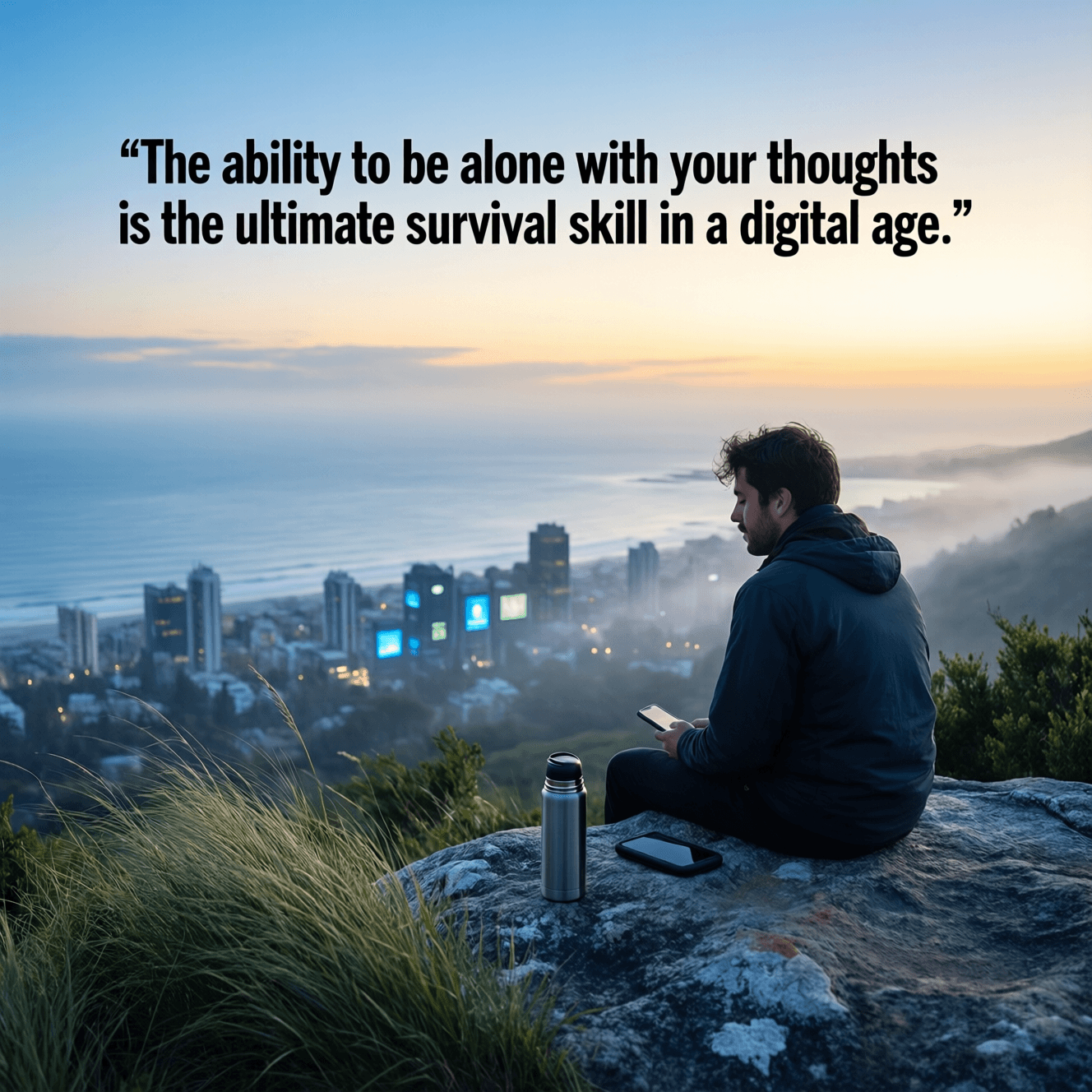
The ability to be alone with your thoughts is the ultimate survival skill in a digital age. — Naval Ravikant
—What lingers after this line?
A New Definition of Survival
Naval Ravikant reframes “survival” away from physical hardship and toward cognitive resilience. In a digital age, the threats are rarely predators or famine; instead, they are distraction, manipulation, and the slow erosion of attention. If you cannot sit with your own thoughts, your inner life becomes dependent on external input, and that dependence makes you easy to steer. From there, his claim suggests a practical hierarchy: before you can make good choices about work, relationships, or beliefs, you must be able to hear your own mind clearly. Solitude becomes not a luxury but a baseline capability—like reading, budgeting, or basic fitness—because it protects the instrument that makes every other decision.
Attention as the Scarce Resource
Once survival is understood as mental self-preservation, attention emerges as the scarce resource. Digital platforms compete to occupy every idle moment, leaving fewer gaps for reflection or self-correction. The result is a life lived in reaction: you respond to notifications, trends, and arguments rather than shaping your own priorities. Consequently, being alone with your thoughts functions like a firewall. It creates a protected space where you can notice what you actually want, what you fear, and what you’ve been avoiding. In that sense, solitude is not merely quiet; it is ownership of your attention, which determines what kind of person you become over time.
Solitude as an Antidote to Algorithmic Drift
Because algorithms learn what captures you, they can gradually pull you toward stronger stimuli—more outrage, more novelty, more certainty. Over time, this can create “algorithmic drift,” where your worldview is subtly shaped by what keeps you engaged rather than what is true or wise. If you never step away, you may not notice the direction you’re being carried. This is where Ravikant’s emphasis becomes strategic: solitude is the moment you regain navigational control. Even a short period without inputs allows you to test your beliefs against your own reasoning and lived experience. By returning to your thoughts unprompted, you interrupt the invisible hand that otherwise curates your emotions and opinions.
Emotional Regulation Without Constant Stimulation
Moreover, constant stimulation can become a form of emotional anesthesia. Many people reach for a feed, a video, or a chat the instant discomfort appears—boredom, loneliness, anxiety, or uncertainty. Yet if discomfort always triggers escape, the mind never learns that it can endure and metabolize hard feelings. Being alone with your thoughts builds tolerance for the full range of inner experience. It’s similar to gradually strengthening a muscle: you learn that a troubling idea can be observed without immediate action, and a painful emotion can pass without being drowned out. That capacity is “survival” because it prevents fragile coping loops, where life’s normal stressors become crises demanding constant digital relief.
Creativity and Problem-Solving in Quiet
In addition, solitude is a practical engine for insight. Many solutions require uninterrupted time for the mind to wander, connect ideas, and notice patterns. History is full of examples that celebrate this process, such as Henry David Thoreau’s deliberate retreat in *Walden* (1854), which frames solitude as a tool for clarifying what matters. The transition from consumption to creation often starts with silence. When you remove the steady stream of other people’s conclusions, your mind has room to generate its own. Over weeks and months, this can compound into original work and clearer judgment—advantages that feel increasingly rare when everyone is inundated with the same headlines and memes.
Practical Ways to Train the Skill
If solitude is a skill, it can be trained with small, repeatable constraints. Start by creating pockets of “no input” time: walks without headphones, short waits without checking a phone, or a morning routine that delays screens. These micro-practices teach the brain that emptiness is not an emergency. Then, as the habit strengthens, you can extend the window—journaling, meditation, or simply sitting and letting thoughts arise without immediately judging them. The point isn’t to have only pleasant thoughts; it’s to become someone who can face whatever appears. In the logic of Ravikant’s quote, that steady ability to be alone becomes a kind of modern self-reliance.
One-minute reflection
What does this quote ask you to notice today?
Related Quotes
6 selectedI care for myself. The more solitary, the more friendless, the more unsustained I am, the more I will respect myself. — Charlotte Brontë
Charlotte Brontë
Charlotte Brontë’s words begin as a quiet but forceful act of self-possession. Rather than treating loneliness as proof of failure, the speaker transforms it into evidence of resilience.
Read full interpretation →But many of us seek community solely to escape the fear of being alone. Knowing how to be solitary is central to the art of loving. — bell hooks
bell hooks
Bell hooks begins with a quiet but difficult observation: not every search for community is rooted in love. Sometimes, we reach for others because solitude feels threatening, as though being alone exposes a lack within u...
Read full interpretation →To have passed through life and never experienced solitude is to have never known oneself. — Joseph Krutch
Joseph Krutch
Joseph Krutch’s statement begins with a striking reversal: what many people avoid—solitude—he treats as essential to a meaningful life. In his view, simply moving through the world surrounded by noise, duties, and compan...
Read full interpretation →The mind needs solitude in the same way a forest needs quiet after a storm. It is not because nothing is happening; it is because that is when everything begins to grow. — Pico Iyer
Pico Iyer
Pico Iyer compares the mind to a forest recovering after a storm, and the image immediately shifts our understanding of solitude. Rather than treating aloneness as emptiness, he presents it as a necessary period of renew...
Read full interpretation →The real problem with being alone is that you're stuck with yourself all day. Make sure you're someone you actually like hanging out with. — Maya Angelou
Maya Angelou
Maya Angelou’s line begins with a sharp but compassionate truth: being alone is difficult not merely because others are absent, but because the self becomes unavoidable. In solitude, distraction fades, and our habits, th...
Read full interpretation →If you want to be happy, learn to be alone without being lonely. Learn that being alone does not mean being unhappy. — Michael Josephson
Michael Josephson
Michael Josephson’s remark turns on a subtle but life-changing distinction: being alone is a circumstance, while being lonely is an emotional interpretation of that circumstance. In other words, solitude does not automat...
Read full interpretation →More From Author
More from Naval Ravikant →A rational person can find peace by cultivating indifference to things outside of their control. — Naval Ravikant
At its heart, Naval Ravikant’s statement echoes a classic Stoic principle: inner peace grows when we stop attaching our well-being to events we cannot govern. Rather than encouraging apathy toward life itself, this kind...
Read full interpretation →Real confidence is not needing to prove anything. — Naval Ravikant
At first glance, Naval Ravikant’s remark separates genuine confidence from the urge to advertise it. If someone truly trusts their own worth, they do not need constant applause, argument, or comparison to confirm it.
Read full interpretation →Happiness isn't everlasting tranquility. Happiness is solving good problems. — Naval Ravikant
At first glance, Naval Ravikant’s line overturns a common fantasy: that happiness means reaching a permanent state of peace where nothing difficult ever happens. Instead, he reframes joy as something active rather than p...
Read full interpretation →If you want to be free, you must practice self-mastery. — Naval Ravikant
At first glance, Naval Ravikant’s statement reframes freedom as something deeper than external choice or social permission. He implies that liberty is not simply the absence of restraint; rather, it is the ability to gov...
Read full interpretation →