
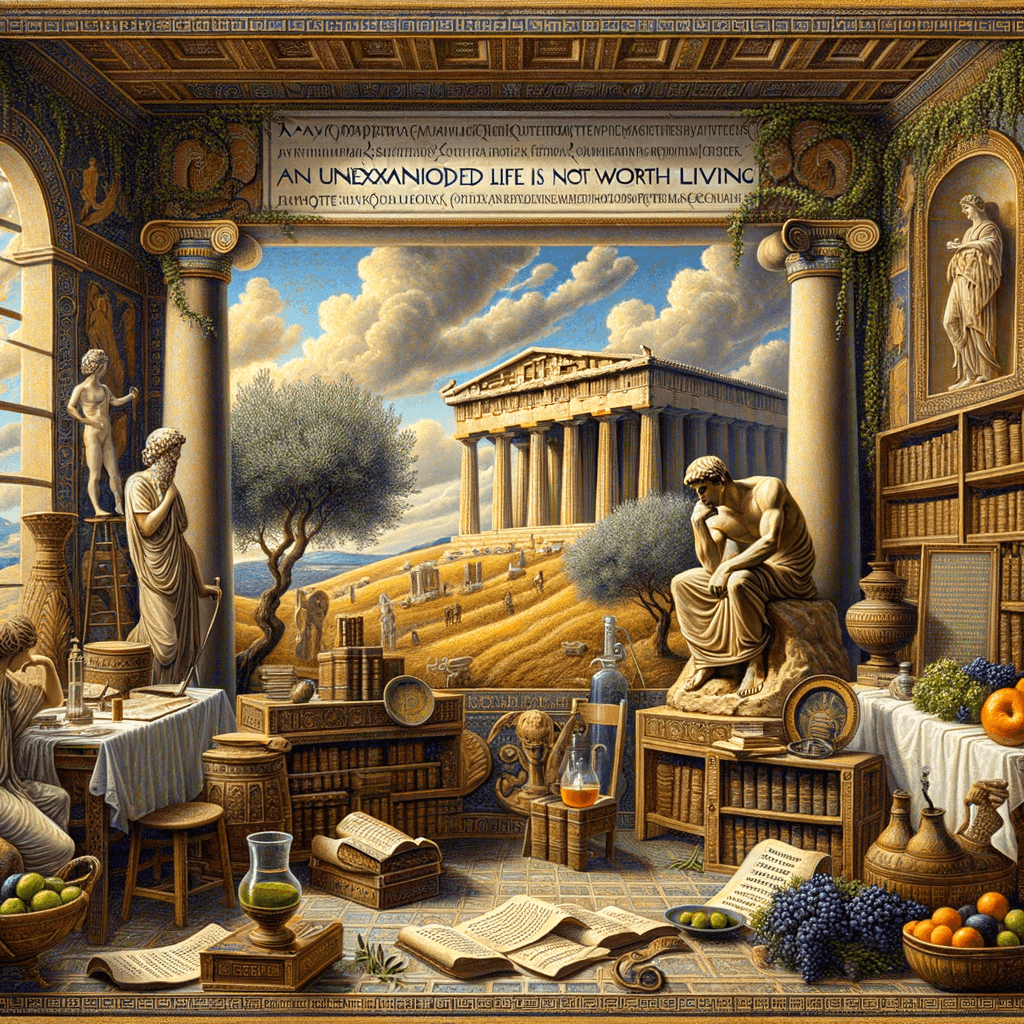
An unexamined life is not worth living. — Socrates, Ancient Greece.
—What lingers after this line?
Importance of Self-Reflection
Socrates advocates for the necessity of self-examination and introspection. He suggests that without questioning our beliefs, values, and actions, we risk leading a life that lacks purpose and meaning.
Philosophical Inquiry
This quote underscores the value of philosophical inquiry. Engaging in deep thoughts and discussions allows individuals to understand themselves and the world around them, enhancing their overall existence.
Moral and Ethical Growth
Socrates emphasizes that examining one's life is essential for moral and ethical growth. Understanding one's choices and the consequences they carry is crucial in becoming a virtuous person.
Cultural Context of Ancient Greece
In ancient Greece, philosophy was central to culture and society. Socratic teachings encouraged individuals to pursue wisdom and knowledge, challenging the societal norms of the time for a more reflective life.
Legacy of Socratic Thought
Socrates is often regarded as one of the founders of Western philosophy. His method of questioning, known as the Socratic method, fosters critical thinking and the continuous pursuit of truth and understanding.
One-minute reflection
What's one small action this suggests?
Related Quotes
6 selectedThe most fundamental aggression to ourselves is to not have the courage to look at ourselves honestly and gently. — Pema Chödrön
Pema Chödrön
Pema Chödrön reframes “aggression” in a startling way: not as something we do outwardly, but as a subtle violence we direct inward when we refuse to face our own experience. Instead of fists or harsh words, the harm come...
Read full interpretation →The way to redeem your past is not to run from it, but to try to understand it. — Jay-Z
Z
Jay-Z’s line reframes redemption as something earned internally rather than granted externally. Instead of treating the past as a stain to hide, he suggests it can become raw material for growth once it is faced with hon...
Read full interpretation →All of humanity's problems stem from man's inability to sit quietly in a room alone. — Blaise Pascal
Blaise Pascal
Pascal’s line compresses an entire moral psychology into a single image: one person, one room, and the unnerving demand to be alone with oneself. Rather than blaming politics, fate, or scarcity first, he points to an inn...
Read full interpretation →Maybe you are searching among the branches, for what only appears in the roots. — Rumi
Rumi
Rumi’s line opens with a quiet diagnosis: we often look for solutions where they are most visible—among the “branches,” the outward symptoms of a life—rather than where causes actually begin. In practice, this can mean c...
Read full interpretation →Being entirely honest with oneself is a good exercise. — Sigmund Freud
Sigmund Freud
Freud’s remark that “being entirely honest with oneself is a good exercise” sounds deceptively simple, yet it points to one of the hardest forms of psychological work. Rather than referring to ordinary truth-telling, he...
Read full interpretation →Not until we are lost do we begin to understand ourselves. - Henry David Thoreau
Henry David Thoreau
This quote suggests that it is only when we face significant challenges or confusion that we truly start to understand our own capabilities, values, and identities.
Read full interpretation →More From Author
More from Socrates, Ancient Greece. →