
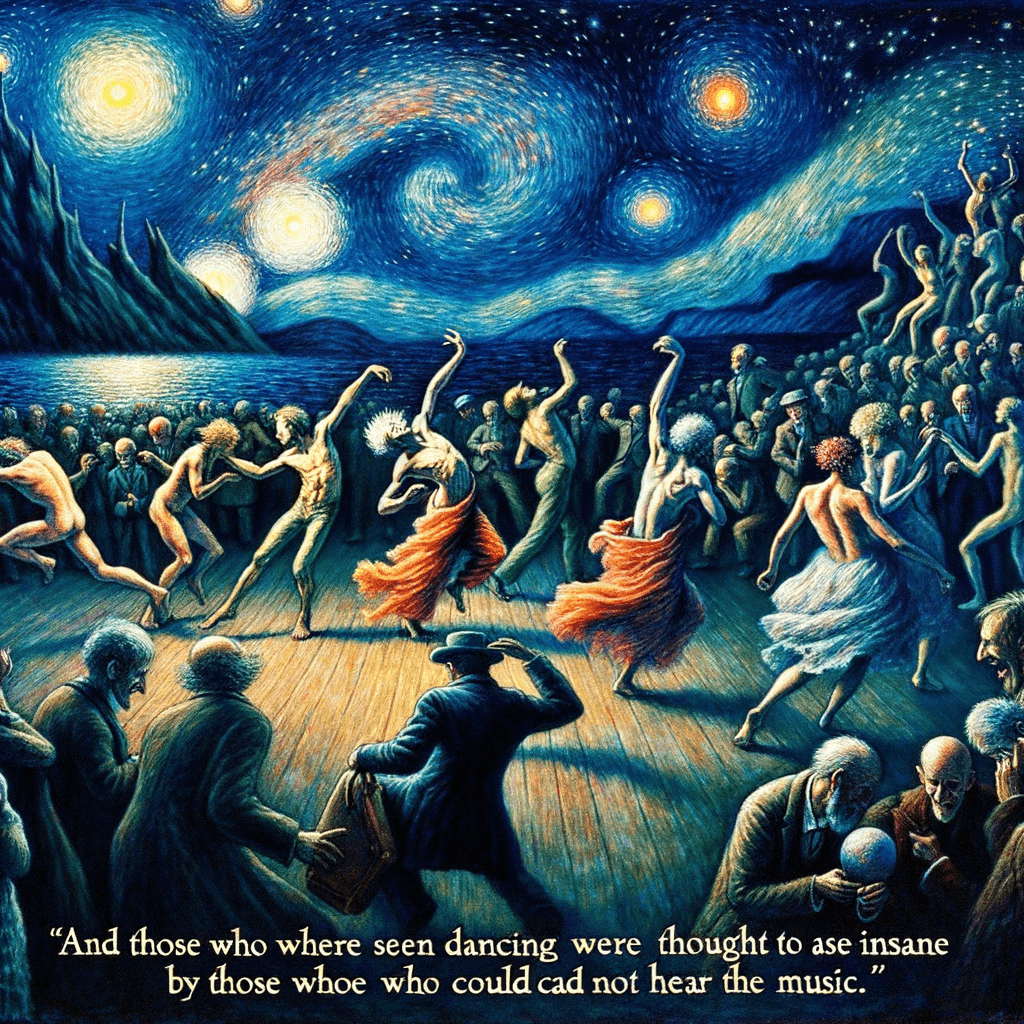
And those who were seen dancing were thought to be insane by those who could not hear the music. - Friedrich Nietzsche
—What lingers after this line?
Perception and Reality
This quote highlights the difference between perception and reality. What one person understands and experiences may be completely misunderstood by another based on their limited perspective.
Individual Experience
It suggests that individual experiences and emotions can deeply influence how one perceives the actions of others. Without understanding the underlying context, one might misinterpret those actions.
Creativity and Nonconformity
The quote celebrates the creativity and nonconformity of individuals who embrace their unique visions and passions, even if others cannot understand or appreciate them.
Misunderstanding and Judgment
It underscores the ease with which people can judge and label others as 'insane' or 'abnormal' simply because they do not or cannot understand their behaviors or ideas.
Empathy and Open-mindedness
The quote calls for greater empathy and open-mindedness. Observing and trying to understand others' perspectives could prevent misunderstandings and foster a more inclusive society.
Historical and Philosophical Context
Friedrich Nietzsche, a 19th-century German philosopher, often challenged societal norms and conventions. His works frequently explore themes of individuality, existentialism, and the meaning of life, mirroring the essence of this quote.
One-minute reflection
What does this quote ask you to notice today?
Related Quotes
6 selectedOriginality is the best form of rebellion. — Mike Sasso
Mike Sasso
Mike Sasso’s line reframes rebellion in a striking way: instead of imagining protest only as noise, confrontation, or spectacle, it presents originality as a subtler but often more enduring act of defiance. To create som...
Read full interpretation →If you have not been called a defiant, incorrigible, unmannerly woman, there is still time. — Clarissa Pinkola Estés
Clarissa Pinkola Estés
Clarissa Pinkola Estés turns a familiar set of accusations—“defiant,” “incorrigible,” “unmannerly”—into a kind of initiation rather than a shame sentence. The line suggests that these labels often appear not when someone...
Read full interpretation →I have no desire to fit in. I've always been a bit of a weirdo. — Erykah Badu
Erykah Badu
Erykah Badu’s line begins with a clean refusal: she doesn’t merely fail to fit in—she has no desire to. That distinction matters because it frames difference as a choice, not a shortcoming.
Read full interpretation →The world is not a rectangle. — Zaha Hadid
Zaha Hadid
Zaha Hadid’s line sounds almost childlike at first—of course the world isn’t a rectangle—but its force comes from what it rejects: the quiet assumption that life should be organized into right angles and tidy grids. In o...
Read full interpretation →When you don't dress like everyone else, you don't have to think like everyone else. — Iris Apfel
Iris Apfel
Iris Apfel’s line treats clothing as more than decoration; it becomes a public claim to personal agency. When you choose what genuinely delights you rather than what blends in, you rehearse the act of deciding for yourse...
Read full interpretation →Art is what we call it when the human soul shows up. — Seth Godin
Seth Godin
Seth Godin’s line reframes art as a moment of arrival: art happens when something distinctly human becomes visible through what we make. In this view, technique and output matter, but they are secondary to presence—the f...
Read full interpretation →More From Author
More from Friedrich Nietzsche →I am superior to you only in one point: I'm awake, whereas you are only half awake, or completely asleep sometimes. — Friedrich Nietzsche
At first glance, Nietzsche’s remark sounds like a sharp insult, yet it quickly reveals itself as something more philosophical. By claiming superiority only in being “awake,” he shifts the issue from status to consciousne...
Read full interpretation →He who cannot obey himself will be commanded. That is the nature of living creatures. — Friedrich Nietzsche
Nietzsche’s line presents a stark warning: if a person cannot govern his own impulses, habits, and fears, someone or something else will do the governing for him. In that sense, obedience is never absent; it merely shift...
Read full interpretation →No price is too high to pay for the privilege of owning yourself. — Friedrich Nietzsche
Nietzsche’s line treats self-ownership not as a pleasant ideal but as a hard-won privilege. To “own yourself” is to be governed from within rather than steered by fashion, fear, or the expectations of the crowd.
Read full interpretation →He who has a why to live can bear almost any how. - Friedrich Nietzsche
This quote emphasizes the importance of having a purpose or meaning in life. According to Nietzsche, individuals who have a clear reason for their existence are better equipped to endure hardships and challenges.
Read full interpretation →