
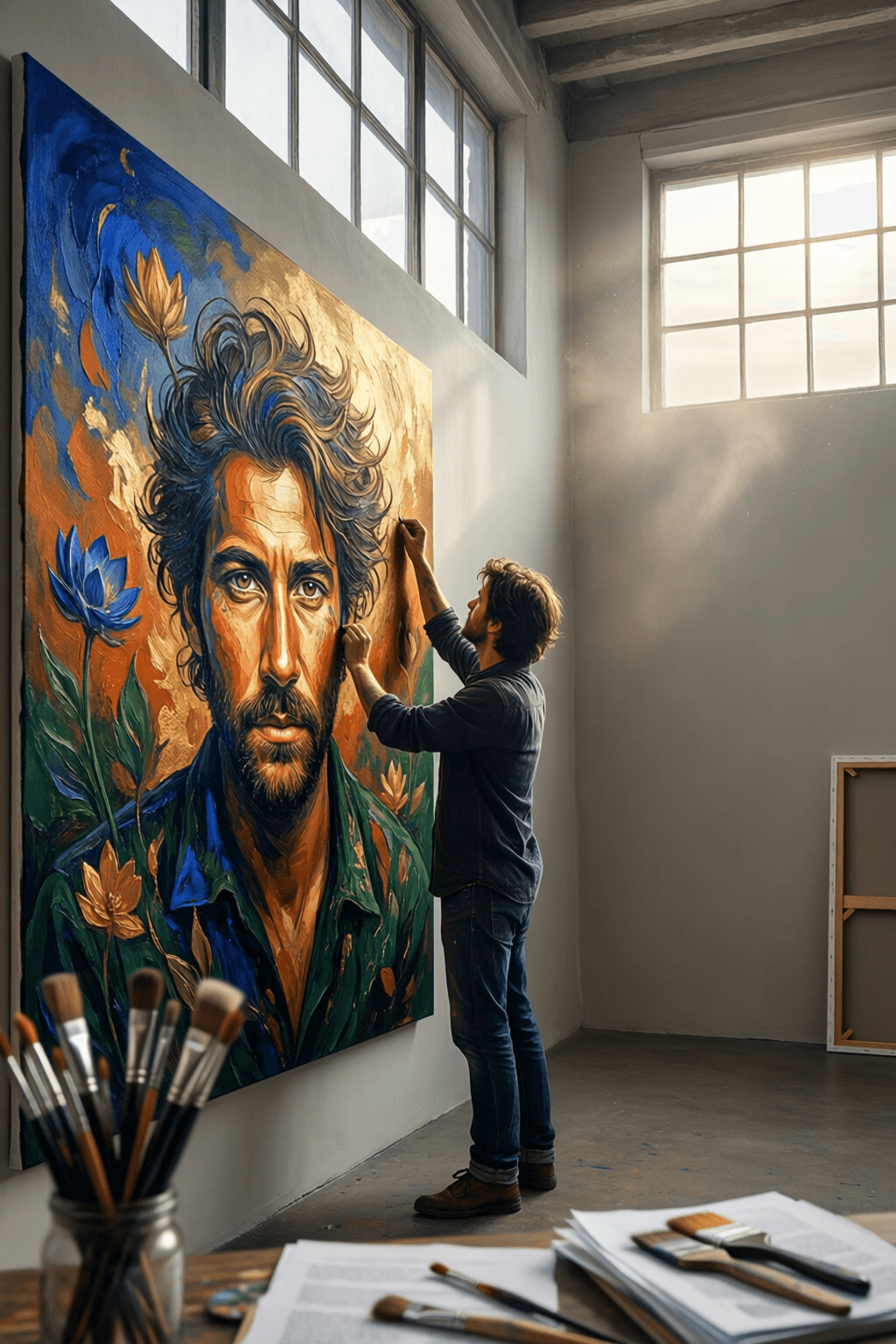
Art is a form of standing up for yourself, a way to declare that your internal world has a right to exist. — Rebecca Solnit
—What lingers after this line?
Creating as Self-Assertion
Rebecca Solnit frames art not as decoration but as an act of self-defense and self-definition. In this view, to make something—a poem, painting, song, or story—is to insist that one’s private perceptions deserve space in the shared world. Rather than asking permission, the artist quietly or boldly announces, through form and image, that an inner life exists and matters. From there, the quote gains political and emotional force. It suggests that creation becomes especially vital when a person feels overlooked, dismissed, or silenced. Art then is more than expression; it is a stance against erasure, a way of saying that what is felt inwardly cannot be reduced to silence.
The Inner World Made Visible
Once Solnit links art to self-assertion, the next step is visibility. Inner life—memory, grief, desire, fear, wonder—is inherently invisible until it takes shape in language, color, rhythm, or gesture. Art bridges that gap, translating what is deeply personal into something others can encounter. Virginia Woolf’s essays, especially A Room of One’s Own (1929), similarly argue that creative work gives form and authority to lives often left unrecorded. In that sense, art does not merely reveal the self to others; it clarifies the self to itself. By externalizing experience, the artist discovers patterns and meanings that might otherwise remain submerged. Thus creation becomes both declaration and recognition.
Resistance Against Erasure
Moreover, Solnit’s words carry special weight for people whose realities have historically been denied. When dominant culture refuses to acknowledge certain identities or experiences, art can function as testimony. Frida Kahlo’s self-portraits, for example, insist on the reality of pain, disability, desire, and Mexican identity all at once; they do not soften experience to make it more acceptable. Consequently, artistic expression becomes a refusal to disappear. This is why protest songs, autobiographical novels, and community murals often matter beyond aesthetics: they preserve worlds that power would prefer to ignore. In declaring an internal world’s right to exist, art also challenges the systems that decide whose inner worlds count.
From Solitude to Shared Recognition
Yet the declaration is not purely solitary. Once art enters the world, it invites recognition from others who may see their own hidden feelings mirrored there. James Baldwin’s essays often perform this movement, beginning in personal witness and expanding into a collective truth about race, desire, and belonging. What starts as one person’s interior testimony becomes a bridge between strangers. Therefore, art’s defense of the self can also build community. A reader who feels seen, a listener who hears their own heartbreak in a song, or a viewer who recognizes their history in an image experiences more than appreciation—they experience confirmation. The artist stands up for the self, and in doing so often stands up for others as well.
Vulnerability as a Form of Courage
At the same time, Solnit’s idea implies risk. To present one’s inner world publicly is to expose what is fragile, unfinished, or easily misunderstood. That vulnerability is precisely what makes the artistic act courageous: the creator does not know in advance whether the world will welcome, ignore, or mock what is offered. Nevertheless, the act remains powerful because it does not depend entirely on approval. Sylvia Plath’s journals and poems, for instance, reveal how writing can become a fierce claim to psychic reality even when that reality is painful. In this light, art is courage made visible—the willingness to let inner truth take form despite uncertainty.
Why the Quote Still Resonates
Finally, Solnit’s statement resonates because modern life often pressures people to be efficient, marketable, and legible, leaving little room for complexity within. Art pushes back against that pressure by affirming ambiguity, emotion, and singular perception. It says that a life is not only what it produces outwardly, but also what it dreams, remembers, and imagines. For that reason, the quote speaks to professionals and amateurs alike. One need not be famous to make art in this sense; keeping a sketchbook, writing songs, or shaping a personal photograph can all become acts of existential witness. In the end, Solnit reminds us that art is one of the most human ways of saying: I am here, and what I carry inside is real.
One-minute reflection
Why might this line matter today, not tomorrow?
Related Quotes
6 selectedNo man has the right to dictate what other men should perceive, create or produce, but all should be encouraged to reveal themselves. — Ansel Adams
Ansel Adams
At its core, Ansel Adams’s statement rejects artistic authoritarianism. He insists that no individual has the moral authority to prescribe what others must see, make, or express.
Read full interpretation →Don't be an art critic, but paint, there lies salvation. — Paul Cézanne
Paul Cézanne
Cézanne’s line reads less like a theory of aesthetics than a stern piece of life advice. Instead of standing back and judging art, he urges us to make it—to enter the difficult, absorbing labor of painting itself.
Read full interpretation →If you do not express your own original ideas, if you do not listen to your own being, you will have betrayed yourself. — Rollo May
Rollo May
At first glance, Rollo May’s warning sounds intensely personal, yet it carries a moral force: failing to voice one’s original ideas is not merely hesitation, but a form of self-betrayal. In this sense, May frames authent...
Read full interpretation →The creative process is a journey of letting go of the need for perfection to make space for the truth of expression. — Rick Rubin
Rick Rubin
Rick Rubin’s quote begins with a reversal of a common assumption: many people believe great art comes from flawless execution, yet he argues that the creative process starts by releasing that demand. In this view, perfec...
Read full interpretation →Making your unknown known is the important thing. — Georgia O'Keeffe
Georgia O'Keeffe
At its core, Georgia O’Keeffe’s statement turns creativity into an act of revelation. “Your unknown” suggests the private territory within a person—feelings, intuitions, memories, and perceptions not yet fully understood...
Read full interpretation →It is important to express oneself… provided the feelings are real and are taken from your own experience. — Berthe Morisot
Berthe Morisot
At its heart, Berthe Morisot’s statement argues that expression matters only when it arises from something genuinely felt. She is not dismissing technique or style; rather, she insists that artistic or personal expressio...
Read full interpretation →More From Author
More from Rebecca Solnit →The most important aspect of gratitude is that it spurs action—that it compels us to go outside ourselves to express our gratitude in a way that makes a difference in someone else's life. — Rebecca Solnit
Rebecca Solnit shifts gratitude away from being a private sentiment and turns it into a moral impulse. In her view, thankfulness matters most not when it remains an inward glow, but when it pushes us outward toward other...
Read full interpretation →I am fascinated by tiny, incremental changes, almost imperceptible shifts in how people orient themselves in the world, because those are in some ways the most hopeful. — Rebecca Solnit
Rebecca Solnit’s reflection begins with a striking claim: the smallest changes may carry the greatest promise. Rather than celebrating dramatic revolutions, she turns our attention to subtle adjustments in how people see...
Read full interpretation →Hope is not a lottery ticket you can sit on the sofa and clutch, feeling lucky. Hope is an ax you break down doors with in an emergency. — Rebecca Solnit
Rebecca Solnit overturns a familiar habit: treating hope like a lucky ticket we clutch while waiting for fortune. By recasting it as an ax, she turns hope from a passive feeling into an instrument for intervention.
Read full interpretation →Impossibilities are merely things that we have not yet found ways to democratize. — Rebecca Solnit
This statement suggests that what we often perceive as impossible is simply a challenge waiting to be addressed. It encourages a reassessment of limits and fosters a belief in the potential for change.
Read full interpretation →