
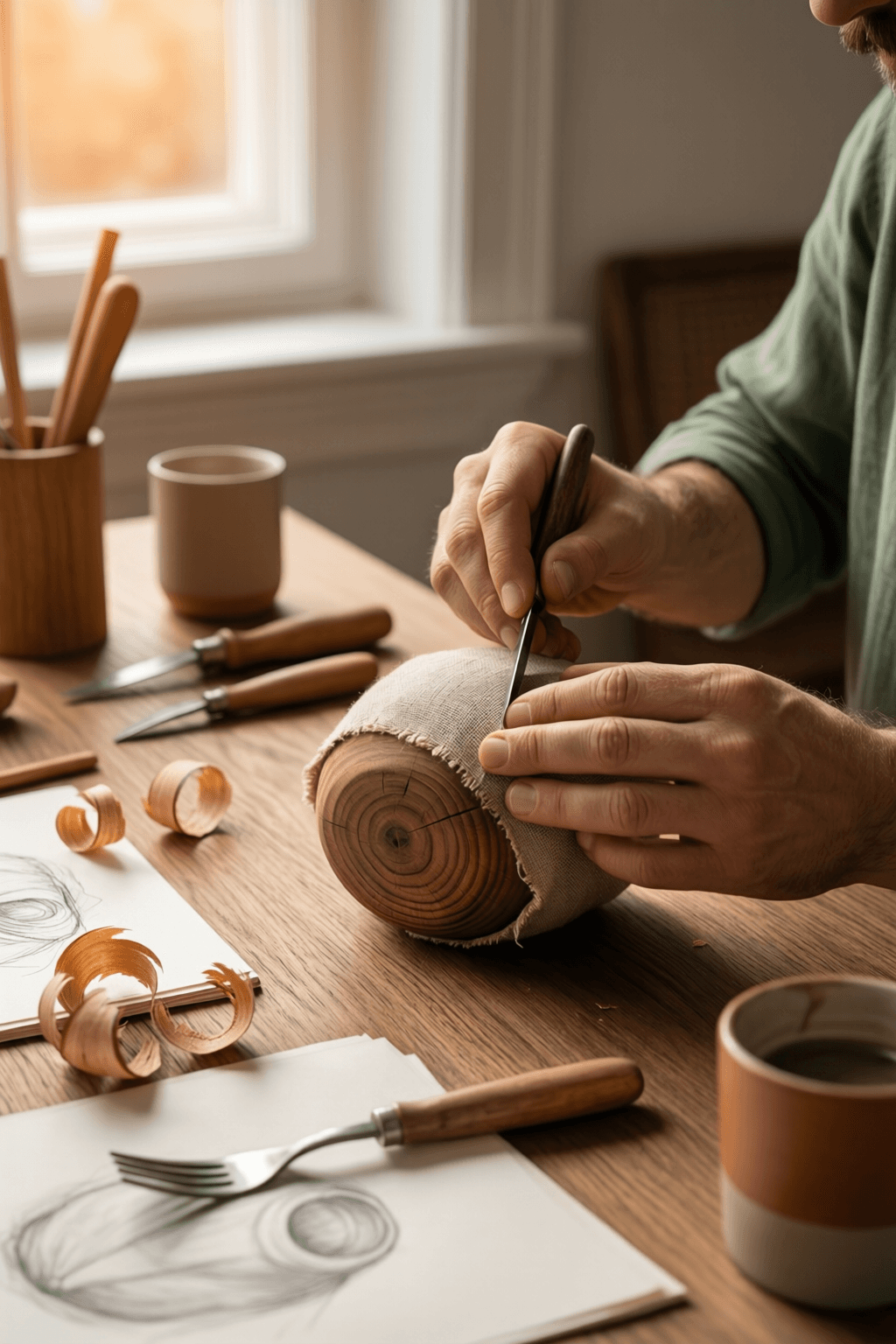
Craftsmanship is the refusal to accept the mediocre, the patient pursuit of a standard that exists only in your own mind. — William Morris
—What lingers after this line?
Rejecting the Comfortable Average
William Morris defines craftsmanship not as mere skill, but as an act of resistance against the acceptable average. From the beginning, his words suggest that mediocrity often arrives disguised as practicality: good enough, fast enough, profitable enough. Yet the craftsperson refuses that bargain, sensing that true work begins precisely where convenience ends. In this way, craftsmanship becomes a moral posture as much as a technical one. Morris, a central figure in the Arts and Crafts movement of the late nineteenth century, argued in essays such as “The Lesser Arts” (1877) that beauty and integrity should shape everyday making. His quote continues that argument by insisting that quality is not accidental; it is chosen, often against pressure to settle.
The Invisible Ideal in the Maker’s Mind
What makes Morris’s statement especially striking, however, is his emphasis on a standard “that exists only in your own mind.” This turns craftsmanship inward. The highest measure is not applause, market demand, or even comparison with rivals, but a mental image of how the work ought to be. Long before the object is finished, the maker is already in conversation with an unseen ideal. That inner benchmark recalls Michelangelo’s famous notion, recorded by Giorgio Vasari in Lives of the Artists (1550), that the sculptor releases the form already latent in stone. Although Morris speaks in more practical terms, the principle is similar: the artist or artisan serves a vision not yet visible to others. As a result, craftsmanship requires imagination before execution.
Patience as a Creative Discipline
From there, Morris links excellence to patience, and this is crucial. A high standard without patience becomes frustration; patience gives the maker time to revise, refine, and begin again. Whether one is weaving fabric, shaping wood, editing prose, or designing software, the finest details usually emerge through repeated correction rather than sudden brilliance. This patient pursuit also distinguishes craftsmanship from performance. Performance seeks quick recognition, whereas craftsmanship accepts slow improvement and often invisible labor. The Japanese idea of shokunin, often described as devotion to one’s craft and community, expresses a similar ethic: mastery is less a finish line than a lifelong practice. Thus, patience is not delay; it is the very method by which excellence becomes real.
A Personal Standard, Not Mere Perfectionism
At the same time, Morris’s idea should not be confused with sterile perfectionism. Perfectionism is often driven by fear—fear of failure, judgment, or imperfection itself. Craftsmanship, by contrast, is animated by care. The maker continues not because flaws are intolerable in an abstract sense, but because the work deserves fuller attention. This distinction matters because a private standard can either liberate or imprison. When guided by love of the work, it pushes a person toward deeper honesty and originality. We can see this in the notebooks of Leonardo da Vinci, filled with studies, revisions, and unfinished investigations, which reveal not paralysis but relentless curiosity. Morris’s craftsperson is not obsessed with flawlessness; he is committed to fidelity to the vision.
The Social Value of Refusing Mediocrity
Although Morris speaks of an inward standard, the effects of craftsmanship are never purely private. A chair made with care changes the experience of a room; a well-built tool earns trust; a thoughtfully written page clarifies another person’s mind. In other words, the refusal to accept the mediocre becomes a gift to the wider world, even when it begins as a solitary discipline. Here Morris’s broader social philosophy comes into view. In News from Nowhere (1890), he imagined a society in which labor was not alienated from beauty or pride. Craftsmanship, then, is not elitist fussiness but a form of respect—toward materials, users, and daily life itself. By insisting on standards higher than mere adequacy, the maker quietly raises the quality of shared human experience.
Why the Quote Still Resonates Today
Finally, Morris’s insight feels especially timely in an age of speed, automation, and disposable production. Modern systems often reward output over depth, visibility over substance, and scale over care. Against that backdrop, his definition of craftsmanship sounds almost radical: do not settle, keep refining, and answer to the clearest standard you can imagine. That is why the quote speaks beyond traditional artisans. A teacher preparing a lesson, a chef adjusting seasoning, or an engineer refining code can all recognize this inward pursuit. What unites them is the decision to honor work beyond minimum requirements. Morris reminds us that craftsmanship begins the moment a person says, quietly but firmly, this can be better, and I will stay with it until it is.
One-minute reflection
What feeling does this quote bring up for you?
Related Quotes
6 selectedThe beauty of a thing is not just in its final form, but in the slow, deliberate history of how it was made. — William Morris
William Morris
At first glance, William Morris shifts attention away from the polished object and toward the human story embedded within it. His point is not that the final form does not matter, but that its beauty deepens when we unde...
Read full interpretation →The craft of life is not in the final product, but in the slow, intentional turning of the hands and the quiet cultivation of the soul. — William Morris
William Morris
At its heart, this reflection shifts attention away from finished achievements and toward the manner in which a life is shaped. William Morris suggests that meaning does not reside chiefly in what we produce, display, or...
Read full interpretation →To do common things perfectly is far better than to pretend to do wonderful things badly. — William Morris
William Morris
William Morris’s remark begins with a sharp moral distinction: it is better to perform ordinary work with real skill than to chase grandeur without competence. In that sense, he challenges the temptation to value appeara...
Read full interpretation →We don't value craftsmanship anymore! All we value is ruthless efficiency, and I say we deny our own humanity that way! — William Morris
William Morris
William Morris’s complaint opens as more than nostalgia for handmade beauty; rather, it is a moral protest against a society that measures worth only by speed, output, and utility. When he says that ruthless efficiency d...
Read full interpretation →Craftsmanship means an uncompromising dedication to excellence and durability. It means doing a job to the very best of your ability, simply because that is the basis of integrity. — The Craftsmanship Initiative
The Craftsmanship Initiative
At its core, this statement defines craftsmanship as more than technical skill; it presents excellence as an ethical obligation. To work with care, precision, and patience is not merely to produce something attractive or...
Read full interpretation →The mark of all good art is not that the thing done is done exactly or finely, but that it is worked out with the head and the workman's heart. — Oscar Wilde
Oscar Wilde
Oscar Wilde immediately shifts the standard by which art is judged. Rather than praising work simply because it is exact, polished, or finely executed, he argues that true artistic value comes from something deeper: thou...
Read full interpretation →More From Author
More from William Morris →A man at work, making something which he feels will exist because he is working at it and wills it, is exercising the energies of his mind and soul as well as of his body. — William Morris
At its core, William Morris presents work not as drudgery but as an act of creation. A person who makes something with the conviction that it will endure is doing more than completing a task; he is shaping reality throug...
Read full interpretation →One's home should be a place where one can be oneself, a sanctuary from the noise of the world. — William Morris
William Morris presents home not merely as a physical shelter, but as a moral and emotional refuge. At the heart of the quote lies a simple human need: the desire for one place where performance ends and authenticity beg...
Read full interpretation →The beauty of a thing is not just in its final form, but in the slow, deliberate history of how it was made. — William Morris
At first glance, William Morris shifts attention away from the polished object and toward the human story embedded within it. His point is not that the final form does not matter, but that its beauty deepens when we unde...
Read full interpretation →The craft of life is not in the final product, but in the slow, intentional turning of the hands and the quiet cultivation of the soul. — William Morris
At its heart, this reflection shifts attention away from finished achievements and toward the manner in which a life is shaped. William Morris suggests that meaning does not reside chiefly in what we produce, display, or...
Read full interpretation →