
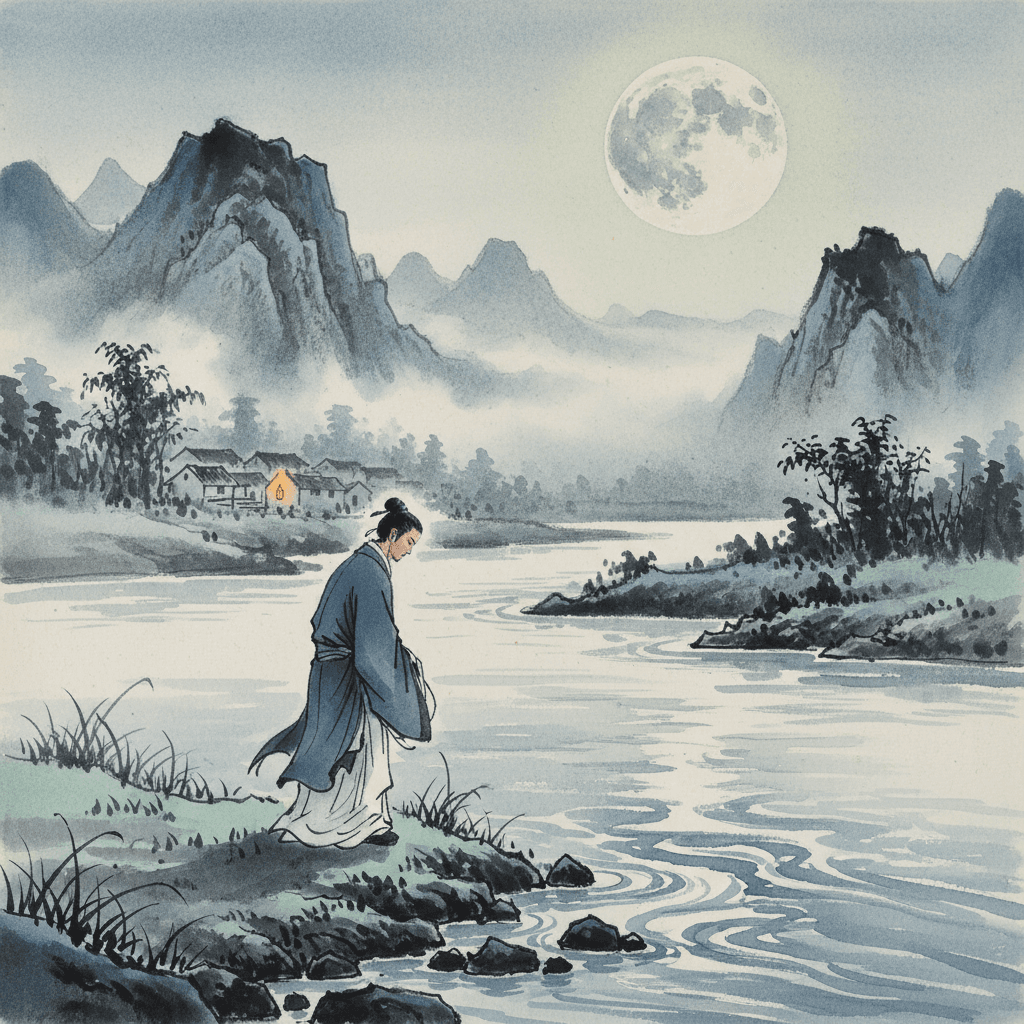
"I lift my head to gaze at the bright moon; I lower it, thinking of my home." — Li Bai
—What lingers after this line?
A Night Thought in Two Motions
To begin, the couplet captures a miniature drama of attention: first the head lifts toward the bright moon, then drops as the mind returns home. With two plain gestures, Li Bai maps an outward gaze to the cosmos and an inward turn to remembrance. The physical motions choreograph emotion—upward for wonder, downward for longing—so that the body becomes the poem’s punctuation. These lines conclude Li Bai’s “Quiet Night Thought” 静夜思 (c. 8th century), whose opening images mistake moonlight for frost on the floor. That initial cool gleam primes the scene with stillness, making the final pivot to homesickness both inevitable and tender.
The Moon as a Sign of Reunion
From this quiet room, the poem expands into culture: in Chinese tradition, the full moon often signifies reunion, especially during the Mid-Autumn Festival. Families separated by distance look at the same disk and imagine togetherness through shared light. Hence the moon becomes not just scenery, but a ritual bridge. This symbolism resonates across texts. Su Shi’s “Shui diao ge tou” (1076) wonders under the same bright moon when loved ones might reunite, concluding that although people part and meet, the moon’s cycles endure. Li Bai’s couplet, smaller in scale, taps the same current of collective memory.
Minimal Words, Careful Architecture
Formally, the poem is a five-character quatrain (jueju), prized in the Tang dynasty (618–907) for compression and resonance. Verbs carry the weight: lift, gaze, lower, think. Their parallel placement creates a clean hinge between exterior sight and interior thought, while the symmetry of head movements frames the emotional turn. Moreover, the earlier image—moonlight like frost—adds tactile chill to the visual calm. Because the diction is elementary, the poem appears in children’s primers, yet its architecture rewards mature reading: a twenty-character universe whose clean lines invite lifelong rereading.
Travel, Exile, and Tang-Era Distance
Historically, poets of the Tang moved widely—serving at court, wandering in search of patronage, or living in enforced exile. Li Bai himself traveled extensively along rivers and mountains, and the ache of dislocation permeates the era’s verse. In such a world, night and moonlight accentuate absence: the day’s bustle recedes, and distance becomes audible. Du Fu’s “Moonlit Night” (761) shows the same mechanism at work: under the moon, he imagines his wife looking too, their thoughts meeting where their bodies cannot. In this context, Li Bai’s downward tilt is both personal and generational.
Shared Sky, Shared Feeling
Moreover, the poem’s power lies in a universal geometry: two people can be far apart, yet the same moon draws a line between them. That shared object confers simultaneity—my now and your now—shrinking miles into a single glance. The effect is intimate without speech, communal without crowd. Because of this, readers across languages claim the poem as their own. Soldiers in barracks, migrants in hostels, and students abroad repeat the lines as a compact liturgy of belonging, trusting the moon to hold what distance refuses.
Translating a Bright, Clear Simplicity
Finally, translation choices fine-tune the mood. “Bright moon” can be rendered “clear moon,” and “home” may be “hometown” or “old village”—each option nudging the feeling toward domestic tenderness or ancestral roots. Yet the poem’s core survives these inflections because its structure—the rise and fall of the head—embeds meaning in motion. Thus, whether read in Chinese or in translation, the poem offers a method for longing: look outward until the world steadies you, then look inward until memory answers. In Li Bai’s hands, that simple ritual becomes a lifelong practice.
One-minute reflection
What does this quote ask you to notice today?
Related Quotes
6 selectedCatch the moonlight in your hands and let it guide the next step of your wandering feet. — Li Bai
Li Bai
The invitation to catch moonlight in your hands turns the intangible into a companion. It suggests that guidance need not be heavy or absolute; it can be a soft brightness that touches the skin and then slips through.
Read full interpretation →The moon over the water is a poem in silence.
Unknown
This phrase suggests that the moon's reflection on the water creates a serene and unspoken beauty, akin to a poem that communicates through its silence.
Read full interpretation →"From tonight the dew grows white; the moon shines brightest over my hometown." — Du Fu
Du Fu
“From tonight the dew grows white” marks the first chill of autumn, when nocturnal moisture gleams frost-pale by dawn. This seasonal pivot is more than meteorology; it signals an inner turning.
Read full interpretation →Alone in a foreign land, I am a lonely stranger; every time during the festive season, my longing for my loved ones doubles. - Wang Wei
Wang Wei
The quote encapsulates the sense of alienation and loneliness one feels when they are away from their homeland, especially in a foreign environment where they might feel out of place.
Read full interpretation →Moonlight drowns out all but the brightest stars. — J.R.R. Tolkien
J.R.R. Tolkien
This quote suggests that in the presence of light or greatness (symbolized by moonlight), only those who are truly exceptional (the brightest stars) stand out. It highlights the idea that genuine brilliance shines throug...
Read full interpretation →Starlight does not question those who travel, and time does not betray those who are determined. — Li Bai
Li Bai
This quote symbolizes the idea that the universe silently supports those who choose to embark on their journeys. Starlight representing guidance for travelers signifies unwavering support for those who venture out.
Read full interpretation →More From Author
More from Li Bai →Bend like bamboo under pressure and rise again toward the sun. — Li Bai
Li Bai’s image of bending bamboo reframes strength as something supple rather than rigid. Instead of meeting pressure with defiance, bamboo yields—yet it does not break, and that distinction is the heart of the metaphor.
Read full interpretation →Carry a simple intention each morning; it will steer your day like a compass. — Li Bai
Li Bai’s line frames the morning as a threshold: what you choose at the start quietly shapes what follows. An “intention” here isn’t a rigid plan or a long checklist; it’s a simple inner direction—be patient, be brave, l...
Read full interpretation →Let the quiet of early morning remind you that steady work summons great change — Li Bai
Li Bai frames early morning quiet as more than a pleasant atmosphere—it becomes a lesson in how change actually happens. In the hush before the day’s noise, you can sense time moving without spectacle, which mirrors the...
Read full interpretation →Starlight does not question those who travel, and time does not betray those who are determined. — Li Bai
This quote symbolizes the idea that the universe silently supports those who choose to embark on their journeys. Starlight representing guidance for travelers signifies unwavering support for those who venture out.
Read full interpretation →