
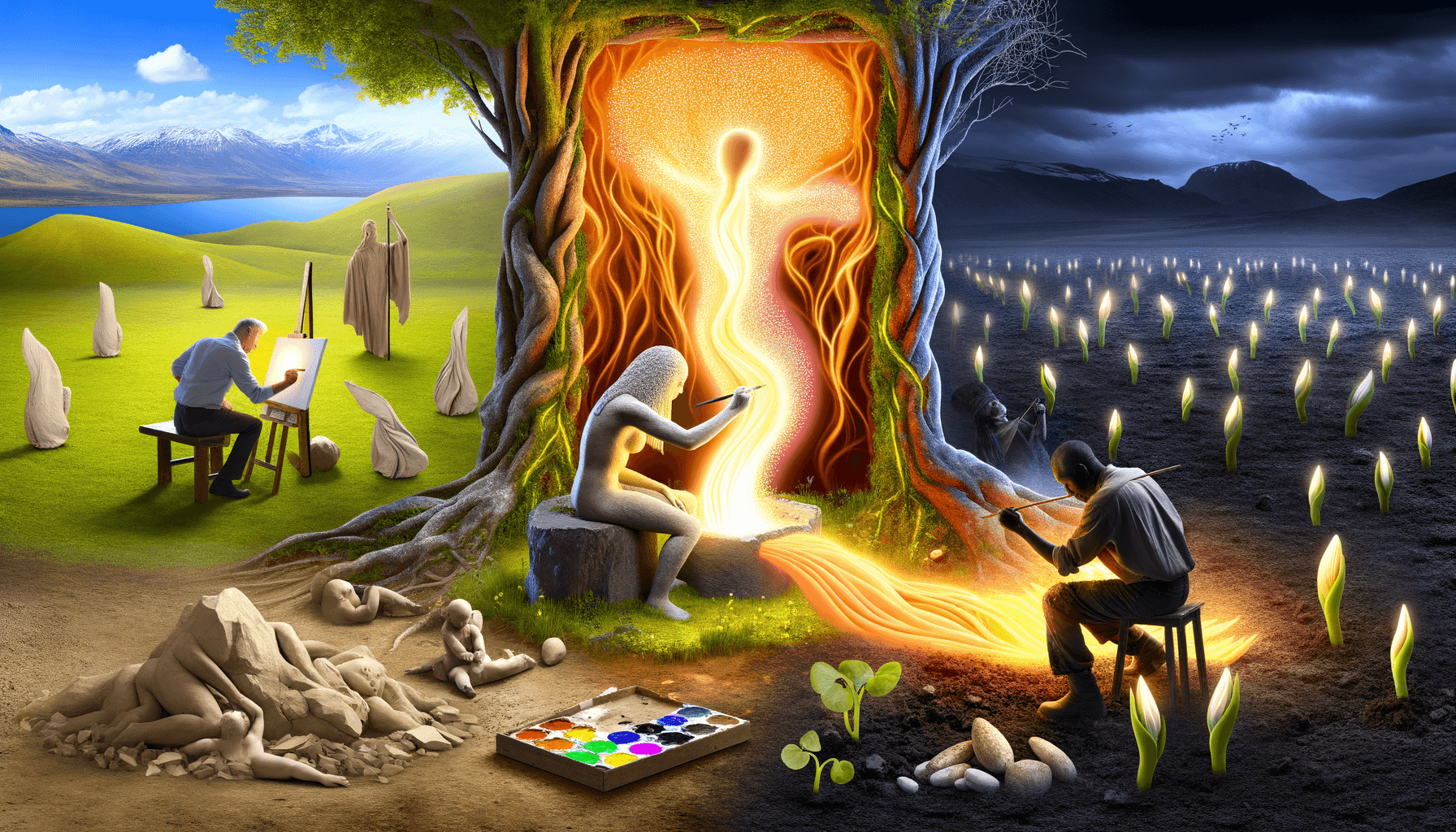
It is through creating, not possessing, that life is revealed. — Vida Dutton Scudder
—What lingers after this line?
Creativity as the Essence of Life
This quote emphasizes that the act of creation—whether artistic, intellectual, or emotional—is what gives life its true meaning and vibrancy. It argues that expressing oneself through creativity brings personal fulfillment and reveals our deepest identities.
Value of Experience Over Ownership
Scudder contrasts creation with possession to suggest that the experiences we actively shape are more vital and life-affirming than the mere accumulation of material goods or status.
Spiritual and Philosophical Insight
The quote reflects a spiritual or philosophical perspective that sees life as a dynamic process. Life isn’t something static to be owned, but a continual unfolding that comes from engagement and expression.
Social and Ethical Implications
Given Scudder's background as a social reformer, this quote can be interpreted as a critique of materialism and a call to focus on contributing to society through creativity and service rather than seeking personal gain.
Author Background
Vida Dutton Scudder was an American educator, writer, and social activist in the late 19th and early 20th centuries. A pioneer in social justice and women’s rights, her work often emphasized spiritual and communal growth over individual wealth or possession.
One-minute reflection
What does this quote ask you to notice today?
Related Quotes
6 selectedThere is no must in art because art is free. — Wassily Kandinsky
Wassily Kandinsky
At its core, Kandinsky’s statement rejects the idea that art must obey fixed obligations. By saying there is no ‘must’ in art, he frees creation from rigid formulas, academic demands, and social expectation.
Read full interpretation →Often what the artist expresses is unconscious, but we can learn to decode the story by collaboratively finding the pieces to the puzzle that create new possibilities for innovation. — Ben Okri
Ben Okri
At the heart of Ben Okri’s statement is the idea that art often says more than the artist consciously intends. A poem, painting, or song may carry hidden fears, cultural memories, or emotional truths that emerge without...
Read full interpretation →The things you own end up owning you. It is only after you lose everything that you're free to do anything. — Chuck Palahniuk
Chuck Palahniuk
At first glance, Palahniuk’s line appears to criticize materialism, yet it goes further by describing a reversal of power. We believe we possess objects, but gradually those objects begin to dictate our time, anxiety, an...
Read full interpretation →I think that when you create something, you leave a part of yourself in it. — Henri Matisse
Henri Matisse
At its core, Matisse’s reflection suggests that making anything—a painting, a poem, a song, even a room—inevitably transfers something inward into outward form. Creation is not merely the arrangement of materials; rather...
Read full interpretation →There is a deep peace that comes from creating something that didn't exist before. It is your way of telling the universe that you were here, and you felt something. — Maya Angelou
Maya Angelou
At its heart, Maya Angelou’s reflection suggests that creation is not merely productive but restorative. To make something that did not exist before—a poem, a garden, a melody, even a repaired room—is to experience a rar...
Read full interpretation →The creative act is not an escape from reality, but a way to encounter it more deeply. — bell hooks
bell hooks
At first glance, creative work can look like withdrawal: a painter disappears into a studio, a writer vanishes into pages, a musician closes the door and listens inward. Yet bell hooks reverses that assumption.
Read full interpretation →More From Author
More from Vida Dutton Scudder →