
No great artist ever sees things as they really are. If he did, he would cease to be an artist. — Oscar Wilde
—What lingers after this line?
Art Begins Where Literal Seeing Ends
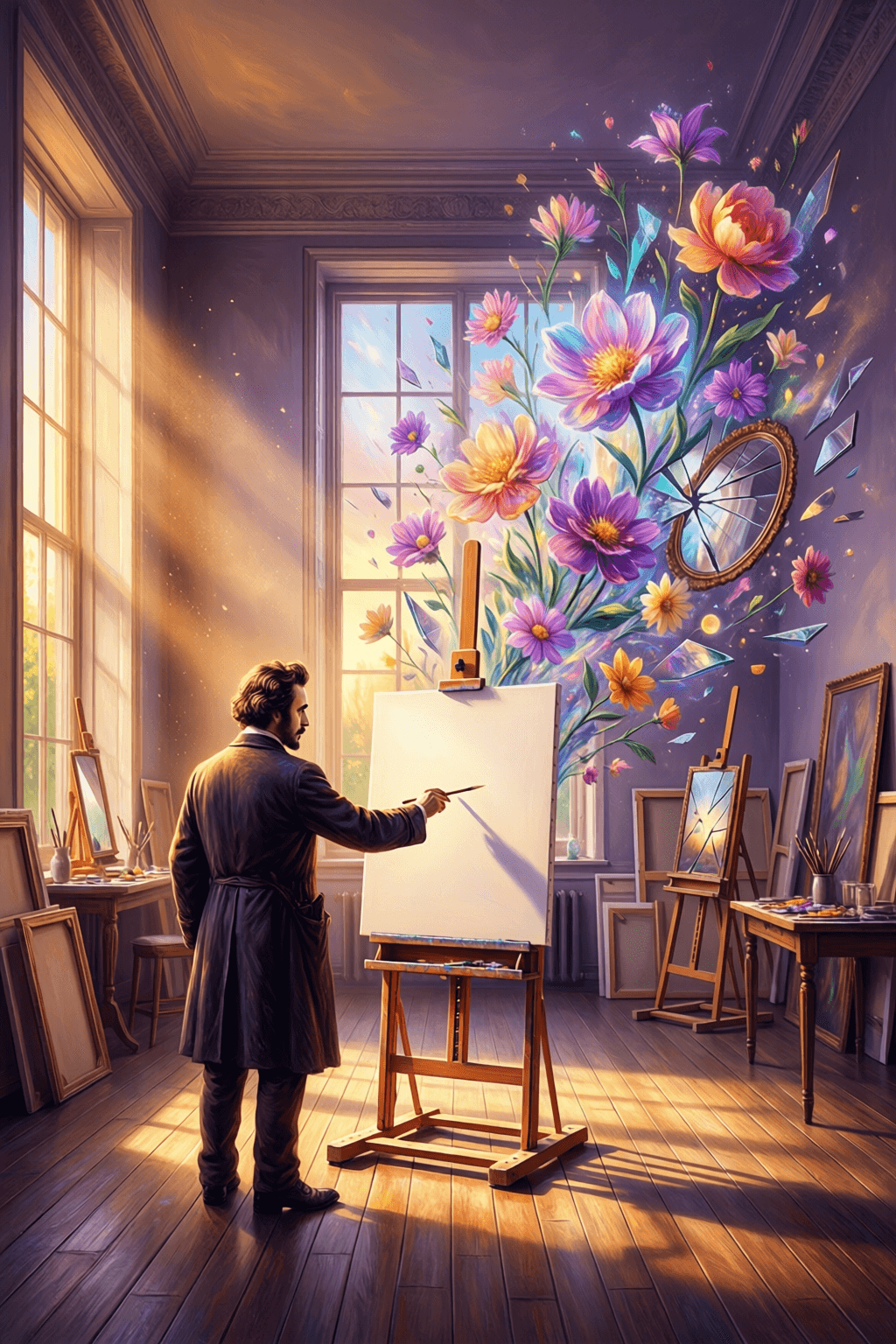
Oscar Wilde’s remark turns artistic perception into an act of transformation rather than transcription. To see things “as they really are” would mean accepting the world as a fixed surface of facts, but Wilde suggests that the artist’s gift lies in refusing that surface. Art begins when reality is reshaped by temperament, desire, irony, memory, or dream. In this sense, Wilde is not dismissing truth; instead, he is redefining it. The artist does not merely copy the visible world but reveals meanings that ordinary sight overlooks. Thus, the quote invites us to understand art as a heightened form of vision, one that changes the object by truly encountering it.
Wilde’s Aesthetic Rebellion
This idea flows naturally from Wilde’s larger aesthetic philosophy. In essays such as “The Decay of Lying” (1889), Wilde provocatively argues that life imitates art more than art imitates life. For him, art was not a mirror held up to nature, but a creative force that teaches people how to perceive beauty, drama, and style. Seen in that context, the artist becomes a maker of worlds rather than a recorder of facts. Wilde’s statement challenges realism’s claim to objectivity and insists that imagination is not an escape from reality but a superior way of organizing it.
The Artist as Interpreter
Moving from philosophy to practice, every great artist interprets before creating. A painter looking at a landscape does not simply reproduce trees, light, and sky; the scene passes through mood and choice. Claude Monet’s Rouen Cathedral series (1892–1894), for example, shows the same building altered by changing light, weather, and perception, proving that reality is never seen only one way. Likewise, a novelist transforms ordinary social encounters into symbols of class, longing, or moral conflict. The artist’s vision is selective, and that selectiveness is precisely what makes the work alive.
Why Exact Reality Can Limit Art
If an artist saw only what was plainly there, Wilde implies, creation would collapse into documentation. Exactness may produce a record, but art requires emphasis, distortion, rhythm, and omission. Even realism depends on arrangement: Gustave Flaubert’s Madame Bovary (1857) feels lifelike not because it includes everything, but because it chooses details that expose Emma Bovary’s illusions. Therefore, artistic truth often emerges through departure from literal truth. By exaggerating a gesture, darkening a mood, or beautifying a moment, the artist uncovers emotional realities that plain observation might conceal.
Imagination as a Form of Truth
This leads to the deeper paradox in Wilde’s line: illusion can reveal what fact alone cannot. Vincent van Gogh’s The Starry Night (1889) does not show the night sky with scientific accuracy, yet its swirling forms communicate spiritual agitation, wonder, and loneliness with extraordinary force. The painting feels true because it expresses an inner reality. In that way, imagination does not falsify the world; it translates it. Wilde’s artist sees beyond the visible arrangement of things into their emotional and symbolic possibilities, making art a bridge between external appearance and inner experience.
The Necessary Distance From Reality
Finally, Wilde’s quote suggests that art depends on distance. The artist must stand slightly apart from ordinary perception, not because reality is unimportant, but because it must be reimagined before it can become meaningful. This distance allows comedy, tragedy, beauty, and critique to emerge from everyday life. So, the artist does not cease to be truthful by refusing to see things “as they really are.” Rather, the artist remains an artist by seeing what reality might become under the pressure of vision. Wilde’s insight endures because it defends art as transformation: not the copying of life, but its intensification.
One-minute reflection
What's one small action this suggests?
Related Quotes
6 selectedArt is the most intense mode of individualism that the world has known. — Oscar Wilde
Oscar Wilde
Oscar Wilde’s bold assertion elevates art beyond mere craft or aesthetic pursuit, positioning it as the purest manifestation of individual character. According to Wilde, artists exemplify singularity through their works,...
Read full interpretation →The function of art is to do more than tell it like it is—it's to imagine what is possible. — bell hooks
bell hooks
bell hooks argues that art should not stop at documenting reality, however honestly. Instead, it must move one step further and open a window onto possibility, suggesting that creativity is not only reflective but transf...
Read full interpretation →Everything you can imagine is real. — Pablo Picasso
Pablo Picasso
This quote highlights the extraordinary power of human imagination. It suggests that the act of imagining something gives it a form of reality, even if only in the mental or creative realm.
Read full interpretation →The creative act is to let down the net of human imagination into the ocean of chaos on which we are suspended and then to attempt to bring out of it ideas. — Rupert Sheldrake
Rupert Sheldrake
Sheldrake’s image begins with a simple but powerful metaphor: creativity is not merely a private mental exercise, but an act of casting outward into something vast and unknown. The “net of human imagination” suggests tha...
Read full interpretation →The goal of life is rapture. Art is the way we experience it. — Joseph Campbell
Joseph Campbell
Joseph Campbell’s statement begins with a bold claim: life is not merely about survival, achievement, or social approval, but about rapture—a heightened state of wonder, intensity, and felt aliveness. By placing rapture...
Read full interpretation →Anxiety is just the imagination working overtime, and most of that overtime is completely unpaid. — Alain de Botton
Alain de Botton
At first glance, Alain de Botton’s remark frames anxiety with disarming humor: the mind behaves like an overworked employee, generating scenarios, rehearsing disasters, and collecting no reward for the effort. By calling...
Read full interpretation →More From Author
More from Oscar Wilde →Always forgive your enemies; nothing annoys them so much. — Oscar Wilde
At first glance, Oscar Wilde’s remark sounds like simple moral advice, yet its brilliance lies in its inversion of expectation. Instead of presenting forgiveness as saintly self-denial, he recasts it as a sly strategy: t...
Read full interpretation →It is only shallow people who require years to get rid of an emotion. A man who is master of himself can end a sorrow as easily as he can invent a pleasure. — Oscar Wilde
Oscar Wilde’s remark is deliberately provocative, drawing a sharp line between those ruled by feeling and those who govern it. At first glance, he seems almost cruel in dismissing prolonged sorrow as a mark of shallownes...
Read full interpretation →The mark of all good art is not that the thing done is done exactly or finely, but that it is worked out with the head and the workman's heart. — Oscar Wilde
Oscar Wilde immediately shifts the standard by which art is judged. Rather than praising work simply because it is exact, polished, or finely executed, he argues that true artistic value comes from something deeper: thou...
Read full interpretation →Everything in moderation, including moderation. — Oscar Wilde
Oscar Wilde’s line, “Everything in moderation, including moderation,” works by first borrowing a familiar moral rule and then twisting it into a paradox. If moderation is always good, then we should practice it without e...
Read full interpretation →