
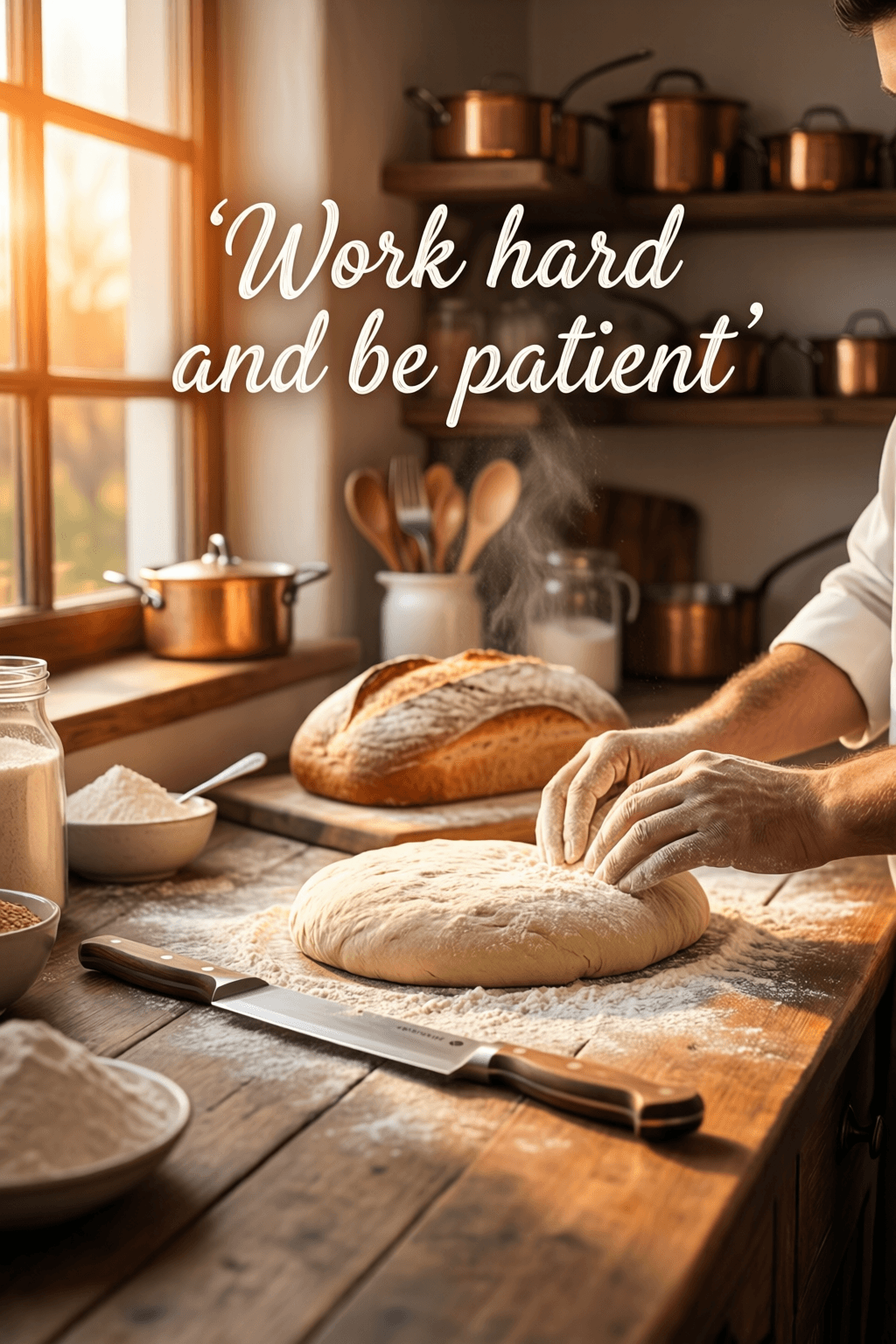
Work hard and be patient. It was the best advice I ever received. You have to put the hours in. — Gordon Ramsay
—What lingers after this line?
A Simple Formula for Progress
At first glance, Gordon Ramsay’s advice sounds almost blunt: work hard, be patient, and put in the hours. Yet its power lies precisely in that simplicity. He strips success of glamour and reminds us that meaningful achievement is usually built through repetition, endurance, and time rather than sudden talent or luck. In this way, the quote challenges a culture that celebrates instant results. Ramsay’s phrasing suggests that effort alone is not enough unless it is sustained, and patience alone is hollow unless it is matched by discipline. Together, they form a practical formula for progress.
Why Patience Strengthens Effort
From there, the role of patience becomes clearer. Hard work often fails to produce immediate rewards, and without patience people may abandon a worthy goal just before improvement begins. Ramsay’s insight recognizes that time is not a passive backdrop to effort; rather, it is the medium through which effort matures into skill. This pattern appears in crafts of every kind. As Aristotle notes in the Nicomachean Ethics (4th century BC), excellence is formed by repeated action, not isolated intention. Patience, then, is what allows repetition to accumulate into mastery instead of dissolving into frustration.
The Kitchen as a Training Ground
Seen through Ramsay’s own world, the quote carries the heat of lived experience. Professional kitchens are famously demanding spaces where speed, precision, and resilience are tested daily. A young cook does not become exceptional after one inspired service; instead, growth comes from countless early mornings, repeated mistakes, and the humility to keep learning. In that sense, the kitchen becomes a vivid metaphor for any ambitious life. Much like apprentices in Anthony Bourdain’s Kitchen Confidential (2000), people earn competence by enduring pressure and refining their craft over time. The hours are not incidental; they are the training itself.
Against the Myth of Overnight Success
Moreover, Ramsay’s words push back against one of modern culture’s most persistent illusions: the myth of overnight success. Public recognition often appears sudden, but the labor behind it is usually invisible. What audiences see as a breakthrough is frequently the final, visible moment of a much longer private struggle. This idea echoes Malcolm Gladwell’s Outliers (2008), which popularized the notion that expertise grows through extensive practice. Although the exact numbers are debated, the broader truth remains persuasive: achievement generally rests on accumulated hours. Ramsay’s advice is compelling because it restores attention to the unseen groundwork.
Discipline Becomes Character
As the quote settles in, it reveals something deeper than career strategy. Working hard and remaining patient do not merely produce external results; they shape the person doing the work. Repeated effort builds endurance, while patience trains emotional steadiness, especially when progress feels slow or uncertain. Here the advice begins to sound almost moral as well as practical. In Viktor Frankl’s Man’s Search for Meaning (1946), resilience emerges through the decision to persist despite difficulty. Likewise, Ramsay’s lesson implies that character is forged in the very hours others may be tempted to avoid.
A Realistic Path to Mastery
Finally, the enduring appeal of Ramsay’s statement lies in its realism. It does not promise ease, shortcuts, or constant inspiration. Instead, it offers a grounded path: commit fully, endure the slow phases, and trust that time invested with care eventually changes both ability and confidence. For that reason, the quote speaks beyond cooking. Whether someone is studying, building a business, learning an instrument, or recovering from failure, the same principle applies. Progress may be gradual, but when hard work is joined to patience, the hours begin to add up to something lasting.
One-minute reflection
What feeling does this quote bring up for you?
Related Quotes
6 selectedRoses do not bloom hurriedly; for beauty, like any masterpiece, takes time to blossom. — Matshona Dhliwayo
Matshona Dhliwayo
At its heart, Matshona Dhliwayo’s quote reminds us that true beauty cannot be forced. A rose does not rush toward bloom, nor does it apologize for the time required to unfold.
Read full interpretation →There is no road too long to the man who advances deliberately and without undue haste; there are no honors too distant to the man who prepares himself for them with patience. — Jean de La Bruyère
Jean de La Bruyère
At its core, La Bruyère’s line praises steady movement over restless speed. A long road feels intimidating only when seen all at once; once it is broken into deliberate steps, distance loses much of its power.
Read full interpretation →The ultimate mysteries are opened only to those who have immense patience. — Osho
Osho
Osho’s statement begins with a simple but demanding premise: the deepest truths do not yield to force. In this view, mystery is not a puzzle to be solved quickly but a reality that unfolds on its own terms.
Read full interpretation →Do you have the patience to wait until your mud settles and the water is clear? — Lao Tzu
Lao Tzu
Lao Tzu’s question frames patience not as passive delay but as an active kind of wisdom. The image of muddy water settling on its own suggests that confusion often clears not through force, but through restraint.
Read full interpretation →Successful people are not gifted; they just work hard, then succeed on purpose. — G.K. Nielson
G.K. Nielson
At its core, G.K. Nielson’s quote challenges a comforting myth: that successful people arrive at excellence through rare, innate gifts.
Read full interpretation →The wise do things slowly, because they love it. — David Fell
David Fell
At first glance, David Fell’s line seems to praise caution, yet it reaches further than mere hesitation. To do something slowly, in this view, is not to be indecisive but to be fully present.
Read full interpretation →More From Author
More from Gordon Ramsay →