
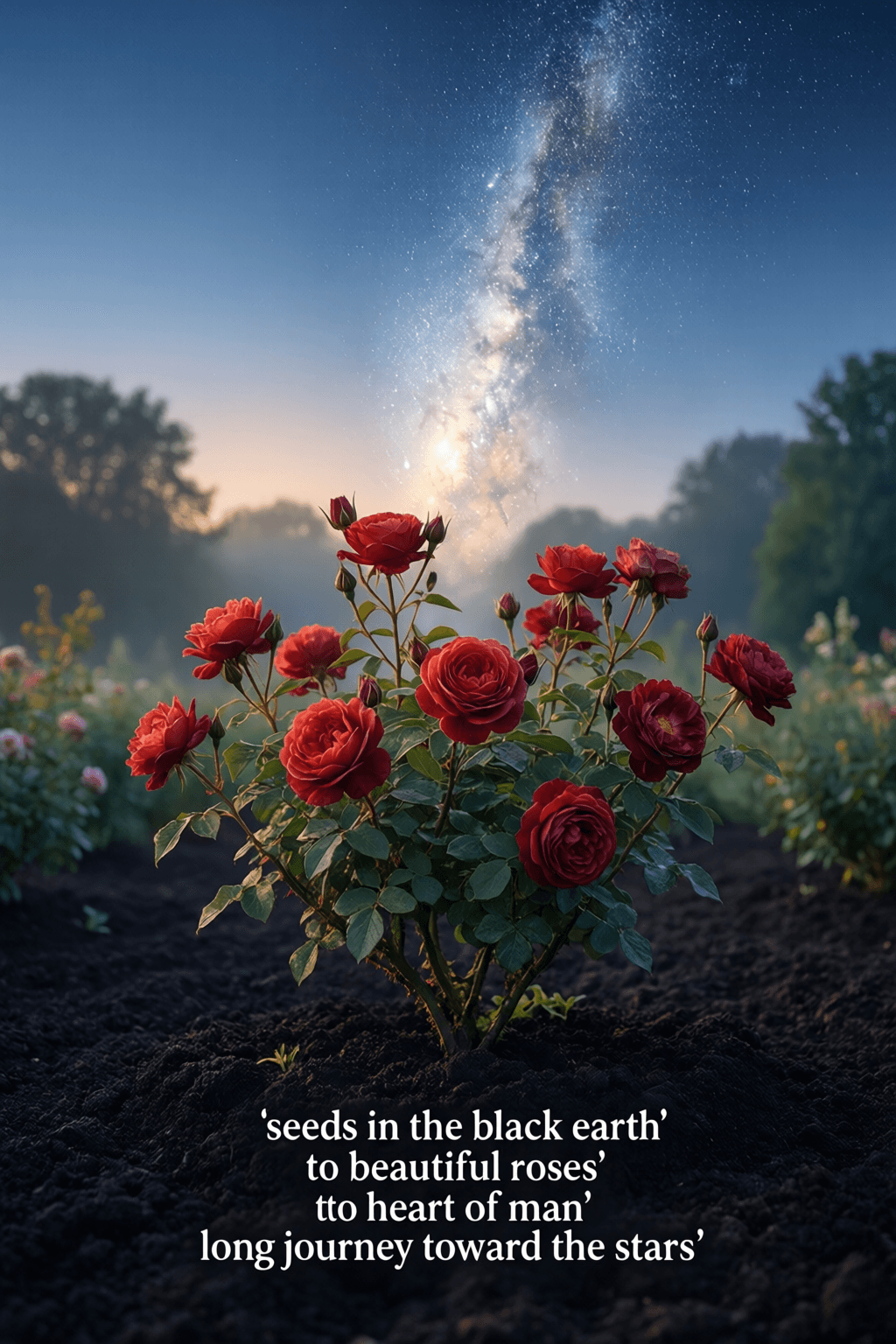
If seeds in the black earth can turn into such beautiful roses, what might not the heart of man become in its long journey toward the stars? — G.K. Chesterton
—What lingers after this line?
Hope Hidden in Humble Beginnings
Chesterton begins with a striking contrast: black earth, dark and ordinary, somehow gives rise to roses of astonishing beauty. From that image, he invites us to see human nature in the same light. If something so lovely can emerge from soil, then the imperfect human heart may also contain unsuspected possibilities. In this way, the quote resists cynicism. Rather than judging humanity only by its current flaws, Chesterton asks what it might become through time, struggle, and growth. The movement from earth to blossom becomes the first step in a larger vision of transformation.
The Rose as a Symbol of Becoming
The rose is not merely decorative here; instead, it serves as a symbol of development through hidden processes. A seed does not resemble a flower, yet it carries the form of one within it. Likewise, Chesterton implies that the human heart may hold virtues and capacities not yet visible in everyday life. This symbolic logic appears across literature and scripture, from the parables of growth in the New Testament to Dante’s celestial rose in the Paradiso (c. 1320). As a result, the image of flowering suggests that greatness often begins in obscurity, nurtured by patience rather than spectacle.
The Moral Imagination of Humanity
From this natural image, Chesterton turns toward moral imagination. He does not ask only what humanity is, but what it may become. That shift matters, because it frames the heart not as a fixed object but as something capable of enlargement—through love, courage, repentance, and wonder. In turn, this reflects a broader tradition in moral philosophy. Aristotle’s Nicomachean Ethics (4th century BC), for example, presents virtue as a habit formed over time rather than an instant possession. Chesterton’s thought moves in a similarly hopeful direction: the human heart is unfinished, and that incompleteness is not a defect alone but an opening.
A Journey Toward the Stars
The phrase “journey toward the stars” expands the quote from personal growth into cosmic aspiration. Chesterton is not satisfied with mere improvement in comfort or status; instead, he imagines humanity oriented toward something higher, almost transcendent. The stars suggest distance, mystery, and a destiny beyond the immediate conditions of earthly life. Consequently, the quote joins poetic and spiritual traditions that link human longing with the heavens. Plato’s Symposium (c. 385–370 BC) and Pascal’s Pensées (1670) both explore the tension between human smallness and human grandeur. Chesterton transforms that tension into encouragement: our present state does not define our final horizon.
Against Despair and Reductionism
Because of this upward vision, the quote also argues quietly against despair. It rejects the idea that people are nothing more than their appetites, failures, or social conditions. Just as the seed cannot be understood only by looking at the dirt around it, the human heart cannot be understood only by its weaknesses. Here Chesterton anticipates later debates about whether human beings are reducible to biology or circumstance alone. Viktor Frankl’s Man’s Search for Meaning (1946) similarly insists that even in grim conditions, a person retains the capacity for inner transformation. Thus the quote becomes not sentimental optimism, but a defense of human depth.
A Call to Cultivate the Heart
Finally, Chesterton’s metaphor carries an implicit responsibility. Seeds do not bloom without conditions that foster life, and hearts do not grow noble without care, discipline, and hope. The quote therefore encourages cultivation: education, friendship, faith, art, and moral effort all become forms of tending the inner garden. By ending with the stars, Chesterton leaves the reader with aspiration rather than certainty. He does not describe a completed perfection; instead, he points to a long journey. That makes the line both realistic and inspiring: human beings begin in darkness, perhaps, but they are not meant to remain there.
One-minute reflection
What feeling does this quote bring up for you?
Related Quotes
6 selectedThe old skin has to be shed before the new one can come. — Joseph Campbell
Joseph Campbell
Joseph Campbell’s image of old skin being shed before new skin can appear turns personal growth into something vivid and bodily. At its core, the quote suggests that renewal is not simply about adding better habits or br...
Read full interpretation →A blazing fire makes flame and brightness out of everything that is thrown into it. — Marcus Aurelius
Marcus Aurelius
Marcus Aurelius compresses a central Stoic lesson into a vivid image: a strong fire does not merely endure what is cast into it, but transforms it into more flame and light. In that sense, adversity is not just something...
Read full interpretation →It doesn't happen all at once. You become. It takes a long time. — Margery Williams
Margery Williams
Margery Williams’s line from The Velveteen Rabbit (1922) begins with a gentle refusal of sudden change. ‘It doesn’t happen all at once’ suggests that becoming—whether becoming real, mature, or fully oneself—is not an eve...
Read full interpretation →To create is to destroy the old version of yourself that no longer fits the new truth you have found. — Martha Graham
Martha Graham
Martha Graham’s statement presents creativity not as decoration, but as a radical act of inner change. To create something genuine, she suggests, a person must let go of an earlier self—the habits, beliefs, and identitie...
Read full interpretation →Art is a wound turned into light. — Georges Braque
Georges Braque
At its core, Georges Braque’s line suggests that art does not erase suffering; instead, it converts injury into meaning. A wound is intimate, raw, and often hidden, while light is what reveals, guides, and makes things v...
Read full interpretation →It is not where you take things from—it is where you take them to. — Jean-Luc Godard
Luc Godard
At first glance, Godard’s remark shifts attention away from the anxiety of borrowing and toward the transformative act of making. He argues that creativity is not measured solely by pristine originality, but by the desti...
Read full interpretation →More From Author
More from G. K. Chesterton →I would maintain that thanks are the highest form of thought, and that gratitude is happiness doubled by wonder. — G. K. Chesterton
Chesterton’s remark begins by elevating gratitude beyond manners and placing it within the life of the mind. To say that thanks are the highest form of thought is to suggest that real intelligence does not end in analysi...
Read full interpretation →Gratitude is not a passive observation of good things; it is a deliberate, daily refusal to be consumed by what is missing. — G.K. Chesterton
Chesterton’s statement immediately shifts gratitude from a soft emotion to an active discipline. He argues that thankfulness is not simply noticing pleasant moments as they pass; rather, it is a conscious choice to direc...
Read full interpretation →The artistic temperament is a disease that afflicts amateurs. — G. K. Chesterton
At first glance, Chesterton’s remark sounds almost cruel, yet its sharpness is deliberate. By calling the artistic temperament a “disease,” he mocks the habit of treating artistic sensitivity as a grand personal afflicti...
Read full interpretation →Humility is the mother of all virtues. — G.K. Chesterton
Chesterton’s statement presents humility not as one virtue among many, but as the source from which the rest arise. In calling it the “mother of all virtues,” he suggests that courage, justice, patience, and charity beco...
Read full interpretation →