
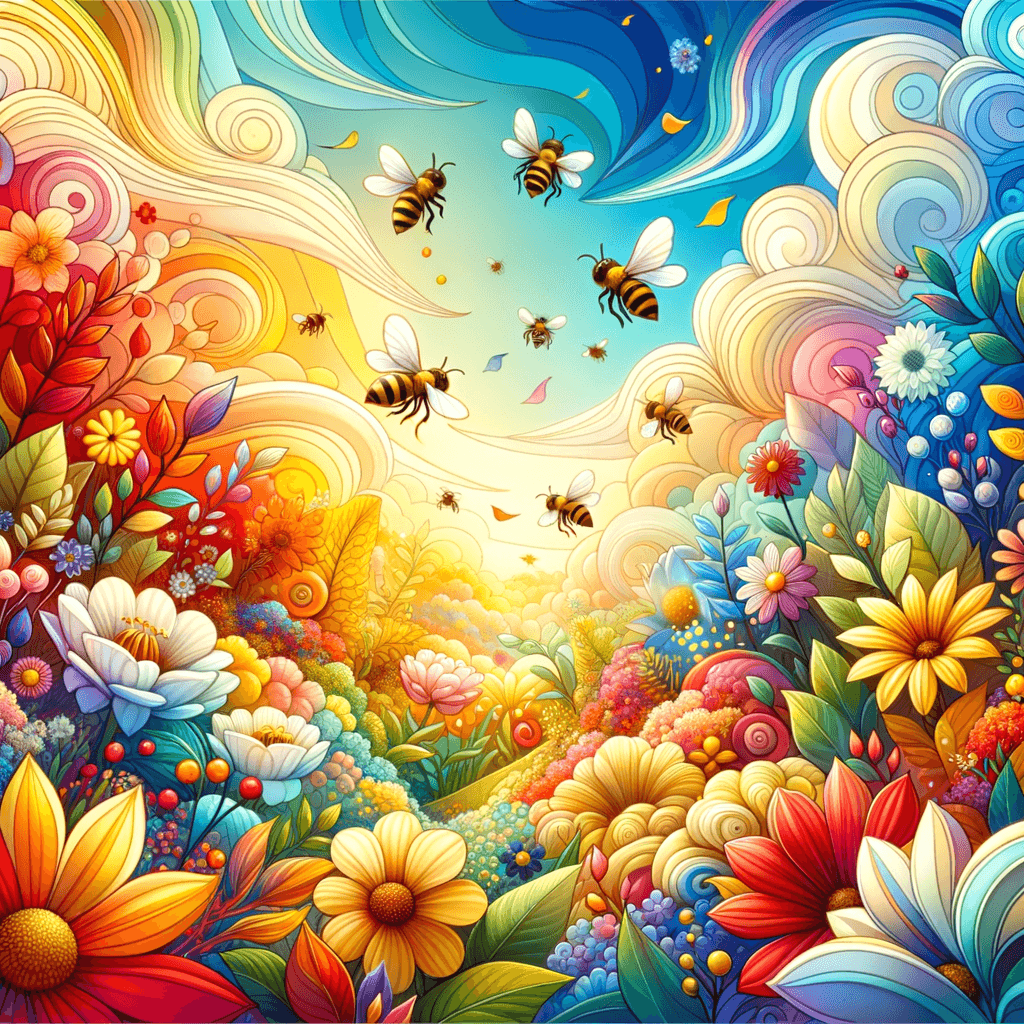
Life is a flower of which love is the honey. — Victor Hugo
—What lingers after this line?
Metaphor of Life and Love
In this quote, Victor Hugo uses the metaphor of a flower to represent life, suggesting that life is beautiful and delicate. Love, likened to honey, enhances this beauty and sweetness, making life more fulfilling.
The Essence of Happiness
Honey represents the joy and happiness that love brings into one's life. Without love, life's beauty might seem diminished, emphasizing how crucial love is for a fulfilling existence.
Interconnectedness of Nature and Emotions
The imagery connects natural elements to human emotions, illustrating how love is as essential to life as the diverse relationships within nature, creating a rich tapestry of experiences.
Transience of Life and Love
Flowers bloom for a short period, mirroring the fleeting nature of life. This suggests that love, while precious, is also transient and should be cherished in the moment for the sweetness it provides.
Philosophical Undertones
Victor Hugo was a prominent French writer known for exploring deep philosophical and emotional themes in his work. This quote reflects his belief in the transformative power of love, providing insight into his literary philosophy.
One-minute reflection
What feeling does this quote bring up for you?
Related Quotes
6 selectedBut many of us seek community solely to escape the fear of being alone. Knowing how to be solitary is central to the art of loving. — bell hooks
bell hooks
Bell hooks begins with a quiet but difficult observation: not every search for community is rooted in love. Sometimes, we reach for others because solitude feels threatening, as though being alone exposes a lack within u...
Read full interpretation →We need joy as we need air. We need love as we need water. We need each other as we need the earth we share. — Maya Angelou
Maya Angelou
Maya Angelou’s words turn emotional needs into elemental ones, placing joy beside air, love beside water, and human connection beside the earth itself. By doing so, she refuses to treat happiness, affection, and communit...
Read full interpretation →To love beauty is to see light. — Victor Hugo
Victor Hugo
Victor Hugo’s line suggests that beauty is not merely something pleasing to the eye; it is a way of perceiving the world more clearly. To love beauty is to become receptive to illumination, as if the soul gains a new sou...
Read full interpretation →If you love deeply, you're going to get hurt badly. But it's still worth it. — Tom Petty
Tom Petty
Tom Petty’s line begins with a blunt truth: deep love exposes us to deep hurt. The more fully we care, the more vulnerable we become to loss, disappointment, and change.
Read full interpretation →To love is not about merging. It is a noble calling for the individual to ripen, to differentiate, to become a world in oneself in response to another. — Rainer Maria Rilke
Rainer Maria Rilke
At first glance, Rilke challenges one of romance’s most familiar ideals: the desire to ‘become one.’ Instead, he argues that genuine love is not a collapse of boundaries but a deepened encounter between two distinct peop...
Read full interpretation →There is nothing pleasanter than spading when the ground is soft and damp. — John Steinbeck
John Steinbeck
At first glance, Steinbeck’s line seems almost modest, yet its pleasure is precise and deeply felt. Spading soft, damp ground turns labor into something nearly sensual: the tool enters easily, the earth yields without re...
Read full interpretation →More From Author
More from Victor Hugo →To love beauty is to see light. — Victor Hugo
Victor Hugo’s line suggests that beauty is not merely something pleasing to the eye; it is a way of perceiving the world more clearly. To love beauty is to become receptive to illumination, as if the soul gains a new sou...
Read full interpretation →Build bridges with your will, and let hope walk across them. — Victor Hugo
Victor Hugo’s image begins with a practical insistence: the future doesn’t simply arrive; it is constructed. By saying “build bridges with your will,” he treats willpower as a kind of engineering—an intentional effort to...
Read full interpretation →Forge a path with words and work, and let beauty follow in your wake. — Victor Hugo
Victor Hugo’s line, “Forge a path with words and work, and let beauty follow in your wake,” begins by uniting two worlds often held apart: artistic expression and disciplined effort. Instead of treating beauty as somethi...
Read full interpretation →When doubt knocks, invite it to see what you're building — Victor Hugo
Victor Hugo’s image of doubt knocking at the door immediately turns an internal feeling into an external visitor. Rather than picturing doubt as a storm that breaks in, he imagines it as something that politely announces...
Read full interpretation →