
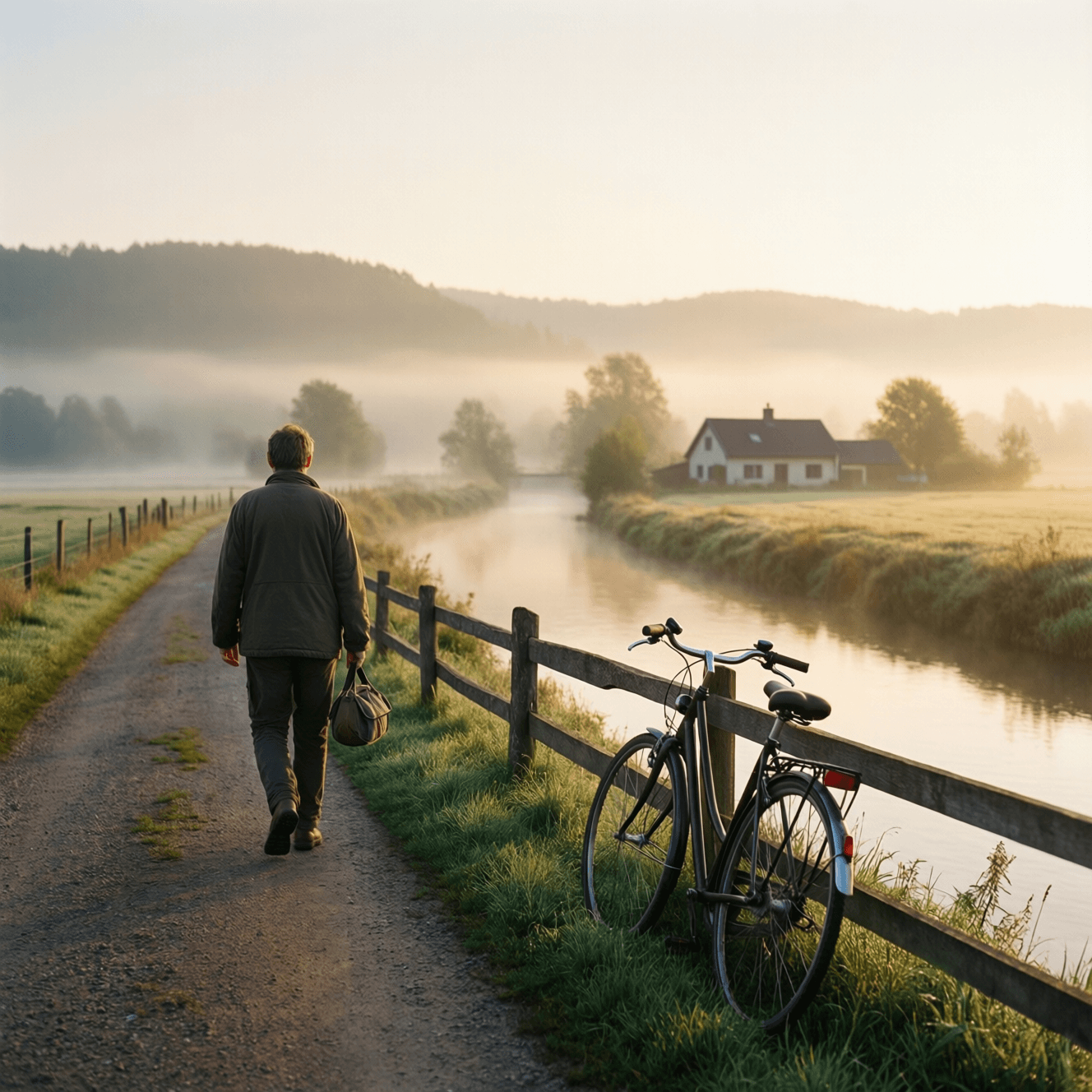
In an age of speed, nothing is so exhilarating as going slow. — Pico Iyer
—What lingers after this line?
A Counterintuitive Kind of Thrill
Pico Iyer’s line hinges on a deliberate paradox: in a culture trained to equate speed with excitement, he argues that the true jolt of aliveness can come from deceleration. The word “exhilarating” reframes slowness not as deprivation, but as a vivid experience in its own right. To see why this lands, consider how predictable haste has become—scrolling, rushing, optimizing. Against that background, choosing to go slow is no longer passive; it becomes a bold act of attention, the feeling of stepping out of the current and suddenly hearing your own thoughts again.
Speed as the Default Setting
The quote also implies that speed is not merely a preference but an environment. Notifications, rapid logistics, and constant access create an expectation of immediacy that quietly shapes our inner tempo, often leaving little room for reflection. By naming “an age of speed,” Iyer points to a collective condition rather than an individual habit. From there, slowness gains its potency precisely because it is scarce. Much like silence becomes striking in a noisy city, a slower pace can feel almost electric—an experience of regained agency in a world that routinely decides the rhythm for us.
Slowness Restores Perception
Once you slow down, ordinary life becomes legible again. Details that speed blurs—shifts in light, subtle emotions, the texture of a conversation—come back into focus. This aligns with older philosophical traditions that treat attention as the foundation of a good life; even Marcus Aurelius’ Meditations (c. 170 AD) repeatedly returns to the practice of noticing what is actually happening in the present. In that sense, going slow is exhilarating because it expands the world. The payoff is not just calm; it is richness, the feeling that life is larger when you stop skimming across its surface.
The Inner Life Reappears
Slowness also changes what you can hear internally. At high speed, the mind tends to operate in reaction mode—answering messages, meeting deadlines, moving to the next task. By contrast, slowing creates the conditions for memory, intuition, and meaning-making to arise. This is why many people report that their clearest thoughts arrive on long walks, in unhurried showers, or during travel delays they initially resent. The transition is subtle but profound: as external urgency fades, the self stops performing and starts speaking.
Anecdotes of Deliberate Deceleration
Iyer’s idea becomes concrete in everyday choices that look minor but feel transformative: taking the scenic route, reading a physical book without checking a phone, or lingering at the table after a meal. These moments can feel surprisingly daring because they resist the cultural script that time must always be “used.” Even the simple act of walking without a destination can produce the exhilaration he describes. What begins as idleness becomes a kind of recovery—first of your breath, then of your awareness, and finally of your sense that you are living rather than merely moving.
Slowness as a New Form of Freedom
Ultimately, the quote suggests that slowness is not nostalgia; it is liberation. When speed is compulsory, choosing slowness becomes a statement about what matters, a way to prioritize depth over throughput. Henry David Thoreau’s Walden (1854) similarly frames simplicity as a route to autonomy, arguing that the cost of constant striving is often the loss of one’s life to its management. Seen this way, “going slow” is exhilarating because it returns control of time to the person living it. The reward is not escape from modernity, but a better stance within it—one where presence, not velocity, defines the day.
One-minute reflection
What feeling does this quote bring up for you?
Related Quotes
6 selectedIn an age of speed, nothing is more invigorating than going slow. — Pico Iyer
Pico Iyer
Pico Iyer’s line hinges on a paradox: when life accelerates, the most refreshing response is to decelerate. Speed promises efficiency and stimulation, yet it often leaves people feeling thinly stretched, as if every mome...
Read full interpretation →In an age of speed, nothing is more exhilarating than going slow. — Pico Iyer
Pico Iyer
Pico Iyer’s line turns modern intuition upside down: if everything is accelerating, then the rarest—and therefore most invigorating—experience may be deceleration. The quote suggests that exhilaration isn’t only produced...
Read full interpretation →In an age of speed, nothing could be more invigorating than going slow. — Pico Iyer
Pico Iyer
Pico Iyer’s line lands as a paradox: if everything around us accelerates, why would deceleration feel energizing? Yet the statement captures a contemporary truth—speed can be draining when it becomes the default setting...
Read full interpretation →Inner calm is not a state you wait for, but a space you build within the daily noise. — Pico Iyer
Pico Iyer
At its core, Pico Iyer’s line shifts calm from something passive to something made. Rather than imagining peace as a rare mood that descends when life finally becomes quiet, he presents it as an inner architecture built...
Read full interpretation →The goal is not to be constantly productive, but to be deeply present. — Pico Iyer
Pico Iyer
At first glance, Pico Iyer’s remark gently overturns one of modern culture’s strongest assumptions: that a meaningful life is measured by output. By saying the goal is not constant productivity but deep presence, he shif...
Read full interpretation →In an age of distraction, nothing is as luxurious as paying attention. — Pico Iyer
Pico Iyer
Pico Iyer’s line quietly flips the usual meaning of luxury. Instead of status objects or exclusive experiences, he points to something more intimate: the ability to be fully present with what’s right in front of us.
Read full interpretation →More From Author
More from Pico Iyer →Connection is not found in the scrolling, but in the pausing. Look up, breathe, and find the person standing right in front of you. — Pico Iyer
Pico Iyer’s reflection begins with a quiet reversal of modern habit: instead of searching for connection through constant motion, he locates it in stillness. The phrase “not found in the scrolling, but in the pausing” su...
Read full interpretation →The mind needs solitude in the same way a forest needs quiet after a storm. It is not because nothing is happening; it is because that is when everything begins to grow. — Pico Iyer
Pico Iyer compares the mind to a forest recovering after a storm, and the image immediately shifts our understanding of solitude. Rather than treating aloneness as emptiness, he presents it as a necessary period of renew...
Read full interpretation →To do one thing well is the only way to endure a world that demands we do everything at once. — Pico Iyer
At its core, Pico Iyer’s line argues that endurance now depends less on speed than on concentration. In a culture that praises multitasking, constant updates, and endless availability, he reframes survival as an act of d...
Read full interpretation →Inner calm is not a state you wait for, but a space you build within the daily noise. — Pico Iyer
At its core, Pico Iyer’s line shifts calm from something passive to something made. Rather than imagining peace as a rare mood that descends when life finally becomes quiet, he presents it as an inner architecture built...
Read full interpretation →