
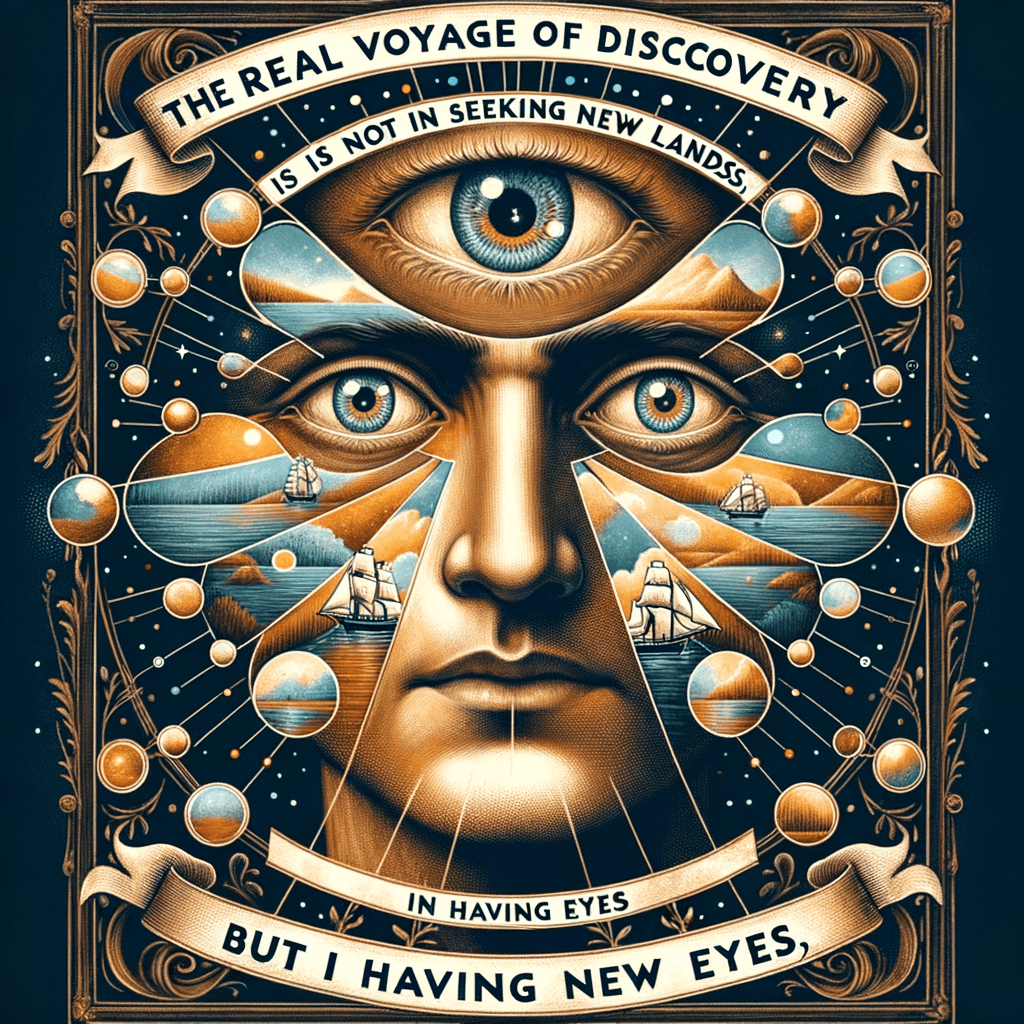
The real voyage of discovery consists not in seeking new landscapes, but in having new eyes. - Marcel Proust
—What lingers after this line?
Perspective and Perception
This quote emphasizes the importance of perspective in the experience of discovery. It suggests that true exploration comes from changing the way we see the world, rather than merely traveling to new places.
Inner Transformation
Proust implies that personal growth and discovery are more about an internal transformation in understanding and perception rather than external adventures.
Mental and Emotional Insight
The quote underscores the idea that having new eyes means gaining new insights and deeper emotional and mental understanding of familiar surroundings and experiences.
Mindfulness and Presence
It speaks to the value of mindfulness and being fully present, encouraging individuals to appreciate and see the extraordinary in the ordinary by being more attentive and aware.
Philosophical Perspective
Proust, a French novelist known for his introspective and reflective writing style, often explored themes of memory, time, and perception, encouraging readers to look beyond the surface of their experiences.
One-minute reflection
What feeling does this quote bring up for you?
Related Quotes
6 selectedThe creative process is not a straight line, but a labyrinth. To get lost in it is not a failure; it is the only way to find the hidden things worth saying. — M.C. Richards
M.C. Richards
At its core, M.C. Richards rejects the comforting myth that creative work unfolds through orderly steps.
Read full interpretation →What is behind your eyes holds more power than what is in front of them. — Gary Zukav
Gary Zukav
At its core, Gary Zukav’s quote argues that the mind’s inner landscape—beliefs, memories, expectations, and values—has greater influence than external appearances. What we carry ‘behind our eyes’ determines how we interp...
Read full interpretation →There are things known and there are things unknown, and in between are the doors of perception. — Aldous Huxley
Aldous Huxley
Aldous Huxley’s line divides reality into three striking regions: what we know, what we do not know, and the mysterious passage between them. Rather than treating knowledge and ignorance as fixed opposites, he imagines p...
Read full interpretation →We are not here to copy the reality that is already sold to us, but to use our own lenses to reshape the world we see. — Georgia O'Keeffe
Georgia O'Keeffe
Georgia O’Keeffe’s statement begins with a refusal: we are not here merely to reproduce a ready-made version of reality. In that sense, she challenges the passive habit of accepting what culture, commerce, and convention...
Read full interpretation →It is not activity that disturbs people, but false conceptions of things that drive them mad. — Marcus Aurelius
Marcus Aurelius
At the heart of this saying lies a classic Stoic insight: external events do not automatically shatter our peace; rather, our interpretations give them emotional force. Although the quote is often attributed to Marcus Au...
Read full interpretation →It isn't the things themselves that disturb people, but the judgments that they form about them. — Epictetus
Epictetus
Epictetus distills a central Stoic principle into a single striking claim: external events do not wound us as deeply as our interpretations of them. In the Enchiridion (c.
Read full interpretation →More From Author
More from Marcel Proust →It is the quiet, daily labor that builds the cathedral of a life. — Marcel Proust
At first glance, Proust’s image shifts attention away from dramatic turning points and toward the unnoticed repetitions that shape a human life. By comparing life to a cathedral, he suggests that meaning is not assembled...
Read full interpretation →We are healed of a suffering only by expressing it to the full. — Marcel Proust
At its heart, Marcel Proust’s line suggests that pain does not loosen its grip when it is hidden or minimized; instead, it begins to change when it is fully articulated. To express suffering “to the full” means giving it...
Read full interpretation →Everything that is great in the world comes from neurotics. They alone have founded our religions and composed our masterpieces. — Marcel Proust
Proust suggests that individuals who might be labeled as 'neurotic' are often more creative or productive, using their internal struggles to fuel extraordinary accomplishments in the fields of art and religion.
Read full interpretation →One must be a little foolish, if one does not want to be unhappy. — Marcel Proust
This quote suggests that strict rationality and excessive seriousness can lead to unhappiness. Allowing oneself moments of foolishness and spontaneity can contribute to a more joyful life.
Read full interpretation →